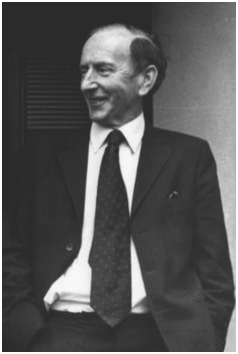
 (photo: courtesy of Pádraig Mac Donnchadha)
If you have come to this page from a search engine
click here to visit our home
page.
Seán 'ac
Dhonncha (Johnny Joe Pheaitsín) (Galway)
(1919 – 1996)
(photo: courtesy of Pádraig Mac Donnchadha)
Seán was born in An Aird Thoir, Carna. The son of a fisherman, he had three
brothers and seven sisters. He married Bríd Ní Eidhin in 1956 and they had five
children. He spent most of his working life as a primary school teacher,
teaching in County Cavan from 1947 and later spending twenty five years as
principal of Ahascragh national school in east Galway. Music and singing was
always in the family and his mother influenced him greatly. He earned a
reputation as one of Ireland's finest traditional singers, and had a wide
repertoire of songs in both Irish and English. He won the Oireachtas Sean-Nós
Competition in 1953 and was awarded the 'Gradam Shean-Nós Cois Life' in 1995.
He was the first singer to be recorded by Gael Linn on their series of 78rpm
recordings in 1957: these recordings are now available on 'Seoltaí Séide' (Gael
Linn CEFCD184). Other recordings include 'An Aill Bháin - The White Rock' (Claddagh
CC9) and 'An Spailpín Fánach' (Cló Iar-Chonnachta CICD006) plus tracks on
various compilations including, 'Grand Airs Of Connemara' (Topic 12T177), 'More
Grand Airs of Connemara' (Topic 12T202) and 'Amhráin ar an Sean-Nós' (RTÉ CD
185).
Rugadh Séan san Aird Thoir, Carna.
Iascaire a bhí ina athair agus bhí triúr deartháireacha agus seachtar
deirfiúracha aige. Phós sé Bríd Ní Eidhin in 1956 agus bhí cúigear clainne acu.
Chaith Seán bunáite a shaoil ina mhúinteoir bunscoile. Thosaigh sé ag múineadh i
gContae an Chabháin in 1947 agus chaith sé cúig bliana fichead ina dhiaidh sin
mar phríomhoide i Scoil Náisiúnta Áth Eascrach in oirthear Chontae na
Gaillimhe.Bhí ceol agus amhráin ag a mhuintir riamh agus bhí an-tionchar ag a
mháthair ar a chuid amhránaíochta. Bhain sé cáil amach mar dhuine de na
hamhránaithe traidisiúnta
ab fhearr sa tír agus bhí stór mór amhrán aige i nGaeilge agus i mBéarla.
Bhuaigh sé Comórtas Sean-Nóis an Oireachtais in 1953 agus bronnadh Gradam
Shean-Nós Cois Life air in 1995.
Ba é an chéad amhránaí riamh a
thaifead Gael Linn dá shraith de cheirníní 78rpm in 1957: tá na taifeadtaí sin
ar fáil ar 'Seoltaí Séide' (Gael Linn CEFCD184). Tá taifeadtaí eile de ar 'An
Aill Bháin - The White Rock' (Claddagh CC9) agus 'An Spailpín Fánach' (Cló
Iar-Chonnachta CICD006) agus tá rianta eile dá chuid amhránaíochta ar
bhailiúcháin ar nós 'Grand Airs of Connemara' (Topic 12T177), 'More Grand Airs
of Connemara' (Topic 12T202) agus 'Amhráin ar an Sean-Nós' (RTÉ CD 185).
Seán 'ac Dhonncha
can be heard on
VT162CD
Pádraic Ó Conghaile (Pat Phádraic Tom)
(Galway)
(1922 - 2010)
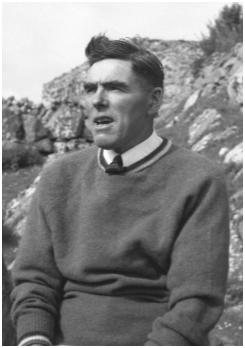 (photo: Terry Yarnell)
Pat was born in Leitir Péic, Spiddal (An Spidéal). He married Máire Ní Mhaoilchiaráin in 1959 and they had six children. He worked as a farmer and always enjoyed meeting people and telling stories. He became interested in traditional songs from singing at weddings and oícheanta airneáin (social nights) in his youth.
He took part in the Oireachtas na Gaeilge sean-nós singing competitions for the
first time in 1954, after winning a local sean-nós competition. He won second
place in Comórtas na bhFear (the men's competition) in 1955 and he was awarded
first place in 1956. Later he taught sean-nós singing to young children in an
Gaelacadamh in Spiddal (An Spidéal) from 1980 until 1992.
There were only two previous
published recordings of his singing: on 'Tógfaidh Mé Mo Sheolta' (Cló
Iar-Chonnachta CIC088) and 'Pat Phádraig Tom' (a CD released privately by his
family in 2013).
Rugadh Pat i Leitir Péic sa Spidéal. Phós sé Máire Ní Mhaoilchiaráin i 1959 agus
bhí seisear clainne acu. Feirmeoir bhí ann agus thaithigh comhluadar daoine agus
scéalaíocht go mór leis i gcónaí. Músclaíodh a spéis sna sean-amhráin le linn a
óige trí a bheith ag gabháil fhoinn ag bainiseacha agus ag oícheanta airneáin.
Ghlac sé páirt i gcomórtais sean-nóis
Oireachtas na Gaeilge den chéad uair in 1954, i ndiaidh dó comórtas áitiúil
sean-nóis a bhuachan. Ghnóthaigh sé an dara háit i gComórtas na bhFear in 1955
agus tugadh an chéad áit dó in 1956. Mhúin sé an amhránaíocht ar an sean-nós do
ghasúir óga ina dhiaidh sin sa nGaelacadamh sa Spidéal idir 1980 agus 1992.
Níor foilsíodh roimhe seo ach dhá thaifeadadh dá chuid amhránaíochta: 'Tógfaidh
Mé Mo Sheolta' (Cló Iar-Chonnachta CIC088) agus 'Pat Phád
Pádraic Ó Conghaile can be heard on VT162CD
Cáit Uí Chonluain (Ní Choisdealbha) (Kate
Sheáin Tom) (Galway)
(1886 - 1973)
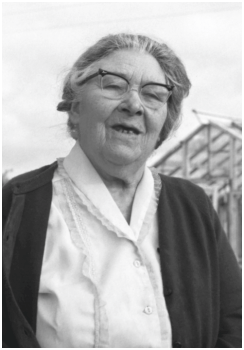 (photo: Terry Yarnell)
Cáit was from Baile an tSagairt, Spiddal (An Spidéal) and was a cousin of Tom Pháidín Tom. She married Micheál Ó Conluain, an Irish-language teacher from Mullingar, and they had ten children. Over the years, many people wishing to learn Irish came to stay in their house. Micheál was also very musical and played violin, piccolo and piano.
In the early 1930s Cait was taken to University College, Galway and recorded on phonograph. Over the ensuing years many RTE radio producers and presenters visited her including Pádraig Ó Raghallaigh, Ciarán Mac Mathúna and Pádraig Dolan, and recordings of her from the archives are still often played on RTÉ Raidió na Gaeltachta.
During Seamus Ennis's collecting trips in the 1940s, he collected material from their daughter Gráinne, and her son Feistí gained considerable fame as a tin whistle player, particularly for his playing of slow airs. He was recorded by Topic Records whilst living in England in the 1960s: 'Grand Airs of Connemara' (Topic 12T177 ), 'More Grand Airs of Connemara' (Topic 12T202). The only recording available of Cáit's singing is one track on 'Amhráin ar an Sean-Nós' (RTÉ CD185).
Ba as Baile an tSagairt, an Spidéal, do Cháit agus ba cholcheathrar léi Tom
Pháidín Tom. Phós sí Micheál Ó Conluain, múinteoir Gaeilge ón Muileann gCearr
agus bhí deichniúir clainne acu. Thar na blianta d'fhanadh go leor daoine leo a
thagadh go dtí an ceantar chun an Ghaeilge a fhoghlaim. Bhí féith an cheoil go
láidir ag Mícheál agus chasadh sé an veidhlín, an fhlúiteog agus an pianó.
Tugadh Cáit chun na hOllscoile i
nGaillimh go luath sna 1930idí agus taifeadadh í ar fónagraf. Thar na blianta
ina dhaidh sin, thugadh go leor leirtheoirí agus láitheoirí ó Raidió Éireann
chuici, Pádraig Ó Raghallaigh, Ciarán Mac Mathúna agus Pádraig Dolan ina measc
agus craoltar taifeadtaí cartlainne dá chuid amhránaíochta go minic ar RTÉ
Raidió na Gaeltachta.
Bhailigh Séamus Ennis ábhar óna
hiníon Gráinne le linn a thuras bailiúcháin sna 1940idí agus cuairteoir eile
chucu ab ea an craoltóir Ciarán Mac Mathúna sna 1960idí. Bhí cáil nach beag ar a
mac Feistí as a chumas ar an bhfeadóg stáin, go háirithe as a fheabhas agus a
chasadh sé foinn mhalla. Rinne Topic Records taifid de sna 1960idí nuair a bhí
cónaí air i Sasana, 'Grand Airs of Connemara' (Topic 12T177 ), 'More Grand Airs
of Connemara' (Topic 12T202).Níl ach rian amháin d’amhránaíocht Cháit ar fáil,
ar 'Amhráin ar an Sean-Nós' (RTÉ CD185).
Cáit Uí Chonluain can be heard on VT162CD
Rita Keane (1923 - 2009) and Sarah Keane (1918 - 2010) (Galway)
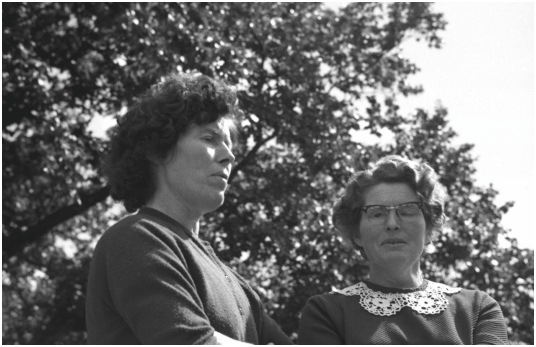 (photo: Terry Yarnell)
The Keane sisters were from the townland of Carragh, Caherlistrane in north
County Galway. The daughters of Matt Keane and his wife May (née Costello), they
grew up in a musical household with their six brothers and sisters. May was an
assiduous collector of traditional songs and tunes, and passed on her passion to
her children. In the 1930s, Rita and Sarah played accordion and fiddle with the
family (Keane's) Céilí Band, which continued until the 1980s.
They were the paternal aunts of
renowned singers, Seán, Matt and Dolores Keane. Dolores came to live with Rita
and Sarah when she was four years old and it was from her aunts that she
absorbed her first songs. Dolores subsequently gained worldwide recognition both
as a solo singer and with the band Dé Danann. During the late 1960s, the
broadcaster Ciarán Mac Mathúna made a series of programs for Raidió Teilifís
Éireann which featured his recordings of Sarah and Rita. This eventually led to
them making the seminal album 'Once I Loved' (Claddagh CC4CD). This was followed
in 1985 by a family album 'Muintir Chatháin' (Gael Linn CEFCD107) and in 1996 a
second album of Rita and Sarah, 'At The Setting Of The Sun' (Demon FIENDCD771).
They gained national and later,
international acclaim, and in 2006 Rita and Sarah received the TG4 Gradam Saoil,
Lifetime Achievement Award for traditional song.
B'as baile fearainn Charraigh, Cathair Liostráin, i dtuaisceart Chontae na Gaillimhe de na deirfiúracha Rita agus Sarah Keane. Ba iníonacha iad le Matt Keane agus a bhean May (Ní Choisdealbha), agus d'fhás siad aníos i dteaghlach lán de cheol in éineacht lena gceathrar deartháireacha agus a mbeirt deirfiúracha. Ba bhailitheoir dúthrachtach May d'amhráin agus foinn thraidisiúnta agus d'fhág sí an díograis sin don cheol mar oidhreacht ag a clann. Sna 1930idí, chasadh Rita agus Sarah an cairdín agus an fhidil le banna céilí an teaghlaigh, an Keane Céilí Band, banna a mhair anuas go dtí na 1980idí.
Ba aintíní iad ó thaobh a n-athar leis na hamhránaithe iomráiteacha Seán, Matt agus Dolores Keane. Tháinig Dolores chun chónaithe le Rita agus Sarah nuair a bhí sí ceithre bliana d'aois agus b'uatha a d'fhoghlaim sí a céad amhráin. Bhain Dolores cáil dhomhanda amach ina dhiaidh sin mar amhránaí aonair agus leis an ngrúpa ceoil Dé Danann.
I ndiaidh na 1960idí, rinne an craoltóir Ciaran Mac Mathúna sraith de chláir i gcomhair Raidió Teilifís Éireann inar chuir sé i láthair taifeadtaí a rinne sé de Rita agus Sarah. Thug sé seo orthu a gcéad fhadcheirnín a dhéanamh 'Once I Loved' (Claddagh CC4CD). Tháining fadchéirnín teaghlaigh amach in 1985 'Muintir Chatháin' (Gael Linn CEFCD107) agus in 1996 a rinne Rita agus Sarah an dara halbam s’acu 'At The Setting Of The Sun' (Demon FIENDCD771).
Ghnóthaigh siad cáil náisiúnta agus idirnáisiúnta agus in 2006, bronnadh Gradam
Saoil TG4 as a raibh déanta acu ar a feadh a saoil ar son na hamhránaíochta
traidisiúnta.
Rita Keane and Sarah Keane can be heard on VT162CD
Tomás Ó Coisdealbha (Tom Pháidín Tom) (Tom
Costello) (Galway)
(1894 - 1979)
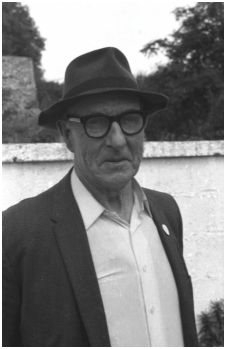 (photo: Terry Yarnell)
Tomás was born in Baile an tSagairt, Spiddal (An Spidéal) and his family were small farmers. He never married, but lived in the cottage where he had been born, and worked the family farm. He was a cousin of the singer Cáit Ní Chonluain.
His father, Pádraic Ó Coisdealbha, who was born in 1834, played the flute mainly at home, although he was known to have been invited to play at 'the big house', the Bunbury family summer residence in Spiddal (An Spidéal).
Tom's songs didn't come from his parents but many came from his cousins in Maigh Cuilinn, while others were learned from the wireless and from magazines such as 'Ireland's Own'. There is little of Tomás's singing available apart from tracks on 'A Story I'm Just About to Tell' (Topic TSCD658) and the Dé Danann LP 'The Mist Covered Mountain' (Gael Linn CEF 087). An LP record was released of his singing by Comhaltas Ceoltóirí Éireann in 1977 but is unfortunately no longer available.
Rugadh Tomás i mBaile an tSagairt, sa Spideal do fheilméaraí beaga. Níor phós sé riamh ach chónaigh sé ar feadh a shaoil sa teach inar rugadh é agus é ag saothrú fheilm a mhuintire. Ba chol ceathrar leis Cáit Uí Chonluain.
Fliúiteadóir ab ea a athair, Pádraic Ó Coisdleabha a rugadh in 1834. Casadh sé sa mbaile den chuid is mó ach d'fhaigheadh sé cuireadh chun ceol a chasadh sa teach mór sa Spidéal, mar a chónaíodh muintir Bunbury sa samhradh. Ní bhfuair Tom a chuid amhrán óna mhuintir ach d'fhoghlaim sé go leor acu óna chol ceathracha i Maigh Cuilinn agus cuid eile acu ón raidió agus ó irisleabhair ar nós 'Ireland's Own'.
Níl mórán taifead de chuid Thomáis ar fáil cé is moite de rianta ar 'A Story I'm
Just About to Tell' (Topic TSCD658) agus ar fhadchéirín de chuid Dé Danann 'The
Mist Covered Mountain' (Gael Linn CEF 087). D'eisigh Comhaltas Ceoltóirí Éireann
fadcheirnín dá chuid amhránaíochta in 1977 ach, ar an drochuair, níl an céirín
sin ar fáil a thuilleadh.
Tomás Ó Coisdealbha can be heard on VT162CD
Colm Ó Caoidheáin (Colm Keane) (Galway)
(1893-1975)
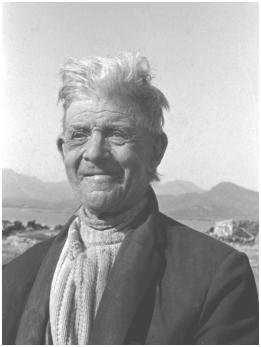 (photo: Terry Yarnell)
Colm was from Glinsk (Glinsce) a few miles northwest of Carna. His father Máirtín was from Glinsk (Glinsce) and his mother, Máire was from the island of Inis Ní. Colm was their eldest child. He made his living as a fisherman and farmer and married Bairbre Pheaits from An Aird Mhóir in 1939.
He was second cousin to the renowned sean-nós singer Seosamh Ó hÉanaí (Joe Heaney) and Joe was said to be very proud of his relationship to Colm because of his prodigious repertoire. In the 1940s, Séamus Ennis collected over 200 songs, tunes, and items of folklore from him while working for the Irish Folklore Commission and later Séamus recorded additional material for the BBC.
Surprisingly there is little of Colm's singing available, with only two tracks on 'Ireland - World Library of Folk and Primitive Music, Volume II' (Rounder CD1742), and a single track on 'Amhráin ar an Sean-Nós' (RTÉ CD185).
Ba as Glinsce do Cholm, tuairim agus cúig mhíle ar an taobh thiar thuaidh de bhaile Charna. Ba as Glinsce dá athair, Máirtín agus tháinig a mháthair Máire ó Inis Ní. Ba é Colm an duine ba shineden chlann. Iacaire agus feilméara a bhi ann agus in 1939, phós sé Bairbre Pheaits ón Aird Mhóir.
Ba chol seisear é leis an amhránaí cáiliúil Seosamh Ó hÉanaí agus bhí an-bhród ar Sheosamh as a ghaol le Colm toisc an stór olmór amhrán a bhí aige. Nuair a bhí Séamus Ennis ag obair do Choimisiún Béaloideasa Éireann sna 1940idí, bhailigh sé breis agus 200 d'amhráin, d'fhoinn agus de míreanna seanchais ó Cholm agus ina dhiaidh sin, thaifead sé ábhair bhreise ó Cholm i gcomhair an BBC.
Aisteach go leor, níl mórán d'amhránaíocht Choilm ar fáil. Níl ach dhá rian ar 'Ireland - World Library of Folk and Primitive Music, Volume II' (Rounder CD1742), agus rian amháin ar 'Amhráin ar an Sean-Nós' (RTÉ CD185).
Colm Ó Caoidheáin can be heard on VT162CD
Manny Aldous (Suffolk)
 (photo: courtesy of Mrs Aldous)
Manny is one of the few singers I have recorded who almost discovered himself.
At least, a phone call from his daughter-in-law, who had heard of my folk-song
collecting activities, put me on his trail and a meeting was arranged at her
house in Needham Market.
Maurice Sidney Aldous was born at Lower Farm, Offton in 1906 and after leaving school at
12 he had many jobs including working on farms, on the roads and in the local
tannery, iron foundry and sugar beet factory, finally working in the kitchens at
RAF Wattisham.
Like many singers who had sung all
their lives, Manny was a song collector himself. He told me, "When I was right
young, when I used to go to Offton Limeburners, 'Hay' Plummer was there, he
sang, The Sages from Somersham, they also had lots of songs and they played
accordeons there. You used to get a lot of old boys and they used to sing one
against the other. That's where I
got a lot of my old songs."
Another pub he visited frequently was
Whatfield Horseshoes. "I used to sing in the Horseshoes. There was a man named
Thorpe there then. Before the war that was. As soon as I got in the pub the old
landlord would say "We'll have a song tonight. There's a pint as soon as you
sing a song! The old stagers they used to really love those old songs. In fact
in that time, them that couldn't sing in the old pub, they'd pass around a hat
and they'd have to put something in. I never had to put anything in!"
Manny told me that he had a list of
song headings in a little red book which he used as a reminder. He had
unfortunately mislaid it and I only had the chance to meet him three times
before he died in 1988. I am pleased I was able to record some of Manny's songs so they
will not be lost. (John Howson)
Manny Aldous can be heard on: VTC2CD & VTC3CD
Norman Alford (Cumberland)
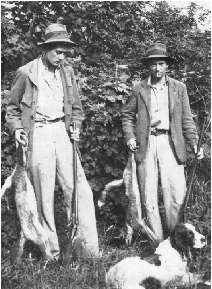 (photo courtsey of David Hay)
(Norman Alford on the left)
Born at Low Hesket, south of Carlisle, Norman and Robert Forrester were friends from boyhood and were apprentices together in an art studio in Carlisle before going to the local art school to study painting. Norman joined the army as an artillery officer during the Second World War and was wounded in Normandy. After the war he and Robert Forrester got together again, biking around the countryside, fishing, drawing and painting, and hunting out singers and songs in the many pubs they fetched up in. Gauging the right moment to take up their instruments, playing quietly at first, until the old men chose to join in: according to Forrester "Norman had a nose like a bloodhound. He would whisper to me "I think we'll be reet tonight." In the recordings he plays the tin whistle on a number of tracks. Tragically, Norman died of leukaemia in 1954 aged only 39. (Sue Allen)
Norman Alford can be heard on: VT142CDR
Bert Allen (Suffolk)
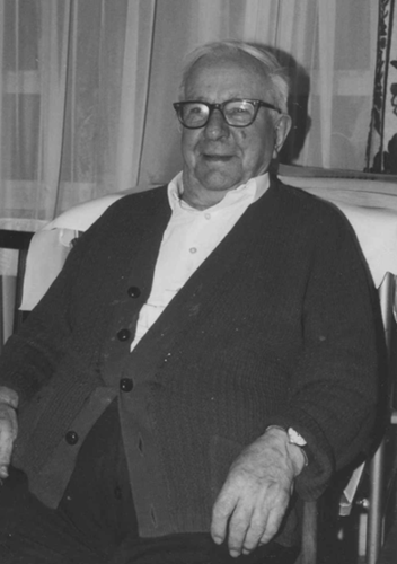 (photo:
John Howson)
(photo:
John Howson)
I met the singer Bert Allen in Wade House, a care home in Stowmarket,
Mid-Suffolk. He was born in Thurston and grew up in Tostock, and sang in the
Gardeners' Arms and the Woolpit Wheatsheaf where he stepdanced to local
accordeon player Jack Balaam, who was known for playing hornpipes. Bert moved to
Drinkstone when he was twenty three and worked at the windmill, where he said he
used to sing all day.
Bert Allen can be heard on: VTDC8CD
Clifford Arbon (Suffolk)
 (photo:
John Howson)
(photo:
John Howson)
Clifford Arbon was born in 1908. I first heard of him when singer Tony Harvey rang to tell me of an old boy who had
turned up at one of the regular Tuesday night music sessions at the Earl Soham
Victoria. He'd sung a couple of comic songs and really impressed and amused
everybody there. Tony had found out his name for me and off I went on his trail,
to the remote village of Monewden. Clifford was in fact well known in the area,
and not just for his singing and starring role in the film 'Akenfield', but
because he was the local wheelwright for most of his life: an important job when
most of the traffic on Suffolk lanes was horse-drawn. His workshop was still
intact, complete with the tools he had used for many years, situated at the
bottom of his cottage garden: the cottage he had lived in since he was two. As
Clifford said, "I was born just the other side of this garden so I haven't moved
far in my life, have I?"
In his early days he was a keen
melodeon player and played in many pubs in the area, including Ashfield Swan
where he met up with the renowned Alf Peachey. "Cor! he could play. A champion."
He learned several songs around the
pubs in those days, and he also learned several for village concerts, which were
an important feature of the village year. It was often the comic songs which
appealed most at such events. (John Howson)
Clifford Arbon can be heard on: VTC3CD & VTDC11CD
Andy Austin /Jimmy Gladwell's Band (Suffolk)
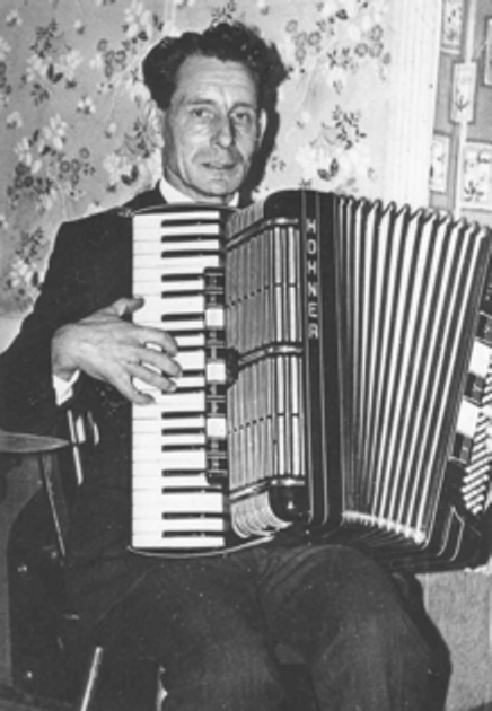
 (photos: courtsey of Andy Austin)
Andy Austin origanlly play melodeon but changed to piano accordion. He was born
in Hessett in Mid-Suffolk in 1916 and moved to Tostock when he was about nine.
His father, Frank Dore Austin, played both one-row and two-row melodeons and
Andy followed in his father's footsteps. As a young man he would gather with his
friends on the street corner and play. Later he played in Tostock Gardeners'
Arms, Woolpit Swan and Woolpit White Elm and for four or five years he played
regularly in Badwell Ash White Horse. When he started playing in dance bands he
took up the piano accordion. He remembered they played the Veleta, the Barn
Dance and the Boston Two Step and he was proud that he never played from written
music. The earliest band was known as The Tostock Dance Orchestra, then The
Harmony Brothers, then The Rhythm Stars, but the band he played with longest was
Jimmy Gladwell's Band with whom he sometimes played three or four times a week.
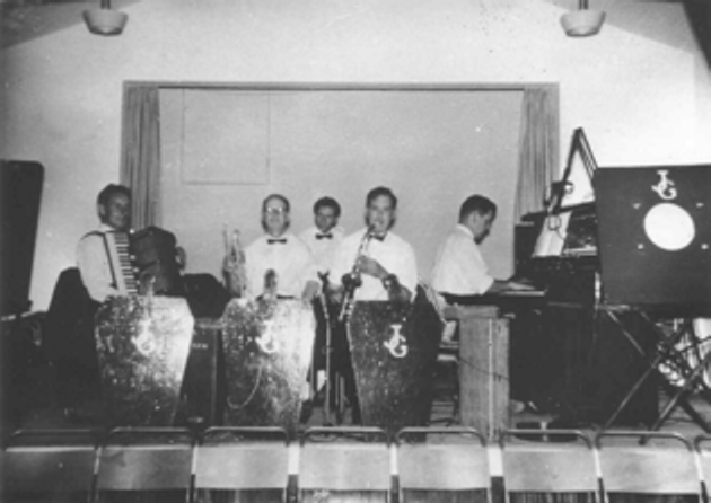
Jimmy Gladwell's Band was based in Stowmarket, although their popularity meant
they were asked to play in village halls all over Mid and East Suffolk including
as far afield as Southwold and Halesworth. Jimmy Gladwell led the band on piano
and the rest of the line-up was: Andy Austin (piano accordion), Russell Kellas
(trumpet), Charlie Gladwell (saxophone) and Bob Levitt (drums).
Andy Austin and the Jimmy Gladwell
Band can be
heard on: VTDC8CD
Ernest Austin (Essex)
 (photo: courtesy of Topic Records)
In November 1973 when Ernest Austin was recorded by Tony Engle for Topic Records
he was 83 years old. The recordings were made in his home at Great Bentley, half
way between Colchester and Clacton-on-Sea, and were released the next year on
the LP (12TS243) 'Flash Company'. The sleeve notes on this album tell us that he
left school at 12 to work as a kitchen boy in a farmhouse, earning 3/6d in
return for a 60-hour week and for most of his early life he worked on the land
as a farm labourer until, with experience, he became an agricultural engineer,
retiring at the age of 70. Some years later Phil Heath - Coleman visited Ernest
in a retirement home at Greenstead, Colchester and Ernest told him how when he
was young he and his friends would walk to Colchester to the Hippodrome and
sometimes come home with printed songs they had bought. He also mentioned that
he used to sing in the local pub (probably The Plough) until he was in his
forties when his wife became ill.
Ernest Ausrtin can be
heard on: VT135CD
Reg Bacon (Essex)
 (photo courtsey of Neil Lanham)
Reg was said to be about 68 when he was
recorded in 1959, so he was born around 1890. The family originally lived at
Redoaks Hill, Essex and his father Elijah played the fiddle. They then moved to
Radwinter, near Saffron Waldon, Essex where Reg lived in Water Lane until his
death.
He was always known as a true countryman who was very proud of his garden,
offering vegetables to anyone who visited him. He sang in the Plough in
Radwinter and was always a popular character there. His songs had come from many
sources but those from the Music Hall probably came via gramophone records, and
there are family memories of him playing records over and over again to learn
the words and then going down to the pub to sing his new song to the gathered
crowd. Apart from Sam Steele, other collectors also visited Reg,including
Russell Wortley and Neil Lanham.
Reg Bacon can be heard on: VT150CD
'Sugar' Bailey (Essex)
 (photo Miles Barrett)
Herbert Bailey was born in the hamlet of Shellow Bowells, near Chelmsford in December 1923. His nickname 'Sugar' comes from the Essex dialect pronunciation of his surname 'Old Barley (Bailey) Sugar'. He worked at the local farm until 1951, when his already poor sight failed totally. Sugar then took to factory work, travelling daily by public transport to Barking, and then working in Ongar until retiring in 1991. Although blind he was a good darts player, played dominoes and was the captain of his local pub's crib team. After matches he would be persuaded to sing from his repertoire of over 150 songs. These ranged widely from old songs learnt from his grandfather and father, to music hall to country and western. A number of these songs, including the two on this CD, were recorded at The Compasses in Littley Green in 1989 and released on a private label cassette called ‘Who’s Going to Hold My Horse?’
'Sugar' Bailey can be heard on: VT135CD
Bampton Traditional Morris Dances (Oxfordshire)
 (photo: John Howson)
Bampton Morris Dancers are one of the few sides who have an unbroken tradition of dancing, which they can trace back for hundreds of years. Members of the team still have to live in the village to be able to dance. When this recording was made the squire of the morris was Francis Shergold who had taken over after the death of their renowned fiddle player ‘Jinky’ Wells. Francis has now retired himself and has been made the honorary president of the team. The present squire is Tony Daniels who comes from another family of dancers within the village. The musician on the recording is in fact Francis' nephew, Jamie Wheeler. (John Howson)
Bampton Traditional Morris Dancers can be heard on: VTC1CD VTC4CD & VT111CDR
Cyril Barber (Suffolk)
 (photo: John Howson)
Cyril was born into a large family in
1922 and
his three brothers Sonny, Rip and Royal all played, danced and sang. The eldest
brother, Sonny, was first to have an accordeon. As Cyril said, "When he was out
of the way we'd all steal a tune on his music." Many of Cyril's songs he grew up
with, as both his mother and father sang. The family home was Wingfield and it
was around that area he first started to sing, play and stepdance. He told me,
"Yes there was a lot of singing in the pubs around Wingfield. There was
one old man who lived to be a hundred and he used to sing about 'shot and shell
flying across the battle field' from the 1914 war. The folk used to sit there
and tears came into their eyes."
He would often keep company with the
Whiting family, "Old Charlie Whiting, he could dance and sing a song!" and
favourite pubs in those days would have been the Hoxne Swan and the Ivy House at
Stradbroke.
Cyril worked mainly on the land and
he moved around quite a lot to find farm work, including a period in
Cambridgeshire. In the sixties he moved to Felsham and worked for the council
before retirement. In these later years he had almost stopped playing and
singing: "Nobody wanted to hear those old songs any more" he told me. I'm
pleased to say that many people are still interested in the old music and Cyril
is always pleased to oblige with a tune, a step or a song. (John Howson)
Cyril Barber can be heard on: VTC2CD VTC3CD VT130CD OH1CD & VTC10CD VTDC11CD
Sonny Barber (Norfolk /Suffolk)
 (photo: John Howson)
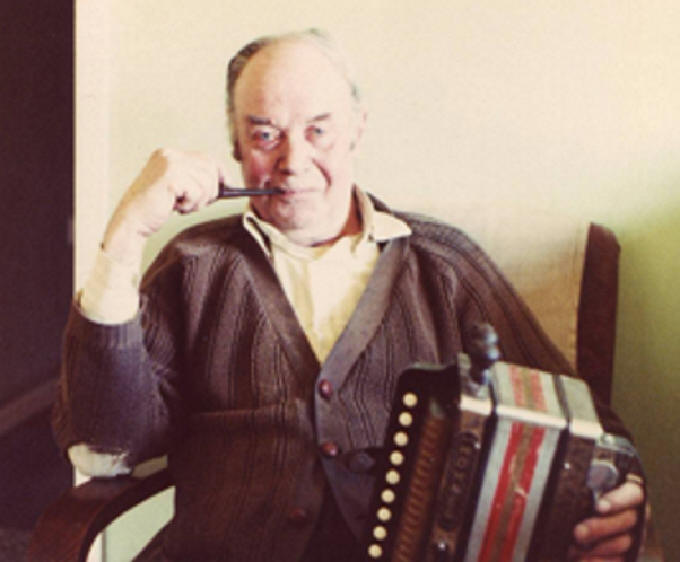
Sonny was born in 1908 in Wingfield, Suffolk but moved to Briningham, Norfolk in 1950. He was the oldest brother of Cyril Barber who is also featured in this collection. His was a musical family with mouthorgans and melodeons being the chosen instruments and their father had a host of old songs, some of which Sonny learned. Apart from picking up tunes from other musicians he met in local pubs, he also had an old gramophone and learned jigs and hornpipes from 78 rpm records. When he moved to Norfolk he soon met up with other local melodeon players like Pat Chesney and Billy Smith as well as stepdancer Dick Hewitt from Melton Constable. He said the The Hastings Arms in Melton Constable was a regular haunt for music and stepdancing until they put in a juke box.
Sonny Barber can be heard on: VTDC11CD
Mark Bazeley (Devon)
 (Mark with Bob Cann - photo:John Howson)
 (photo: Maggie Hunt)
Mark Bazley is the grandson of the one of England's greatest melodeon players, Bob Cann. He grew up with his grandfather love of their native Dartmoor in Devon and with his encouragement to the play the concertina and melodeon and Mark became the fifth generation of family players. In 1988 when Mark was just 15 he recorded many tunes with Bob which can be heard on VT138CD.
Apart from a large family repertoire Mark has continued to learn new tunes and in recent years has teamed up with accordion player Jason Rice, himself the grandson of another Dartmoor legend Jack Rice. They along with banjo player Rob Murch now lead the Dartmoor Pixie Band who play village halls all over their region. And increasingly the three 'lads' venture to venues all over the country gaining them a well deserved national reputation for their own traditional music led by Mark's powerful melodeon playing. (John Howson)
Mark Bazeley can be heard on: VTC1CD VTC4CD VT138CD VT139CD VT144CD VT146CD
Billy Bennington (Norfolk)
 (photo: John Howson)
Born in Norfolk in 1900, Billy spent most of his life as a gardener. His father
kept the King's Head public house at Barford and it was he who gave Billy his
first dulcimer. In 1912 he went to Hingham show and Billy Cooper was playing
dulcimer there. Cooper's father was the bandmaster of the Hingham and Watton
band, and Billy Bennington took lessons from him. 'Old Cooper's' rigid
discipline made Billy practise hard.
After the First World War, Billy
Bennington teamed up with Billy Cooper and they played in Barford King's Head.
It was there they joined up with fiddle player Walter Bulmer. On Saturday nights
they would play in village pubs all over Norfolk, travelling around on a
motorbike combination which had a basket on the front, where they would carry
the two dulcimers and the fiddle. Later, Billy played with a banjo player and he
busked at Great Yarmouth, which he described as "the best paid game going!"
After the war he entered a national talent competition and reached the eastern
region final. Unfortunately, he caught a hammer on a bridge and it landed in a
judge's lap, thus preventing him winning! (John Howson)
Billy Bennington can be heard on::
VTDC12CD (6 tracks on CD & 9 on DVD)
VT152CD (24 tracks)
Bob Blake (Sussex)
 (photo: Mike Yates)
Bob was born in Tooting, south London, in 1908. Holiday visits to an uncle in
Gloucestershire soon made Bob realise that he preferred the countryside to the
city and he moved to the area around Horsham in Sussex when he was nineteen. He
began working as a coach trimmer in a garage before he was able to work as a
farm labourer and a gardener. Later he became a bee-keeper, with hives in Sussex
and the New Forest.
During the 1930's Bob began to spent
his holidays cycling throughout southern England, picking up songs and tunes -
he also played the fiddle - whenever he could. A quiet, thoughtful man, he sang
mainly for his own pleasure (and, no doubt, for the pleasure of his bees!)
although he did sometimes visit local folk clubs in company with Bob Copper, Bob
Lewis and other Sussex singers. (Mike Yates)
Bob Blake can be heard on:
VTC4CD
David Blick (Gloucestershire)
The Roy Palmer book 'What a Lovely War' (Michael Joseph 1990) aimed to show the songs that were actually sung in the forces during war time and he collected songs from ex-service men and women to include in the book. David Blick was one of his sources. He lived in Newent, Gloucestershire and served in the REME in Germany in the late 1950s. (John Howson)
Bob Blake can be heard on: VTC1CD
George Bregenzer (London)
George came from a Shoreditch family. He learned a number of songs before 1939 from a friend who was a T.A. member of the Royal Engineers. So, curiously, George took them into the army with him when he was called up. A tape he sent me (now in the British Library National Sound Archive) contains The Codfish, Hurrah for the CRE, a couple of fragments: A Soldier and a Sailor and I'm the Ghost of John James Christopher Bing plus two songs George learned in the 1920s, Maidstone Football Song and Vote, Vote, Vote. (Roy Palmer)
George Bregenzer can be heard on: VTC6CD
Brian & Darren Breslin (Fermanagh)
Brian Breslin was born in 1931 and his grandson Darren Breslin was born in 1985 and they live in Lisnaskea, Co. Fermanagh, where Darren was born. Brian was born in Rosslea, and his father always had a fiddle in the house. His first influence was the renowned piper Sean McAloon who wrote out some notes for him. In the late 1950s Brian played with the Pride of Erin Ceili Band, then after a break he got back into playing, mainly at pub sessions. The fiddle he plays now was made locally for him by an old fiddle maker called John Gunn from Derrylin.Darren has been playing tin whistle and then the button accordion since he was eight. Apart from his grandfather, who was probably his strongest influence, he also greatly admired two local players Sean Nugent from Fermanagh and Sean McCusker from Tyrone. Darren comes from a large musical family and his father Tommy would play tunes with him every evening. Darren has won many provincial fleadh medals and in 2008 he won the Senior All-Ireland button accordion competition. He can also be heard on his solo CD 'All Ireland Champion'.
Brian & Darren can be heard on: VTC10CD
Charlie Bridger (Kent)
 (photo courtsey of Andy Turner)
I was taken to meet Charlie in Kent by Andy Turner, a good singer in his own right. We recorded a number of songs from Charlie, including 'The Birds Upon the Tree', 'Little By Little', 'The Folkestone Murder' and 'The Zulu Wars'. Charlie had worked for most of his life in a near-by stone-quarry and had picked up his songs from his parents and work mates. (Mike Yates)
Charlie Bridger can be heard on: VTC4CD VTC6CD
Jumbo Brightwell (Suffolk)
 (photo: Mike Yates)
William ‘Jumbo’ Brightwell was one of Velvet’s eleven children, born in 1900 in Little Glemham. It was there he met an old sailor called Jumbo Poacher from whom he got his nickname. After the war in 1919 he returned to Leiston where he worked as a bricklayer’s labourer and then eventually started at Garrett’s and served twenty years as a shunter before retirement. He rarely missed a Saturday night in the 'Foot', where he would go with his father and brother, Bob. He learned his songs from local and visiting singers as well as, of course, from his father Velvet, although he told Keith Summers that 'The False Hearted Knight' came from his mother. E J Moeran seemed to think that Jumbo was not allowed to sing ‘out’ until he was fifty, but local thinking is that this was a wind-up and many remember him singing as a young man in the pub. He was also a champion quoits player and he would hear songs when playing at other pubs in the area. There is some confusion about the 1939 recordings as the BBC credited 'Pleasant and Delightful' and 'The Indian Lass' as being sung by him while it is clear that it is actually Velvet singing. Also, Jumbo does not appear on any of the 1939/40 photographs. Jumbo had a vast repertoire of songs and his wife Cathy (whom he married late in life) talked about a large book of songs of which he knew every one. He was visited and recorded by several collectors over the years, including Peter Kennedy in the 1950s, Neil Lanham in the 1960s, and Keith Summers and Tony Engle (Topic Records) in the 1970s. (John Howson)
Jumbo Brightwell can be heard on: VT140CD VT154CD
Emma Briggs (Suffolk)
 (photo:
John Howson)
(photo:
John Howson)
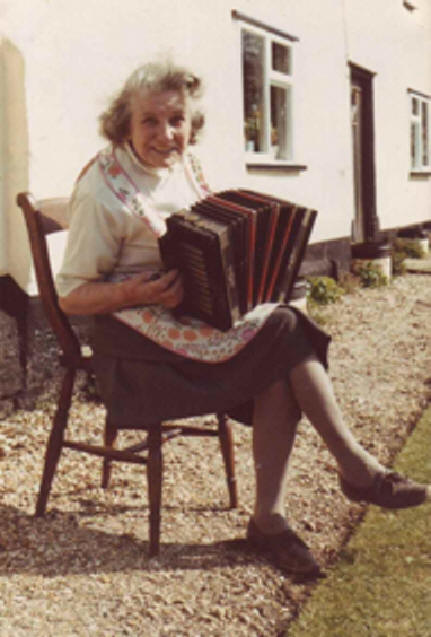
When writing about Gordon Syrett in Mendlesham Green I mentioned the name Ted
Thorpe and I met his daughter Emma Briggs in Thwaite. She learned to play
melodeon by borrowing her father's when he was out, but it was her mother, Betsy
Cooper from Battisford, who taught Emma the songs she sang, although they only
ever sang at home. Emma's husband Harry Briggs also played mouthorgan and
melodeon in several local pubs including another lively pub, the Thwaite Buck's
Head.
Emma Briggs can be heard on: VTDC8CD
Velvet Brightwell (Suffolk)
 (photo courtsey of Keith Summers)
William ‘Velvet’ Brightwell was born 1865 in Little Glemham, he went to sea for a year or two in his early days but moved the family to Carrs Cottages then Archway Cottage, Leiston, in 1916 and worked as a plate-layer on the railway. He was a well educated man compared to his colleagues and could read and write very well, soon becoming foreman. He told Peter Kennedy that he had done forty-eight years and ten months ‘on the line’. He got his nickname of Velvet because of the velvet waistcoat and suit he favoured. He was a member of the ‘Royal Order of the Buffaloes’ and it was at their meetings that he enjoyed singing. He had a large repertoire of songs, was a regular at the Eel’s Foot, and at the centre of the 1930s recordings. Apart from these BBC recordings, the only others seem to be those he made at the age of 91 by Peter Kennedy in 1956 when he sang "Scarboro", "The Faithful Plough", "The Foggy Dew" and (learned from his father Robert), "The Loss of the Ramillies". Velvet died at the age of 95 in 1960. (John Howson)
Velvet Brightwell can be heard on:
VT140CD
Tom Brodie (Cumberland)
 (photo courtesy David Hay)
Tom "Copper" Brodie, born at Cargo, near Carlisle, in 1906, sang 'The Birds Upon the Trees'. He was a fisherman and later a water bailiff on the rivers around Carlisle, until his retirement in the late 1960s. He learned from one Jack Hind of Rockliffe, another great fisherman. (Sue Allen)
Top Brodie can be heard on:
VT142CDR
Percy Brown (Norfolk)
 (photo: Dave Arthur)
Percy, a one-time woodman, chimney sweep and level-crossing keeper, had a large repertoire of song tunes, stepdances, polkas and other dance tunes and hymns. It was a hymn 'Here we suffer grief and pain', which Percy first learned to play as a small boy alongside his mother on an old single-row, four stop 'music', which he later discarded for his two-row Hohner melodeons. Percy always said that he liked 'to find the corners of a tune'. In common with the vast majority of traditional musicians, he learned all his music by ear and felt that written music 'flattened out the tune'. (Dave Arthur)
Percy Brown can be heard on:
VTC5CD
VT150CD
VTDC11CD
Alec Bloomfield (Suffolk)
 (photo courtsey of Keith Summers)
Alec was a tall man who worked as a
gamekeeper. He lived in Westleton, then Benhall and then moved away to
Nottingham. He became a favourite singer at the 'Eel's Foot' at Eastbridge, and a story that is still
in circulation recalls the night when some ‘boys’ from Leiston were in the pub
and landlady Mrs Morling couldn’t get them to leave. Alec was
outside and she explained the problem. He went in, rolled up his sleeves and
said, “Now who’s going to leave by the door and who’s going to leave by the
window!” He was also recorded by Peter Kennedy in 1950 when he sang 'The Old
Couple in the Wood', 'Stand You Up', 'The Old Mole Catcher', 'Burlington Fair', 'The Poor Little Soldier’s Boy', 'Bold General Wolfe', 'The Highwayman
Outwitted', and 'The Ship that never Returned', Kennedy also recorded him for
the BBC at Benhall in 1952, when he sang 'The Foggy Dew', 'The Cunning Cobbler',
'The Wild Rover', 'Young
George Oxbury' (which came from his father, George). (John Howson)
Alec Bloomfield can be heard on: VT140CD & VT154CD
Charlie Buller (Norfolk)
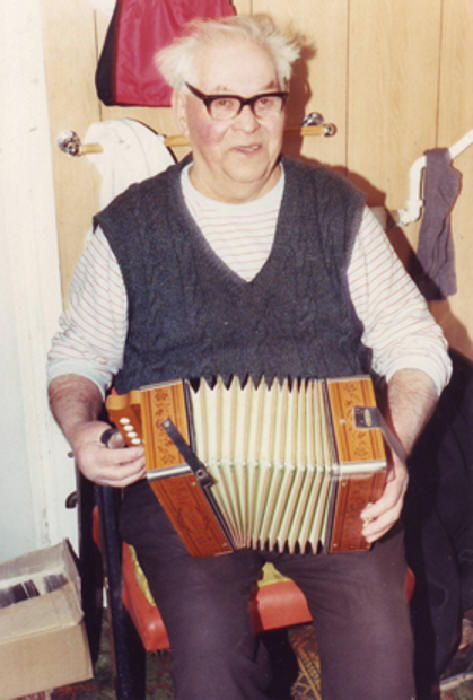 (photo: John Howson)
Charlie
was born and lived all his life in Erpingham, Norfolk. Growing up in the heart
of a melodeon playing area he reckoned every village would have someone who
could play one and he could rattle off a list of local players: Ernie Barstead,
Percy Davidson, George Sandle, one called Wickmere and one called Scarfe. Then
there was the highly regarded players like Albert Hewitt and Percy Brown.
Charlie and his brother-in-law played together and they bought matching
melodeons to take around the local pubs. He also travelled out on a Saturday
night with an old singer called Billy Cook who would sing in every pub they
visted, like Trimingham Crown & Anchor, Mundesley Ship and Bacton Duke of York.
Other outings ended in Cromer where he would play for the fishemen to stepdance
and he reckoned Dick Davies was the best. In village halls in his locality he
would also play for the Long Dance and other old dances like the Veleta, ‘The
Boston Two-Step’ and the old Schottische.
Charlie Buller can be heard on: VTDC11CD
Walter & Daisy Bulwer
(Norfolk)
 (photo courtesy of Reg Hall)
Walter
Bulwer was born in 1888 in Shipdham, Norfolk and following an apprenticeship he
worked as a self-employed tailor. He also cut hair and was well known for his
taxidermy! His father played the fiddle and Walter was taught to read music at
the age of four and played violin, viola, cello, piccolo, clarinet, tin whistle,
trombone, mandolin and drums.
He became heavily involved in the
musical life of Shipdham and was a member of various bands. He also played in
all the pubs in the village, sometimes with another fiddler called Brown. From
an early age Walterpreferred to play by ear and enjoyed improvising and playing
second parts.
He liked to have piano accompaniment
and when he met and married Daisy Hart, who was from the neighbouring village of
Bradenham, she accompanied him on the piano. Over a period of forty years they
played for hundreds of weddings in their locality. In later years they mainly
played at home and it was there that Mervyn Plunkett and Reg Hall took Bill
Leader to record them in the 1960s.
Walter & Daisy Bulwer can be heard on
VT150CD
Edgar Button (Suffolk)
 (photo courtesy of Keith Summers)
Edgar came from Middleton and then
lived in Theberton and was a regular at the 'Eel’s Foot', Eastbridge. He was a strong singer
and was recorded by Peter Kennedy in 1956 when he sang 'Blow the Candle Out',
'The Oak and the Ash', 'The Larks they sang Melodious' and 'The Foggy Dew'. That
visit led to Edgar being invited to sing in London, taking the place of Jumbo
Brightwell who would not go as he thought that he would be made fun of. Neil Lanham also
recorded Edgar when he sang 'Ramble Away', 'Female Cabin Boy' and 'Swinging in
the Lane'. (John Howson)
Edgar Button can be heard on: VT140CD
Jack 'Dot' Button (Suffolk)
 (photo courtesy of Wilf Goddard)
Lenny Button said that his father
could play for hours and knew hundreds of songs. In early life Jack worked in
insurance and then as a gardener at Lower Abbey Farm, near Leiston. He had a
damaged leg, giving him a limp which accounts for his nickname. One of his
daughters was recorded by Keith Summers under her married name of Aline Stollery
(Topic 12TS375) and her son Eric recalled that Jack used to wear long leather
buskins and ride a high old bike with his walking stick tied to the cross bar
with a pair of boot laces and his accordeon on the back. He died in1955 aged 83.
(John Howson)
Jack Button can be heard on: VT140CD
Packie Byrne
(Co.Donegal)
 (photo: Brian Shuel)
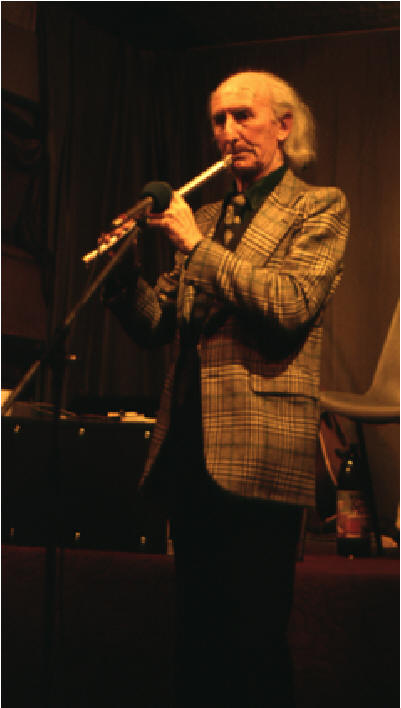 (photo: Doc Rowe)
Packie Manus Byrne was born on 17th February, 1917, on a farm in Cockermore near Ardara, County Donegal. “Aye”, says Packie, “I was born in the heart’s blood of the mountain, seven miles from the nearest village or town.” He was the youngest of four children.... “We’d to walk four miles over the mountain to get to school, and my feet didn’t see a pair of shoes till I was nine!” The farm was one of few in a small community of Gaelic-speaking tenant farmers on land ravaged by brutal winters. “If they’d squeezed the water out of our land we’d have but ten acres out of thirty.”
Music was the main form of entertainment
wherever people gathered together. “Well, there was little else to do to keep
you out of trouble. I remember going away over to my sister’s farm to see the
cattle. I took Charlie Waters with me expecting to be but an hour or two. We
were holed up for four days in a deserted house 'till I had every damn song he
ever knew, and vice versa!”
Packie’s life was filled with the
songs and stories of those around him. His mother was a fine singer, as was Gran-Uncle
Pat and Gran-Aunt ‘Big’ Bridget Sweeny. Every household had a musician in those
days and there’d be a sooty, blackened fiddle hanging on the flag across the
wall over the hearth. Packie’s father, Con Byrne was a matchmaker and would
often be called across the mountains to discuss the merits of a suitable woman
over a drink. “He was bred into compulsive talking and could always persuade any
listener of the virtues of a particular wife: ‘That woman’d take music out of a
fresh loaf!’ he’d say.” He was himself a fine singer though he preferred comedy
songs and supplied plenty of comic material for Packie’s stories. He gave Packie
many songs, amongst them a marathon with twenty four verses to it that Packie
had once sung as slowly as he could while his dad was waiting to get away to a
Poteen gathering, until he leapt up saying, “That’s not a song, that’s a bloody
endurance test!” (John Howson)
Packie Byrne can be heard on: VT132CD
The Cantwell Family (Oxfordshire)
The
Oxfordshire family the Cantwells came from the village of Standlake and were
well known locally for their singing. Raymond and Frederick Cantwell were
recorded by Peter Kennedy in 1956 when Frederick was 73 years old and a
recording of them can be heard on RCD1778
‘Songs of Seduction’. The next generation, John and Aurbrey Cantwell, have
continued the family tradition and Gwilym Davies recorded John in the 1970s.
(John Howson)
The Cantwell Family can be heard on:
VTC7CD
Chagford Merrymakers (Devon)
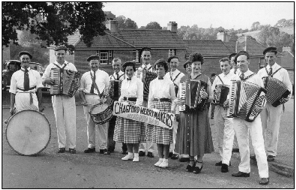 (photo courtesy of Ruth Askew)
 (photo courtesy of Ruth Askew)
Chagford is a small Devon town on the edge of Dartmoor. Each year, in common with many other rural towns around the country, they had a carnival. Originally known as a Jazz Band, the carnival was the reason for the creation of the Merrymakers after the second world war. Peter Kennedy recorded them in the 1950s. Two of the key player were Jack and Les Rice, playing along side other local musicians like Ruth Askew, George Allen and Bob Cann. In the 1980s a revival of the the Merrymakers took place with several of the original members including the Rice brothers. (John Howson)
The new Merrymakers can be heard on: VT144CD
John Campbell (Co. Armagh)
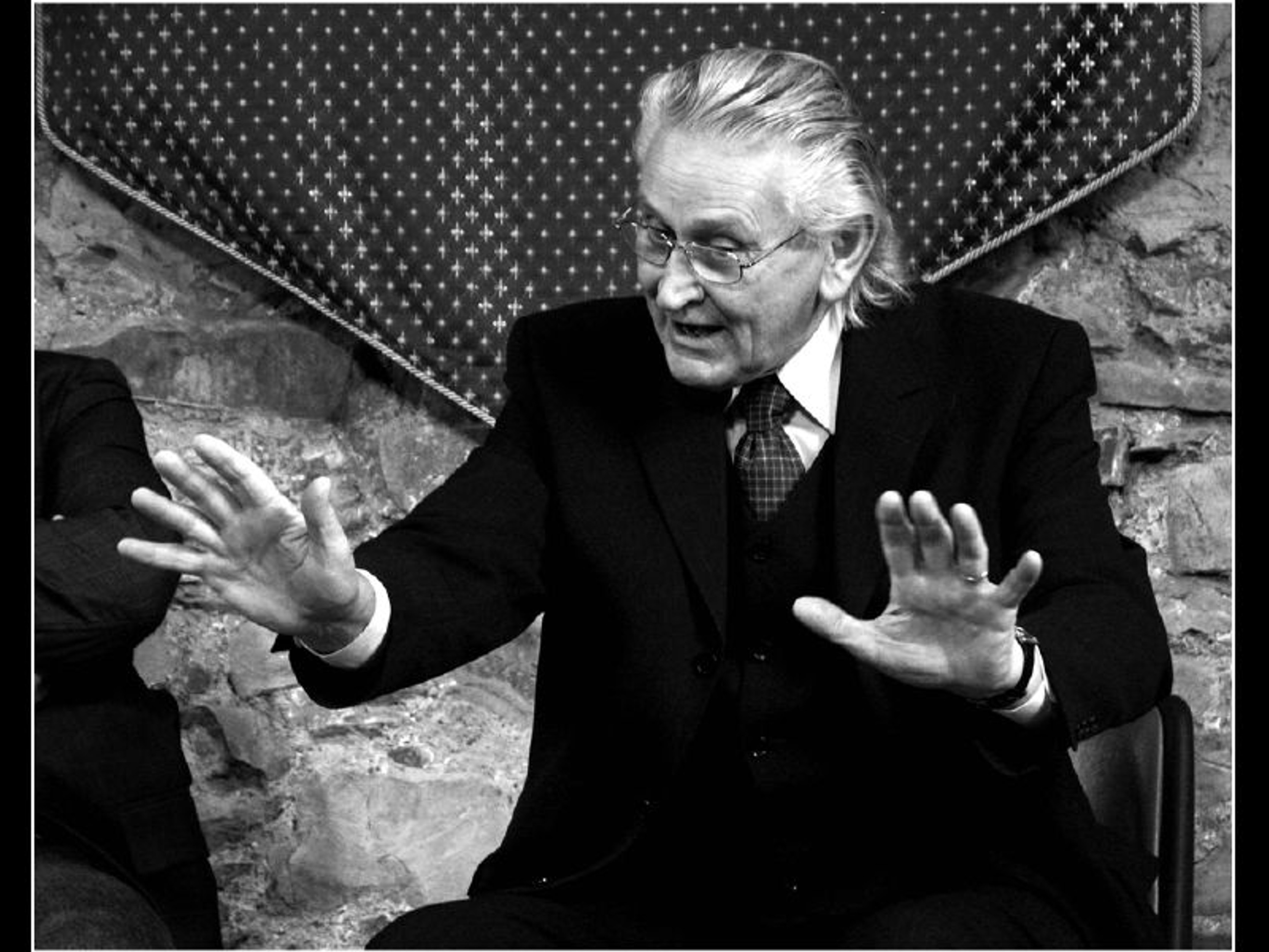 (photo: Pete Heywood)
John Campbell was born in 1933 and lived most of his life in Mullaghbawn, Co. Armagh. He was brought up by his grandfather, gaining his early inspiration from the older generation of storytellers who gathered in his house. At fourteen he started work as a barman and then took a clerical job, rising to site manager, only to be made redundant in 1980. He also kept sheep and took first prize at the Royal Dublin Show. Apart from his exceptional storytelling he was also a fine singer, expert lilter and played the Jew's Harp. In the mid 80s he teamed up with traditional Armagh singer Len Graham and together they made two CDs, 'Ebb and Flow' (1998) and ‘Two for the Road' (2001). John died in 2006 and obituaries appeared in the Guardian and the Independent newspapers.
John Campbell can be heard on: VTC10CD (1)
Bob Cann (Devon)
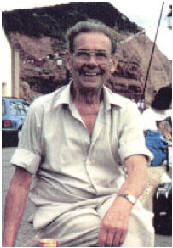 (photo courtesy of Mark Bazeley)
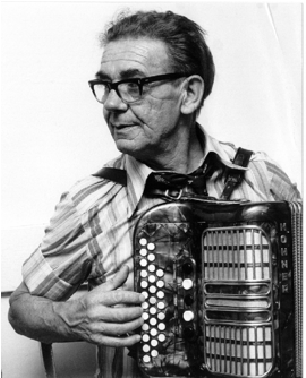 (photo courtesy of Mark Bazeley)
Bob Cann was born in 1916 and spent his early years on a farm mid-way between Whiddon Down and Drewsteighnton on Dartmoor. His final home was in South Tawton, a small village four miles east of Okehampton, where his widow Joyce still lives.
He started playing melodeon at a very early age, and by the time he was three he could play 'Now the day is over' with one finger. Many of his tunes came from his uncles, who had learned them from Bob's grandfather. Uncle George lived locally and played concertina regularly for stepdancing. Uncle Bob was a master on the mouthorgan, and Uncle Jim played the melodeon. They lived at Dunchideock and Bob loved to spend his holidays with Uncle Jim, when his father could afford to send him, particularly because Jim had different tunes to Uncle George. Bob's first melodeon came from an uncle in the navy who would bring him back a new one after every trip.
This was a large family: eleven on his father's side and twelve on his mother's, and there was music played whenever there was a family gathering, particularly at Christmas. They also made up informal bands with melodeons, concertina, mouthorgan and Jews harp, to play for Harvest Suppers and Barn Dances. Music was also required for step-dancing and in particular, the step-dance competition.
These competitions were held at village fairs and would be the main event of the day after the greasy pole, skittling for a pig, pony racing and tug-o-war. A horse-drawn flat-top wagon would be used as a stage and on top of this would be a board, about four inches high and fifteen inches square. Each dancer would have to get up three times in turn. Each time they would first 'set' (keep time) to the music and then perform a step, so three different steps would be performed by each dancer. The musician (usually playing concertina) would sit with his back to the dancers so that he didn't know who was dancing and there wouldn't be any favouritism. The same tune was played for all the dancers and it was always a hornpipe.
Bob Cann's Dartmoor family is one of the few in England whose music making tradition spans five generations. He was always keen that one of family continued their musical tradition and when his grandson was ready he wanted them to be recorded together. At the time Bob was seventy one and his grandson, Mark Bazeley just fifteen years old. Mark continues to foster the family traditions and he now leads the country dance band Bob formed, the Dartmoor Pixies. (John Howson)
Bob Cann can be heard on: VTC1CD VTC4CD VTC9CDR VT138CD VT144CD
Charlie Carver /'Gypsy' Charlie (Suffolk)
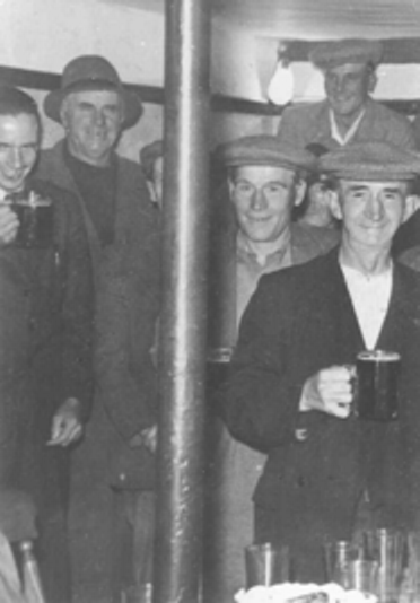 (Charlie
Carver - second from the left -photo: courtsey of Freda Largent)
(Charlie
Carver - second from the left -photo: courtsey of Freda Largent)
Charlie Carver was recorded by Desmond ans Shelagh Herring in 1960, inging in
his local pub the Garndener’s Arms in Tostock. As we have been unable to contact
any members of his family, we know little about him except that he worked on the
land. Another Tostock family, the Everitts, did have memories of him and Charlie
was a contemporary of Alfred Everitt who used to sing regularly in the
Gardeners' Arms. His son George remembered Charlie singing one about ‘boring a
hole went the cobbler, then up the wall went the painter and in and out went the
tailor'. George’s sister, Freda Largent, who played the melodeon in the pub,
also had memories of the old boys singing, particularly another local songster 'Shucker'
Clarke' and her memory of Charlie was singing 'The German Watchmender' -
including the rude bits! The Gardeners' was, like many pubs in the area, a
lively hostelry on Friday and Saturday nights, and when the Herrings visited,
there was another singer they recorded who was unnamed, as well as a stepdancer
and singer who was known only as ‘Gypsy' Charlie.
Charlie Carver and 'Gypsy' Charlie can be heard on: VTDC8CD
James Carty
(London)
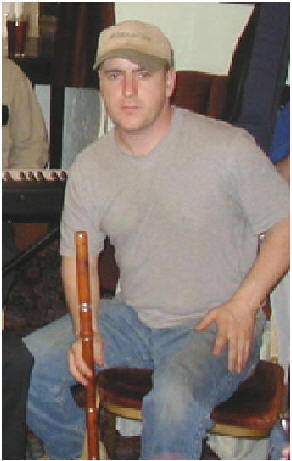 (photo: John Howson)
James Carty is the son of one of the stalwarts of the London Irish music scene, flute player John Carty. James is one of those rare musicians born in London, who feels strongly about home in Ireland and who feels equally strongly about the old-style traditional music. Born in Whitechapel in the East End of London in 1969, he has the strongest of attachments to his father's home in Knockroe near Boyle, Co. Roscommon, where his brother John now lives, and his mother's place in Rosrue, Cashel, Connemara, Co. Galway. As a child he was brought up with the sound of his father and his elder brother John playing the flute and banjo at home, but he reckons he only began to take notice when he was about seven. He had a few tin whistle lessons at Brendan Mulkere's class in Whitechapel, and then he gave up playing for years, though as a teenage he hung about where the music was played. At twenty-three, at a significant point in his life the day after his mother died - Gregory Daly gave him a boxwood flute - a bag of gold dust - and, like many sons of flute players, he worked out how to play on his own. About seven years ago, he was taken down to the Crescent, and it was Joe Whelan and Liam Farrell who really got him going and had him playing there regularly for a couple of years. James plays every Sunday in one of London's finest Irish music session at the Auld Triangle, Finsbury Park. (Reg Hall)
James Carty can be heard on: VT141CD
Harry Chambers
(Suffolk)
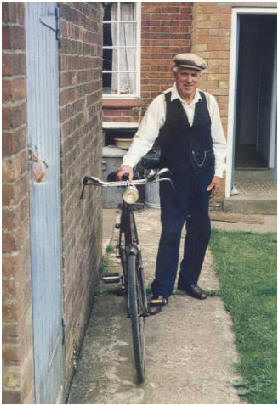 (photo: John Howson)
Although born in Laxfield, Harry Chambers is a Dennington man, having lived in the parish for over fifty years, where he worked on various farms before retirement. He actually lived in Owl's Green (which is a couple of miles from the centre of the village) not far from the famed melodeon player, Dolly Curtis's old cottage, and the Dennington Bell pub. Years ago, in most rural singing pubs, not everyone had a vast repertoire of songs but many of the company would have a couple of items ready in case they were called upon. Harry filled this role well with his classic drinking toast ' The Barley Mow' which was often used to end an evening. He told me that he learned the song "a lot of years ago at a farm worker's Union meeting held at Saxmundham.” (John Howson)
Harry Chambers can be heard on: VTC2CD
Ted Chaplin
(Suffolk)
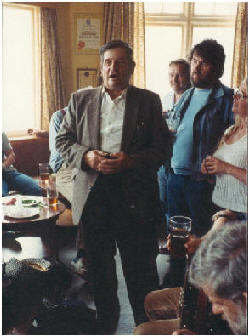 (photo source unknown)
Ted was born in Eye but then made his
home in various parts of the county. After living in Cranley Green he spent
thirty years in the Henley and Barsham area, where he worked as a horseman and
then as a farm manager. His next move was to Bacton, where he operated a coal
business for twenty years, followed by a couple of years in Mendlesham and four
in Wingfield. He finally settled in Mellis, although he didn't stop working as
he spent a lot of his time at Tony Harvey's stables. From there he drove parties
of vistors around the lanes in a horse-drawn carriage to sample a couple of
hostelries and then back to Tannington for a meal.
Ted sang a lot in his younger days, as he told me, " Well we used to get down to old Redlingfield Crown; what else was there to do? There was an old boy there used to come and play the accordeon: Wallie Harpie. He weren't an expert at it but he'd play a tune or two, but one night his boss came in and we said, 'Come on Wallie, strike up!' but he wouldn't play in front of him so that's when we started singing a song or two. The first song I ever sung in there was 'Nellie Dean', and I haven't sung it since. Then I moved over to Henley and got in with a chap there, worked at Cobbold's brewery, and I used to go about with him, down in Ipswich and about. Then village pubs we'd go sing a song in, like Coddenham Duke, Coddenham Crown and I suppose Henley Cross Keys was the main pub where we were known.
There used to be an old boy, Herbert Page used to get in there with a fiddle and he'd sit in a corner, and rasp away. Well he couldn't play and I'd encourage him and everyone there would curse me. 'Play up Herbert: that's beautiful!' I'd say. Now I was in Swilland Half Moon and two chaps came in and sang several funny songs and the next night I went into Coddenham Duke and I sang those songs!"
Ted's singing career then lapsed for thirty years, and I was fortunate enough to meet him just as he was starting again. That was in Brundish Crown: somebody said, 'Old Ted'll give you a song!' Up he got and gave us. 'The fellow that played the trombone' and he never looked back. (John Howson)
Ted Chaplin can be heard on: VTC2CD VTC3CD VTC7CD
Jack Clark
(Suffolk)
 (photo courtesy of Eileen Morling)
Jack was a thick set man and over six foot tall. He lived up the ‘Drift’ in Eastbridge and worked as a builder’s labourer, including several years working for Read’s of Aldeburgh. Eric Stollery worked with him and he said, ”Yes big Jack, he’d sing at work, we’d often have a rendering in the shed!” (John Howson)
Jack Clark can be heard on: VT140CD
Charlie Clissold
(Gloucestershire)
 (photo courtesy of Mrs E Clissold)
Charlie was originally from Moreton Valence, Gloucestershire. His father was a farmer and when Charlie was left the farm he rented it out and then worked for the council. He was famed locally for his version of the song 'The Ledbury Clergyman', and, incidentally, for the quality of his home-made wine. His sister-in-law, Eileen Clissold remembered that wherever he went he would entertain everyone. A real character! (Mike Yates)
Charlie Clissold can be heard on: VTC4CD
Ted Cobbin (Suffolk)
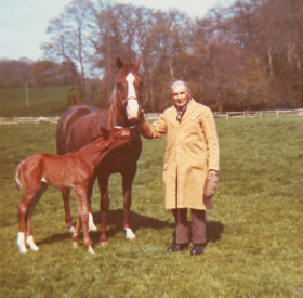 (photo courtsey of Richard Cobbin)
Ted Cobbin was born in 1906 in Parham but spent most of his life in Great
Glemham. The family originally lived at the timber yard which was opposite the
village pub, the Crown. Ted’s working life was spent as a general stockman on
Lord Cranbrooke’s estate at Great Glemham where he tended the pigs, cows and
sheep. Then in later years he looked after the horses, a job he continued with
even after retirement. He was thought of very highly on the estate and when he
died in 1975 they named a barn - ‘Cobbin’s Barn’ after him. Ted Cobbin played
melodeon with Peter Plant in Great Glemham Crown and sang several songs
sometimes, accompanied by Peter. He didn’t play anywhere else much, very rarely
played at home and never sang there. His son Richard remembers: “My earliest
memories of Dad’s music was when I was a boy. He’d be in the Crown here in the
village and he’d ask me to get his accordion from home, because he didn’t want
to see my mother ‘cos she wouldn’t want him to go back with it.”
Ted Cobbin can be heard on: VT154CD
John Cocking (South Yorkshire)
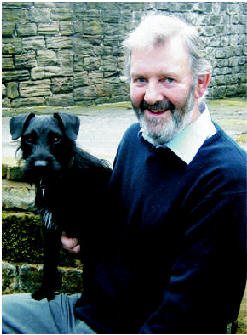 (photo: John Howson)
John Cocking was born in Marsden, near Huddersfield in the South Pennines on
25th February 1938 and has lived there all his life. He was brought up to hill
farming as a boy, where his greatest pleasure was working with heavy horses. He
has for many years
made his living as a dry-stone waller. He has also been the kennelman for the
Colne Valley Beagles and hunted with them and with the Holme Valley Beagles.
The old tradition in the area of
making one's own entertainment at Hunt Suppers and Shepherds' Meetings also
appealed to John,
and soon he began making regular contributions, singing mainly hunting songs and
performing comic monologues, particularly those he heard on the radio as a boy,
performed by Stanley Holloway.
Locally he was influenced by Arthur
Howard of Mount Farm near Holme village. Arthur had a large repertoire of songs
and monologues and although it is said that he was ‘discovered’ too late in life
for the public at large to have the best of him, John met with him frequently at
various gatherings and remembers him and his friend Frank Hinchcliffe (also of
Holme village) bringing the house down at the end of evening after everyone else
had done their bit. The other local performer of monologues teller was Ernest
Dyson whom John met some thirty years ago and who continued learning new
material into his seventies. (John Howson)
John Cocking can be heard on: VT143CD
VT147CD
Albert 'Diddy' Cook (Suffolk)
 (photo courtesy of Wilf Goddard)
‘Diddy’ lived in Eastbridge in a cottage next door to Edgar Button and was one
of the best known singers in the 'Eel's Foot', being highly rated by Jumbo Brightwell. He
was a horseman and worked on Ropes Farm. He was once leading a pair of Suffolk
Punches and was struck by lightning. He survived, although in a ragged state
with the soles burned off his boots. Both horses were killed. (John Howson)
Albert Cook can be heard on: VT140CD
Harry 'Crutter' Cook (Suffolk)
‘Crutter’ (not directly related to the other 'Eel's Foot' singer ‘Diddy’ Cook) was described as a short fat man, who looked after the sluice gates when they were operated manually down at the marshes at Eastbridge. He lived in the sluice-man’s cottages and walked up to the Eel’s Foot every Saturday night. Apart from 'Duck Foot Sue', he was also remembered as singing 'Ramble Away' and 'Blow the Candle Out'. Also, Jumbo Brightwell said that he had learned 'Newlyn Town' from him, and Tom Goddard remembered him stepdancing. (John Howson)
Harry Cook can be heard on: VT140CD
Billy Cooper
(Norfolk)
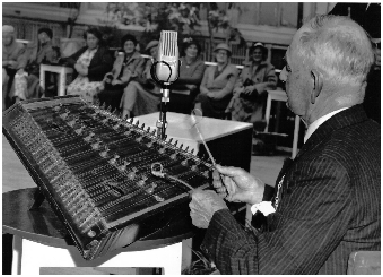 (photo: Eastern Daily Press)
William Frederick (Billy) Cooper was born in 1883 in London but his family moved
to Hingham, Norfolk when he was one.
His father Frederick William Cooper
became the bandmaster of Hingham and Watton Band. He also played euphonium but
it was dulcimer playing for which he was particularly renowned. He taught Billy
to play and when he had learned a couple of tunes, bought him a dulcimer of his
own. Billy spent some time living with his brother in Bury St Edmunds, Suffolk
and played fiddle with his sister-in-law for local dances. He also played
one-string fiddle, auto-harp and anglo concertina. In 1915 he joined the Suffolk
Regiment and was put in charge of the fife and drum band and played the dulcimer
for army services.
Over the years he teamed up with
other local musicians including fiddle player Walter Baldwin, auto-harp (later,
guitar) player Jack Bunn and the younger Billy Bennington who had also been
taught to play the dulcimer by Billy Cooper’s father.
He was brought together with Walter
and Daisy Bulwer by Mervyn Plunkett and Reg Hall to record for Bill Leader and
the recordings were released on a limited edition LP in 1965.
Billy Cooper can be heard on VTDC12CD & VT150CD
Dinks Cooper (Suffolk)
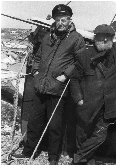 (photo courtesy of the Walberswick Bell)
(Dinks Cooper - left)
‘Dinks’ Cooper was born in Walberswick
in 1914 and was a longshore fisherman working in Sole Bay. He would sing in the
local pubs particularly the Harbour Inn, accross the river in Southwold, which
attracted many visiting musicians and singers.
As he told Keith (from ‘Sing, Say or
Pay’): “Those Seamans used to come down from Darsham here to Southwold a lot.
They used to record down at the Harbour Inn by the BBC. We often used to hear
them on the radio - Wilfred Pickles, that sort of programme. When they had the
big flood (1953) I got stranded in that pub. The water was up to the top window
and there was me and Ernie and a couple of others. When the water came in we
only had time to grab twenty Woodbines and leg it upstairs. That's all we had
between us for four days. I used to go round with them quite a lot at one time -
all round Halesworth, Yoxford and up to the Buck (Rumburgh) - Ernie's cousin
kept that.”
He is still well remembered in his
village as a local character, particularly in the bar of the Bell where, after
he died in 1988, a brass plate was attached to the wall, which proclaims ‘Dinks'
Leaning Post!’
Dinks Cooper can be heard on: VT154CD
Bob Copper (Sussex)
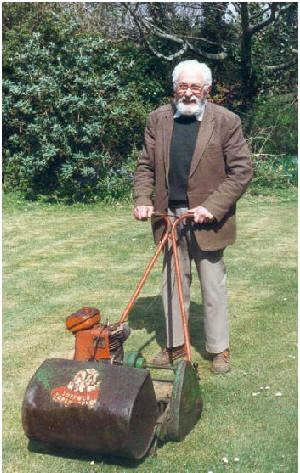 (photo: John Howson)
Born 80 years ago in the village of Rottingdean, Bob is rightly regarded as one of the most important of England's traditional singers, coming from the countries foremost singing families. His own life story is well known through his books and his many radio and television broadcasts, but he remained a very approachable, down-to-earth man who was an inspiration to all who come in contact with him. His many talents also include painting and poetry and he could still be seen seasonally as Old Father Christmas in the Rottingdean Mummers. Since his retirement, he has even taken up musical instruments, playing concertina and melodeon. Former Life Guard and policeman and barber, Bob was a publican for most of his working life, mostly in Sussex, but briefly in Hampshire. Bob Died in 2004.
Bob Copper can be heard on: VT131CD
John Copper
(Sussex)
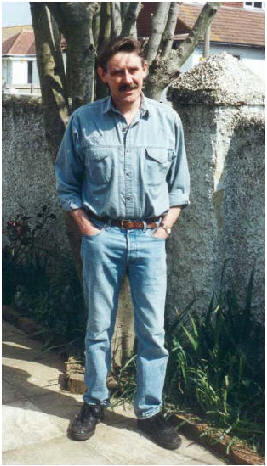 (photo: John Howson)
John must have been one of the youngest traditional singers to be collected from as there are recordings of him aged 8 singing 'Hey He Sing Ivy' in the BBC Archives! By the time he was 16, he was able to start singing the bass line in the family's songs alongside his uncle Ron. When Ron died some 11 years later, John started to lead the bass line to his father's "treble". On the Coppersongs album he is joined in turn by his own children Ben, Lucy and Tom. As a solo singer, John is best known for spirited and beautifully timed interpretations of the humorous items in the family's repertoire, but he plays a leading part in the famous Copper family harmony singing, which these days is usually John with father, Bob, sister Jill and brother-in-law, Jon Dudley. John took over the running of The Central Club in Peacehaven after his father's retirement. (John Howson)
John Copper can be heard on: VT131CD
Harry Cox (Norfolk)
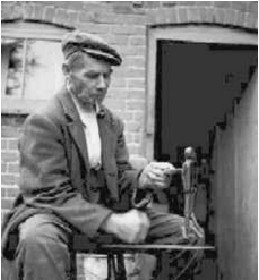 (photo courtesy of EFDSS)
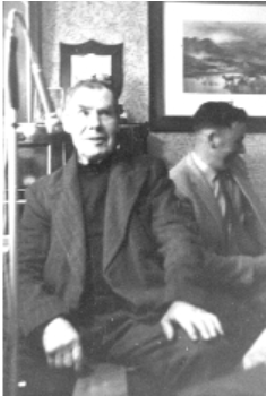 (photo courtesy of Reg Hall)
Harry was born in 1885 at Barton Turf, Norfolk and was a farm worker in the Barton and Catfield area all of his life. He was best known as a singer but he also played fiddle and melodeon. His grandfather stepdanced and his father, who sailed as a fisherman out of Yarmouth, played fiddle in local pubs, often being paid by the landlord to draw in the customers. Peter Kennedy and Alan Lomax recorded Harry’s playing in the 1950s and his repertoire included polkas, schottisches, waltzes and hornpipes. The recordings of his meldoeon playing were made three years before his death in 1971.
Harry Cox can be heard on: VTDC11CD
George Craske (Norfolk)
George lived most of his live in Sustead, Norfolk. George learned to play melodeon from his father who was said to have several unusual tunes. When these recording were made he no longer played at home, but still kept a melodeon in the shed on his allotment and another at his friend Frank Ward’s house in the village. Frank was a good stepdancer and he and George would bike to pubs like Erpingham King’s Head and Alby Horseshoes or sometimes to Cromer. He played in village halls in his locality for dancing, usually along with a drummer, and had wide range of polkas, waltzes and barn dance tunes. He played the ‘Keel Row’ for a dance involving a poker or a rope laid flat on the floor and had jigs for the Long Dance and a score of hornpipes for stepdancing.
George Craske can be heard on: VTDC11CD
Bob Cross (Gloucestershire)
A retired business man from Gloucestershire hardly fitted the perceived stereotype of the country singer - modern house, the latest expensive car. But, as a young man, Bob had learnt a number of songs, including a version of an ancient song that Cecil Sharp called 'Balaam and Egg', and which Bob called 'Green Lived Upon the Green'. As well as singing, he was also adept on the electronic keyboard, although I never heard Bob sing and play at the same time. (Mike Yates)
Bob Cross can be heard on: VTC4CD
Dolly Curtis (Suffolk)
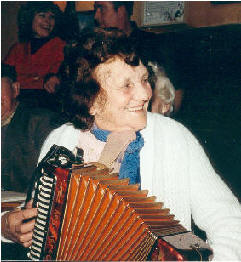 (photo: John Howson)
Dolly was the queen of Suffolk melodeon players with a very rhythmic style and an usual repertoire of tunes.. Dolly was discovered by Keith Summers during his researches in 1977 at Owls Green, Dennington, where her father used to keep the Bell Inn. It was there, as a young girl, that she heard the regular Saturday night music in the bar. The sources of her tunes were such notables as blind melodeon player Walter Read, and the Seaman family. Often added drive was provided by the pounding piano accompaniment of Brian Felgate who played regular engagements with her in various pubs all over the county.
Dolly Curtis can be heard on: VT130CD VT154CD & VTDC11CD
Charlie Cutmore (Essex)
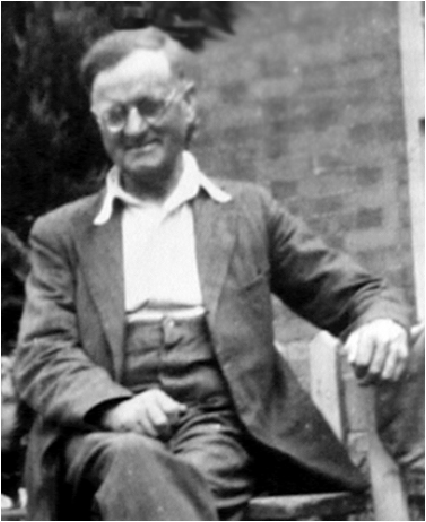 (photo courtesy of Neil Lanham)
Charlie kept The Plough at Belchamp St Paul, Essex and learned the tune on this CD from his father, who was a step-dancer who had a square board with a cross in the centre and he would cross his feet over in various patterns while stepping. Like Monty Chapman, Charlie was a valued entertainer at local concerts.
Charlie Cutmore can be heard on: VTDC11CD
Dartmoor Pixie Band (Devon)
 (photo: John Howson)
Bob Cann led his own country dance band for many years in the 1950 and in the 1960s it became known as the 'Dartmoor Pixies' with an early line-up of melodoen, mouthorgan, drums and banjo doubling on Hawaiian guitar. A couple of decades later Bob was joined by his grandson Mark (Bazeley) on concertina. The line-up seen hear is Kath Mortimer (accordion), Bill Murch (mouthorgan), Bob (melodeon), Cyril May (drums), Mark (concertina) and Rob Murch (banjo). Rob was actually taught by the Pixies original banjo player Tom Barriball. (John Howson)
The Dartmoor Pixie Band can be heard on: VTC1CD & VT113CDR
Bob Davies
(Norfolk)
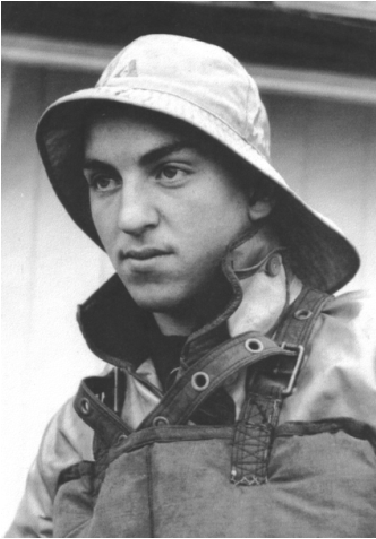 (photo courtesy of Richard Daives)
Bob was born in Cromer, Norfolk and lived there all his life. He was a fisherman and a member of the life boat crew in the 1940s when the coxwain was the famous Henry Blogg. He was taught to play melodeon by his uncle Jack and his cousin Taffy Thompson also played. Bob regularly played for the stepdancing which was a popular pastime with the Cromer fishermen in the Albion pub and the Lion and Bath Hotels in Cromer.
Bob Davis can be heard on: VTC5CD & VTDC11CD
Harry De Caux (Essex)
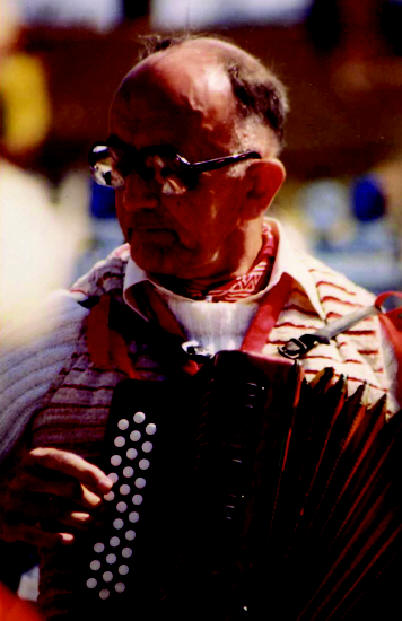 (photo: Simon Ritchie)
Harry was born around 1910 in Norfolk and he learned to play melodeon from his
mother when he was seven years old. Unlike many of the players in collection he
player far and wide and became involved in the International Dance Scene in
London and played at the Albert Hall in the 1920s. He moved to the Thaxted
(Essex) area in 1960 and played for morris dancing as well as social dancing,
when he would call the dances while playing. Harry also played in the pubs in
the town, particularly for the carol singing. He played a Hohner Corona III
melodeon which was claimed to be the first to come into Britain in the 1950s.
Harry De Caux can be heard on: VTDC11CD
Johnny Doughty
(Sussex)
 (photo: Doc Rowe)
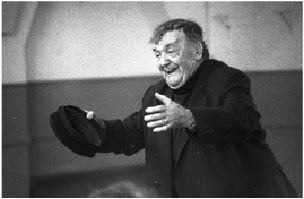
Johnny was born in Brighton, Sussex, in 1903, where he was brought up by his
grandmother. Most of his early life was spent on the beach, rather than at
school, where he helped out on the cockle and whelk stalls before he was strong
enough to help the fishermen unload their catches. Johnny felt an affinity with
the older sailors who spent their time net-mending at the St. Margaret's Net
Arch, close to the Palace Pier. Here he learnt navigation rhymes and the
rudiments of sailing, as well as many of the songs that he was to sing for the rest of his life.
Johnny left school when he was
thirteen and began herring fishing until he joined the Royal Navy in 1919.
Leaving the Navy, he was forced to spend six years working in the Portslade
gashouse - there being little work available at sea - until he had saved up
enough to buy his first boat, the 'Lady Ethel'. Johnny had a succession of boats
which he used for fishing in winter and for taking holiday trippers around the
bay in summer.
After the Second World War, Johnny
was asked to take a boat to Rye Harbour and, liking the place, he stayed and
made Rye his home. There he fished from his two boats, the 'Ocean Reaper 'and the
'Helen Mary', until he was no longer able to work. He did, however, continue to
make shrimp nets and he even built a small smokery at the back of his house
where he continued to smoke all manner of fish.
During the last few years of his life
Johnny was discovered by the folk revival and, having made a solo album for
Topic Records, was invited to any number of festivals throughout the country,
where he became something of a celebrity. (Mike Yates)
Johnny Doughty can be heard on: VTC1CD VTC5CD VTC6CD & VTC7CD
Lucy Farr (Co. Galway, Ireland)
 (photo courtesy of
Rambling House)
(photo courtesy of
Rambling House)
 (photo courtesy of Reg Hall)
(Lucy Farr plays a session with Joe Whelan)
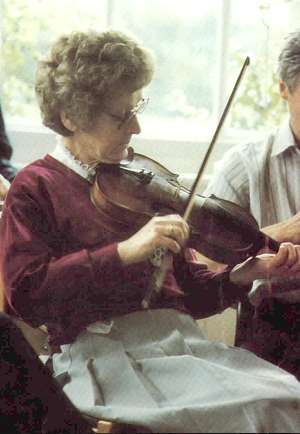
Lucy Farr was born in Ballinakill, County Galway and it was there she took up the fiddle. Between the mid-1930s, when she left home, and the early 1950s she stopped playing due to the demands of bringing up a family and working as a nurse. Then with the encouragement of her husband she re-discovered her musical interests and subsequently, figured prominently in London Irish music circles from the 1960s on. She was thought by many to be one of the inspirational music to come out of these times. (John Howson)
Lucy Farr can be heard on VTC1CD VTC10CD & VT123CDR
Liam Farrell (Co.Tyrone)
 (photo: John Howson)
 (photo courtesy of Reg Hall)
(Liam with the Raymond Roland Quartet)
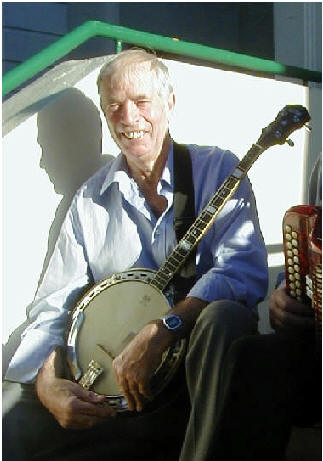
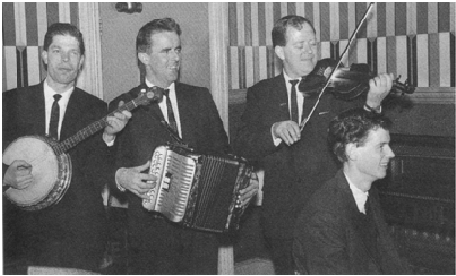
A complete account of Liam Farrell's musical activities would cover just about every social aspect of Irish traditional music-making, not only in London but in Ireland and America, too. It would be no exaggeration to say he has known and played with pretty well every musician of note during the 1960s, seventies and eighties, and perhaps just as importantly, everybody has known him and held his music in high regard. Set against a life of hard physical work on the buildings and in civil engineering, while priding himself that he has never failed to turn up for work in the morning, he has always found time for the informal session, a singsong with his work mates, a wedding here, a tune with a visiting musician there. Always ready to appreciate and praise other musicians to their face and behind their back, he has great tales and he knows how to tell 'em. He has hardly ever missed the annual Fleadh Ceoil in Ireland and, like Joe Whelan, he has kept up with what's going on in the music through Irish radio and television, the latest cassettes and CDs and generally keeping his ear to the ground. Concert hall tours of Ireland and America with Comhaltas Ceoltóirí Éireann presented opportunities for him to associate with the top musicians in New York and Boston and so on, and, though there wasn't any money in it, the after-hours craic was wonderful. There were invitations up north to play with the Liverpool Ceili Band and the fiddle player Jimmy Power chose him as his partner for his trip to Australia. Back in the 1970s, Liam was part of Le Cheili, a group of powerhouse musicians including Danny Meehan on the fiddle, P. J. Crotty on the flute, and the accordeon player, Raymond Roland. They made a couple of long-playing records, and Liam made other records with Bobby Casey and Vincent Griffin. It is good to have their artistry saved on vinyl, but it was all transitory; there's a great time to be had today and there's another session tomorrow.
Liam Farrell can be heard on: VT141CD
Hockey Feltwell (Norfolk)
 (photo
courtesy of Keith Summers)
(photo
courtesy of Keith Summers)
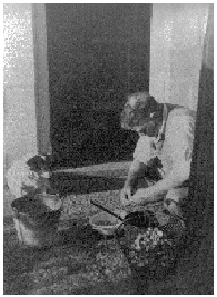
Arthur ‘Hockey’ Feltwell, was born in the Fens near Southery, Norfolk and later
moved into the town. After leaving school at ten he worked first as a horseman
with his father, then with steam traction engines, but for most of his life he
was a lorry driver.
He learned songs from his father and
other horsemen, and his five brothers sang and his eldest brother, Piper, also
played the melodeon. He sang, often at darts matches, in all seven of the pubs
in Southery but the Nag's Headwas his pub. It was the gathering place for
singers in the town and Hockey was usually the leader. He was a great singer,
but would change key during choruses! Sam Steele thought this was to confuse the
other singers, and so remain the loudest. It was in the Nag’s Head that the
recordings on this CD were made. Hockey also once sang on the radio from the BBC
studio in Norwich, but there is no record of when this happened.
Hockey
Feltwell can be heard on:
VT150CD.
Septimus Fawcett (Teesdale)
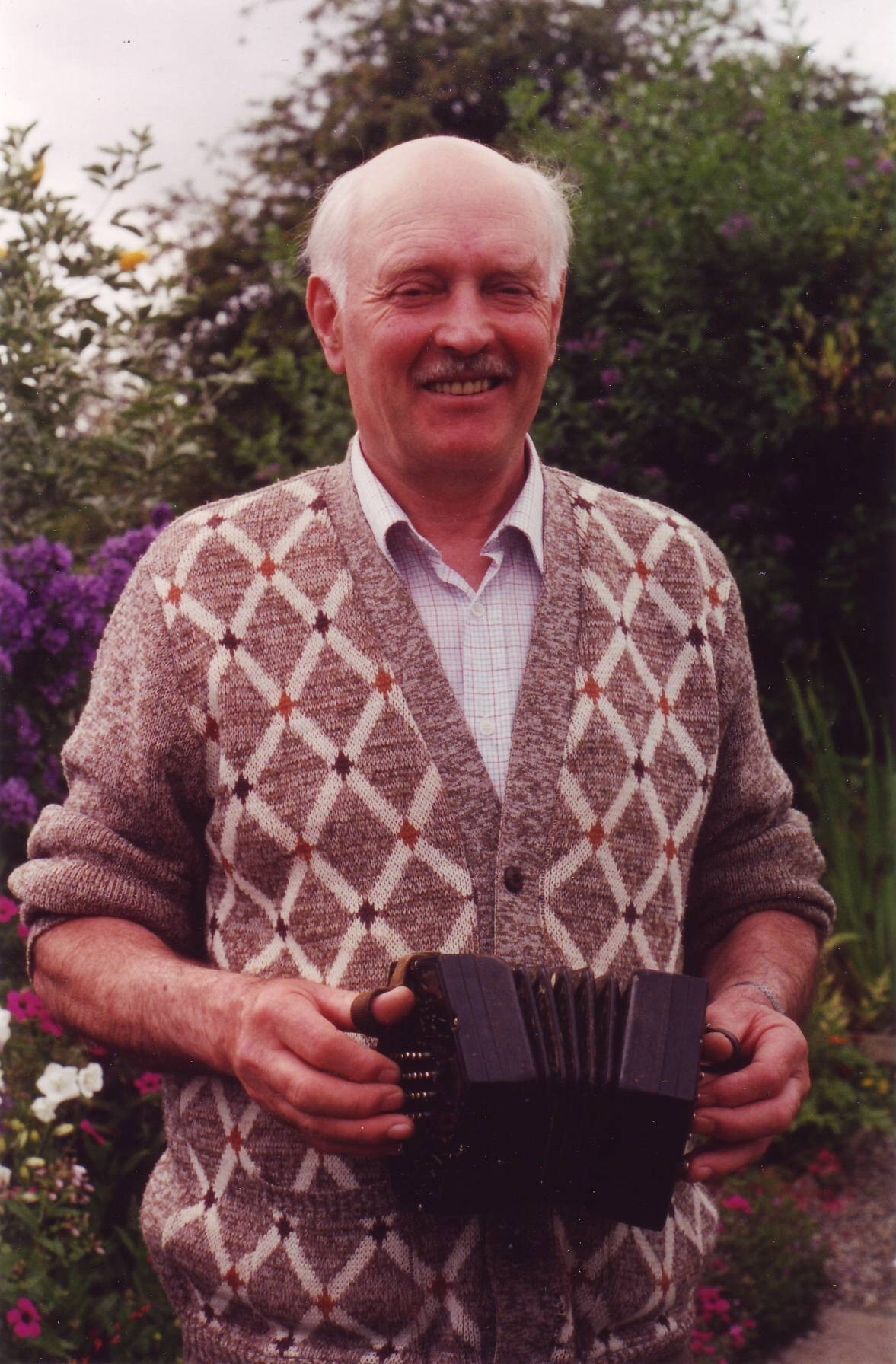
Septimus Fawcett was born in 1928 at West Birk Hatt Farm, Balersdale, Co. Durham. His grandfather had moved there from Swaledale. Septimus was the seventh of eight surviving children and his grandfather and father (Simon, known as Sam) played the English concertina. They had a family band which played for dancing and included his brother Dick who still plays piano accordion around the Dales. Their grandmother used to stepdance and she taught one of their uncles who stepped in fell boots. Sam was recorded by Peter Kennedy in 1953 and the family are mentioned in the 1973 book 'Hannah' about the isolated life of Hannah Hauxwell. When Septimus started playing, his main source of tunes was his father’s repertoire and several of these tunes are now rarely heard elsewhere. Now in his eighties, he still plays in his local pubs.
Septimus Fawcett can be heard on: VTC10CD
Cecil Fisk (Suffolk)
Cecil was born in 1920 in Bedingfield, where his
family ran a building firm. When the Second World War broke out he was not
called up, as building was a reserved trade, but in 1939, he volunteered aged
19, for military service. His army career was an eventful one which included
travel to Nigeria and Sierra Leone, seeing action in Egypt. While in Libya he
was captured and spent 2 years in an Italian prisoner-of-war camp before he and
a friend escaped, crossing the Alps into Switzerland. The whole remarkable story
can be found on
www.bbc.co.uk/ww2peopleswar.
In 1945 Cecil married his
childhood sweetheart, May, while he was stationed in Aldershot. When they
returned home they lived for many years in a cottage on Southolt Green before
moving to a council house in Worlingworth.
Locally, Cecil was best known
for playing the drums which accounts for his strict timing with a dancing doll.
He mostly played in Southolt Plough with piano player Eddie Stevenson, but also
played in Brundish Crown, Dennington Bell and Worlingworth Swan with other local
musicians.
Cecil Fisk can be heard on: VT154CD
Robert Forrester (Cumberland)
 (photo courtesy of Pam Forrester)
Born in 1913 near Carlisle, Bob lived in the city and worked as a commercial artist for the Metal Box Company. He painted and sketched all his life, exhibiting in London as well as in Cumbria. His best known works locally are his two large, dramatic mountain murals, one showing 'Ancient Britons' at Castlerigg stone circle and the other a railway scene at Carlisle's Citadel Station, which are both exhibited prominently at Tullie House Museum in Carlisle. His songs and tunes came to him from his grandfather Joe, a well-known fiddler in the Bewcastle area at the end of the 19th century. Joe apparently enlivened the proceedings at many a wedding, christening and kern supper in that remote part of Cumberland. Robert Forrester died in 1988. (Sue Allen)
Robert Forrester can be heard on: VT142CDR
George Fradley (Derbyshire)
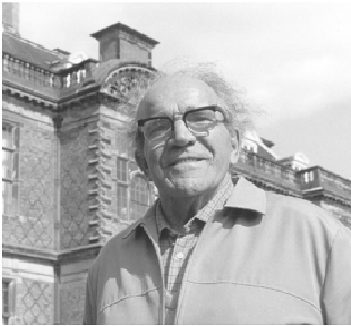 (photo: Mike Yates)
George was born at Woodstock Farm in the village of Goldenhill, near Kidsgrove, Staffordshire, in 1910. When he was seventeen the family settled at Cubley Carr Farm, near Sudbury, in Derbyshire. Just about all of his family were musical and during the 1920's and '30's they had their own concert party, which performed throughout the neighbourhood. George learnt 'The Two Sisters' from his Aunt Bessie, who would sing it while milking the cows, and 'Last New Year's Eve' from his father. George first came to the attention of the folk revival through Roger Watson and John Tams and their group Muckram Wakes, who had performed at Sudbury Hall in 1972. In 1978 he teamed up with Tufty Swift and appeared at several Festivals before his death in 1985. (Mike Yates)
George Fradley can be heard on: VT114CDR VTC1CD VTC4CD VTC6CD VTC7CD VTC7CD & VT114CDR
Eli Frankham (Norfolk)
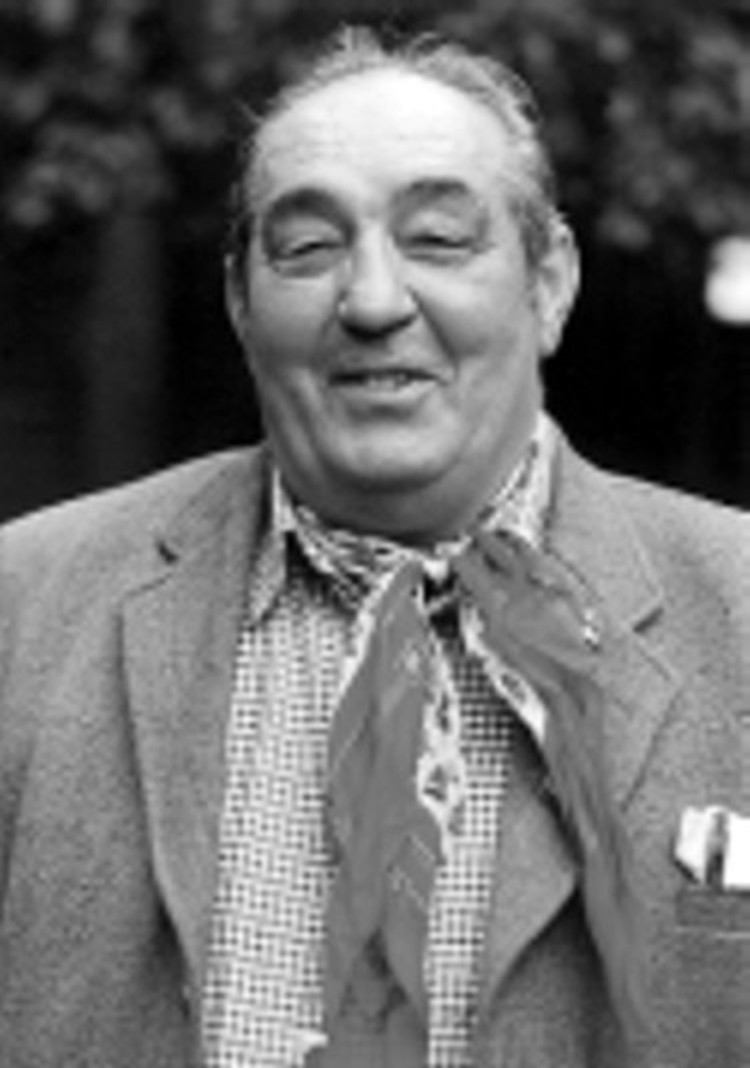
Eli Frankham was born in 1928 in a horse-drawn vardo
at Chanctonbury Ring in Sussex. For much of his young life, he travelled in
southern England, until his family bought land in the Hampshire village of
Horndean, which is close to Petersfield where in 1908 a Mr E. Frankham sang the
'The Ups and Downs' to folk song collector George Gardiner (Marrowbones p.97
EFDSS 1965). Eli became a professional boxer, starting his career in fairground
boxing booths and he
kept and traded horses all his life. The family moved to the Wisbech area of
Norfolk and Eli founded the National Romani Rights Association. He became known
to Travellers across Britain and Europe, being a gifted linguist with a fine
command of the Romany language. Eli enjoyed singing and telling stories and
collected and wrote poems about Romany life. He died in 2000 aged seventy two
and an obituary appeared in the Guardian.
Eli Frankham can be heard on: VTC10CD
Hubert Freeman
(Suffolk)
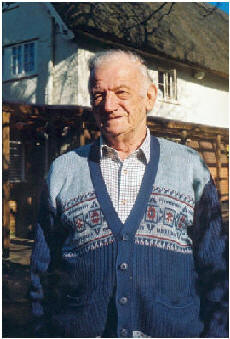 (photo: John Howson)
Hubert was born in 1925 at Ashfield in mid-Suffolk and moved to Monk Soham at
nine. At twenty-three he married and moved to Bedingfield where he worked as a
farm manager until his retirement in 1990's.
He comes from a family of singers:
his father and mother both sang, as did his uncle 'Hack' who used to be landlord
of Bedfield Dog. Hubert's father Jim sang in many pubs in the area and one of
his favourite songs was 'I came home one night' (Seven Drunken nights'). When I
asked Hubert how he started singing he told me, "Well I used to sing at
different parties and that, but I never sung in the pubs. The only time I used
to sing in the pubs - well I'll tell you what happened. I knew several little
songs and when I was about fifteen or sixteen I used to go to Monk Soham Oak on
a Saturday night. I used to have half a pint, and I was only a little old short
boy, and they'd say, 'Stand old Hubert on the table.” (John Howson)
Hubert Freeman can be heard on: VTC3CD & VTC4CD
Louie Fuller
(Sussex)
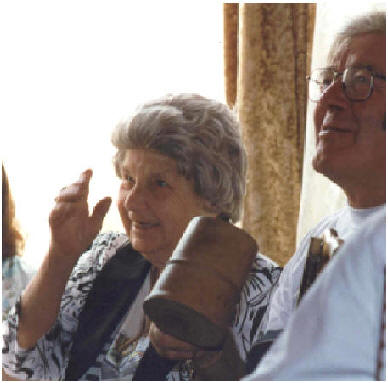 (photo: Maggie Hunt)
(Louie in the Volunteer Inn Sidmouth with George Withers)
Louie was born in Woolwich in 1915 and came south to Copthorne after being bombed out during the second world war. She is a singer of great spirit and style and her enthusiastic, smiling delivery of her songs won her admirers wherever she chose to perform them. As Louey Saunders, she was collected from in 1960 by Ken Stubbs and her version of 'Hopping Down in Kent' enjoyed enormous popularity. She remembed her yearly visits as a youngster to the hop-fields as great place for singing and story-telling as well as family parties and other celebrations. She learned her songs from both her parents and always looked for any opportunities to share them with a range of audiences, from between the bingo games at her local old people's club to pub sessions and folk clubs and festivals. (John Howson)
Louie Fuller can be heard on: VT131CD
Charlie Giddings
(Cambridgeshire)

 (photos courtesy of Viginia Smart)
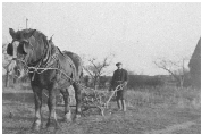

Charlie Giddings was born in Scaldgate near Whittlesey, Cambridgeshire in 1875.
He moved to Fen Drayton in the 1930s where he became horseman on a land
settlement. This was a scheme that enabled unemployed people, particularly
miners from the North and Wales, to have three acres of land to work on. There
were 54 holdings in Fen Drayton.
Charlie sang mainly in the village
local, The Three Tuns. He had his own seat which nobody else was allowed to sit
in. He would visit the pub most nights for a couple of beers and that was where
he did his singing. He did sing at home, but his wife was very religious and not
keen on drink and would say ‘Drink comes in and wit goes out!’
He was a real ‘fen tiger’ and knew all the
well known fen skaters like Turkey Smart, Fish Smart and George See. During the
winter, water was let out of the dykes to flood the fields, leaving the silt on
the ground to act as a fertiliser. When the water-logged fields froze over, Fen
men (known as ‘Fen Tigers’) put on their special skates, and held speed skating
competitions. For most of the year, in order to visit Peterborough they would
have to walk, but in the winter, when the dykes were frozen, Charlie would skate
from Whittlesey to Peterborough. They would also make the trip competitive with
a prize of a hundredweight of coal or a bag of oranges: an exotic prize in those
days! Charlie died in 1964.
Charlie Giddings can be heard on: VT150CD
Fred Ginger (Suffolk)
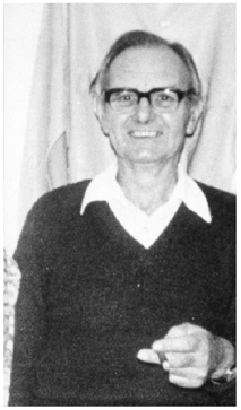 (photo
courtesy of Brian Ginger)
(photo
courtesy of Brian Ginger)
Fred maternal grandfather Mr Rous kept the Eel’s Foot in Eastbridge from 1906 to 1922, and Fred’s mother met his father when she was working in service in London. His mother and father kept the pub for seven years before the Morlings took it over. Fred was born in 1910 and married one of Velvet Brightwell’s daughters, Dora, and lived in a cottage in Eastbridge. He worked for the river board and then on the railway at Leiston as a plate-layer. He didn’t seem to have many songs but his star turn, 'The Old Sow', was the only song broadcast by the BBC from the 'Eel's Foot' in both 1939 and 1947. Fred died in 1984. (John Howson)
Fred Ginger can be heard on: VT140CD
Tom Goddard (Suffolk)
 (photo courtesy of John Goddard)
Tom, who lived on the common at Eastbridge, was a poacher cum gamekeeper whose last job before retirement was as a rat catcher for the council. He told Keith Summers that he had learned some songs in Lowestoft when he went fishing. “I like a good fishing song!” Alec Bloomfield learned 'Buttercup Joe' from him, and mentioned that he also sang an American song called 'Swinging in the Lane'. Jumbo Brightwell remembered him singing 'Three Hebrews' and 'Australia'. Tom died in 1977 at the age of 75. (John Howson)
Tom Goddard can be heard on: VT140CD
Archer Goode (Gloucestershire)
Although resident in Cheltenham for the last forty-odd years of his life, Archer Goode - 'Goode by name and nature', according to his friends - had been born in Abergavenny and was a farm-worker for most of his life. He had loved to work with horses and had many fond memories of his days in rural Wales. During the 1930's Sam Bennett, the well-known Morris Dancer from Ilmington in Warwickshire, would visit Abergavenny. Archer became friendly with Sam and soon picked up a number of Sam's songs, including 'Jan's Courtship'. (Mike Yates)
Archer Goode can be heard on: VTC4CD
Watty Graham
(Cumberland)
Wat Graham was a native of Longtown in the north of Cumberland, almost on the Scottish border. The border country is full of Grahams, and when recorded Watty tells about the clan and plays the 'Cumberland Reel' on his melodeon. (Sue Allen)
Watty Graham can be heard on:
VT142CDR
George Green (Cambridgeshire)
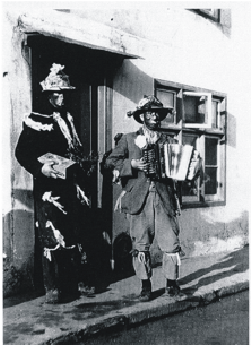 (photo courtesy of W. H. Palmer)
George
Green was born in 1895 and died in 1975 and lived in Little Downham,
Cambridgeshire.
George Frampton’s booklet ‘Necessary
to Keep up the Day’ tells us that George Green never married and worked as a
farm labourer. He also trapped linnets and finches, which were sent live to
London, probably for sale as singing birds. He and his brother were also engaged
in ‘trammelling’ larks at night-time, by sweeping across the fields with a net
held between two poles, a light being used to frighten the birds into flight and
into the nets. The light would also disturb hares, and needless to say, these
were bagged as an added bonus and also dispatched to London. During the Great
War he was employed to dig acres of fruit gardens for local grower "Daddy" A.W.
Chambers.
He was the melodeon player for the
Little Downham Molly Dancers and was photographed with them in 1932. Molly
dancing was usually conducted on Plough Monday (the first Monday after Epiphany)
and was at one time widespread in the Fens. It was usually danced by men but
with of the team dressed as a woman who was known as the molly. The
other dancers wore ordinary working clothes which were decorated with ribbons,
as the photograph shows. The dances were quite simple compared to Cotswold
morris dances and the music was what you would expect for country dancing.
Watty Graham can be heard on: VT150CD & VTDC11CD
Harry Green (Essex)


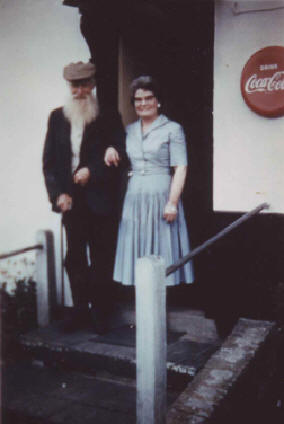 (photos
courtesy of Chrissie Andrews)
(photos
courtesy of Chrissie Andrews)
Harry Green was born in 1874 and lived in Essex all his life. In 1899 he moved into the farm cottage in Tilty where these recordings were made, and it was there that he died. He and his wife married on the same day as one of his sisters and each couple had nine children. His last surviving daughter Chrissie looked after him for 32 years after her mother died in 1937. Chrissie told me that in his younger days Harry used to travel to Chingford with his father, to mow the grass. He used to say that he'd been to 'hay country'. After that he worked on a farm before working for the council for forty years. He would trim the sides of the road and clear out the gulleys and ditches with a set of rods and the gang he worked with were known as 'Lengthmen'. He would have a sing-song with his old friends mostly in 'The Rising Sun' at Duton Hill and if was there that he learned The Merchant's Daughter and the Highwayman from an old boy called Bill Patient. Harry rarely sang at home, he was a pub singer and Chrissie remembered that the two old mates he used to go out with were 'Hunch' Legerton and George Perry. Occasionally there would be an accordion player and somebody would get up and stepdance. Then there was 'Buster' Brown who used to sing lots of songs particularly when there was a coach outing. When Fred Hamer visited to record his songs, Harry would limit him to five songs each visit almost as if he was rationing them out so that Hamer would return. Harry told him that The Nutting Girl came from old 'Singing Jimmy' around sixty to seventy years ago (in 1967), but he wouldn't sing it if there was a lot of women about, particularly as he would often sing the last line as: 'Perhaps he'll make your belly swell and break your apron strings.' Harry Green was obviously a real old character, and you can almost see the sparkle in his eye when he recites The Pear Tree or the epilogue to Down in the Fields and Ladies Won't you Marry. He is still fondly remembered in the Great Dunmow area and it is good to know that some of his songs are being sung once more.
Harry Green can be heard on: VT135CD
Glynn Griffiths (Suffolk)
 (photo:
John Howson)
(photo:
John Howson)
Master of the chromatic mouthorgan Glynn Griffiths was originally from Wales
before settling in Cockfield Green, Mid-Suffolk. He played in Thorpe Morieux
Bull and Felsham Six Bells, where on a Saturday night he would meet up with Tom
Williams as well as lots of local singers including Billy Goddard, George Gooch
and Jack Smith. The Bells was always a lively pub and it is, of course, where
the title of ‘Many a Good Horseman’ comes from.
Glynn Griffiths
can be
heard on: VTDC8CD
Charlie Griggs (Suffolk)
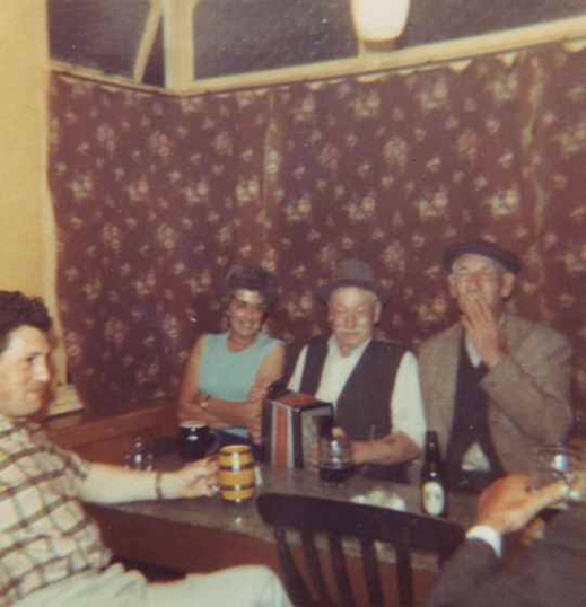 (photo:
courtsey of the landlord of the Unicorn)
(photo:
courtsey of the landlord of the Unicorn)
The best known four stop one-row melodeon player around the pubs of Stowmarket
in Mid-Suffolk was Charlie Griggs. He worked for much of his life as a farm
labourer and played in just about every pub in the town, although his favourites
were the Greyhound, the Walnut Tree and the Unicorn. He started playing at home
at an early age for sing-songs with his
brother Frank, who played violin. Their father, Tom Griggs, stepdanced and
played melodeon and Charlie apparently learned dance tunes such as jigs and
hornpipes from him. Charlie's daughter Mrs Miller, who gave me information about
him and provided the recordings, remembered that he'd be playing in the pub,
then he'd stop and play 'How Dry Am I?' and someone would get him a pint. He
died in 1975 when he was in his early eighties.
Charlie Griggs can be
heard on: VTDC8CD
Gordon Hall (Sussex)
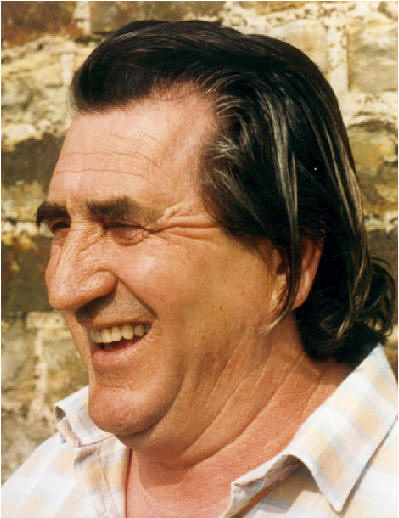 (photo: John Howson)
Gordon Hall, the son of Mabs Hall, was born in south London in 1932. Seven years later the family moved to Leeds, then Swansea, before settling in Horsham in Sussex, where coincidentally, their first home, (34, The Bishopric) had once been home to Henry Burstow, one of the great Sussex folksingers. Old Henry would, I'm sure, have been smiling in his grave had he known that another singing family had taken over his old house. Gordon's love of singing was nurtured in Horsham and he picked up songs wherever he could. In 1984 Gordon and Mabs met Bob Copper, who encouraged them to sing in public. Sadly, Gordon died in the year 2000 and is missed by all who knew him. He was, as Bob Copper has said, "a one off...(who was) absolutely irreplaceable." (Mike Yates)
Gordon Hall can be heard on: VTC4CD VTC5CD VT131CD & VT115CD
Mabs Hall
(Sussex)
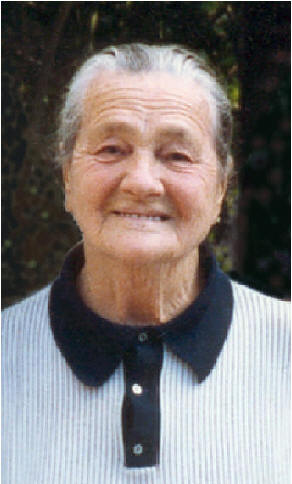 (photo courtesy of Mike Yates)
Mary
Josephine Hall (Mabs, as she was always known) was born on 12th October 1899 at
Cheal Cottage, Wivelsfield, West Sussex. Her earliest memory of singing in her
family was her mother, who sang snatches of hundreds of songs and her father,
who knew many long songs: the first songs she remembered them singing were
Cecilia and Come Write Me Down. Then there was her Uncle Dick, who played
mouthorgan and mandolin and Harry, her sister’s husband, who played accordeon.
Dick was not really an uncle but a lodger with her sister and Mabs first heard A
Sailor from Dover sung by him, and Harry would sing McCaffery. Another singer
she remembered was an early boyfriend of hers called Sam Starr who lived on a
farm at Ripe, near Lewes, East Sussex. When Mabs visited him he would sing
‘There was a country blade who loved a country maid’ usually in the barn while
cutting chaff.Mabs had a remarkable memory but reckoned that she had forgotten
more songs than she could remember. She spent her life singing, whether it was
at work, at home on her own or even walking down the street. She often remarked
that when she was younger if she heard a song once, she could sing it. Mabs died
on the 16th November 1992.
Mabs Hall can be heard on: VTC4CD VTC5CD & VT115CD
Reg Hall (London)
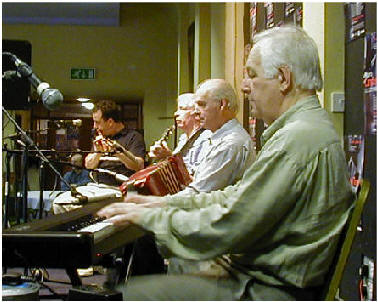 (photo: John Howson)
(Reg Hall playing piano with Joe Whelan, Liam Farrell, and James Carty)
 (photo: John Howson)
(Reg Hall -with sound restoration expert Charlie Crump)
Reg Hall has lived most of life with some sort of involvement in traditional music. He played melodeon with Sussex concertina player ScanTester and with other influential English traditional musicians in Norfolk like Walter and Daisy Bulwer and Billy Cooper. He plays fiddle for Bampton Traditional Morris Dancers and is a musician for the Blue 'Oss May Day dancers in Padstow Cornwall. In the 1950s he was at the core of the vibrant Irish music scene in London, becoming known as a rock steady piano player. He was the editor of the important Topic 'Voice of the People' series working closely with the sound restoration expert Charlie Crump who he knew through his other great interest in New Orleans Jazz. In recent years he has been a visiting research fellow at the University of Sussex from where he has now been awarded his doctorate. (John Howson)
Reg Hall can be heard on: VT141CD
Ray Hartland (Gloucestershire)
Mike Yates was taken to the village of Turley by Gwilym Davies to meet Ray Hartland: a true Gloucestershire character, he had a broad local accent and ran a dairy farm. He also made cider and the local delicacy ‘Plum Jerkin’. On a Saturday afternoon his friends, including local singers Roger Lewis and George Boucher would meet in his cider house and sing songs while sampling his wares in horn mugs. Ray had a repertoire of about twenty songs and he enjoyed writing parodies of songs. One of his best known was about fishing for elvers (eels). Ray died in the 1980s and the cider business continues but unfortunately the singing doesn’t! (John Howson)
Reg Hall can be heard on: VTC7CD
Charlie Hancy (Suffolk)
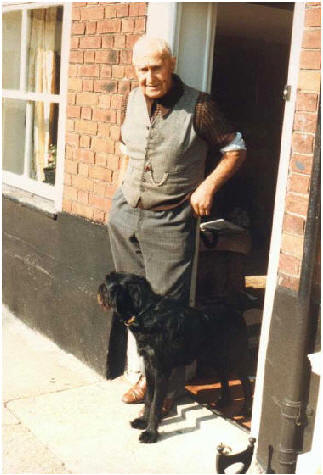 (photo: John Howson)
During a discussion about old singers in an Oulton Broad pub I was told that I
should pay a visit to Charlie Hancy in Broad Street, Bungay as he would sing me
some songs, and he certainly did. In fact within minutes of me entering his home
he was singing to me with that wonderful rich voice and immaculate pacing. Apart
from singing me some interesting and unusual songs he also
told me much about his life:
"I never did live anywhere else than
Bungay. I was born in Bungay in the next street from here in 1899. Well the
town's changed, like when I was going to school there was only about two
bicycles, old penny farthings. Then motorbikes came along. I knew the first
motor car in Bungay, old Doctor Ransome had it.
"My people were in the hay trade,
they did nothing else only in that trade. Well we supplied Norwich, Lowestoft,
Yarmouth or Southwold. Where ever we needed to go to. I've been to the barracks
in Norwich and all the brewers in Norwich. I used to drive a horse then, I'd
drive three. We'd sometimes leave at one o'clock in the morning. I used to sing
like hell in the morning. I was done seven times for being asleep in charge of
the horses. Bloody policemen would wait up for you, they'd wait in one of these
old cart sheds.
"I've been to just about every fair
in England after horses. That's where you used to hear old songs from the old
gypsy boys. Then there would be ploughing matches and afterwards they'd get up
and sing a song and someone else would get up and sing one. That is how it used
to be. There used to be one regular at St James' White Horse; all around the
villages, Rumburgh - they had drawing matches. There'd be prizes of money or a
spade or a fork and the old farmer would get his bloody field ploughed up for
nothing!
"In the pub opposite here they used
to tap dance on the tables. I remember one old boy would take a watch out of his
pocket and dance over it and never break it. They used to call him old 'Lively'
Hood. Then there was those old boys the Parravani, the Italian ice-cream people.
Their father first came about here in the thirties. He'd play accordion and go
from one pub to another. Then Walter Nobbs, he was real good on the accordeon.
He had an old squeeze box first, then a piano accordion."
Charlie Hancy can be heard on: VTC2CD VTC7CD & VTC3CD
Tony Harvey
(Suffolk)
 (photo: John Howson)
The Harvey family have lived and farmed in Tannington since the turn of the
century on what became one of the largest farms in the county. Tony has been
keen on singing all his life and he used to love to hear his grandfather sing to
him. In may ways he has been a song collector himself, but always in the belief
that songs are for singing. I have often heard him say of a song he's never
heard before, "Now there's a good song", and I'd know he would want the singer
to write the words out for him. If it had not been for Tony's enthusiasm I am
sure many of the songs sung locally would had been lost. Several of his local
pubs have been good for singing, like Brundish Crown, Dennington Bell and
Laxfield Low House, but the nights I will never forget were those he organised
at Framlingham Hare and Hounds in the days when the late Jimmy Finbow was
landlord. Well into his nineties, Jimmy would sit in his old chair by the fire
surveying a gathering of some of the finest local singers crammed into his tiny
bar.
Apart from singing, Tony's other
great love is for his horses: he has been the master of the local hunt, Easton
Harriers, and for many years has collected horse-drawn carriages, carts and
gypsy caravans, undertaking several charity drives in them to Appleby horse fair
and to the Derby at Epsom He has run a business providing horse-drawn outings
from Tannington Hall. Several local pubs would be visited and if you were lucky you
might have got a song or two from the driver! (John Howson)
Tony Harvey can be heard on: VTC2CD VTC3CD
Mary Ann Haynes
(Sussex)
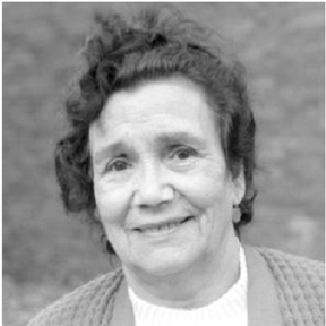 (photo: Mike Yates)
Mary Ann Haynes was born in a caravan behind the 'Coach and Horses' in Portsmouth, Hampshire, in 1903, the daughter of a horse-dealer. As a young girl she travelled throughout southern England with her family to fairs and markets, and as she told Mike Yates, "We used to go to the vinegar and pepper fair at Bristol, then to Chichester, Lewes, Canterbury and Oxford, then up to Appleby and back down to Yalding." Later she settled in Brighton, Sussex, where, following the premature death of her husband, she brought up a large family single-handed on her earnings as a flower-seller. Mike Yates recorded nearly a hundred old songs from her and, while precise details of where she learned and performed them is not known, it is almost certainly within the close-knit traveller community. (Reg Hall from the 'Voice of the People')
Marry Ann Haynes can be heard on: VTC1CD & VTC6CD
Len Heyward (Gloucestershire)
When Mike Yates visited Gloucestershire in 1975 he was taken by Gwilym Davies to meet and record Len Heyward who was then well into his eighties. Mike remembered that Len lived in a house which was in imminent danger of flooding from the rapidly swelling river Severn. Wassail was the only song that was recorded. (John Howson)
Len Heyward can be heard on: VTC6CD
Dick Hewitt (Norfolk)
 (photo: John Howson)
I first met Dick Hewitt at his home in Briston, near Melton Constable, after some trusty advice given to us by Anne Marie Hulme and Peter Clifton about whom we should visit on our first sortie into North Norfolk. Within minutes of entering Dick's house a tape was playing of his late father Albert Hewitt, a great melodeon player who had been recorded by the BBC in the 1950’s. Dick got the step-dance board out and away he went! He was probably the best East Anglian stepdancer I ever saw. (John Howson)
Dick
Hewitt can be heard on:
VTVS05/06
&
VT150CD
Another Gloucestershire singer introduced by Gwilym to Mike Yates was Ivor Hill of Bromsberrow Heath. The Hills were a singing family and they favoured local carols. They can be heard singing The Holly and the Ivy on another of Mike’s recordings, ‘The Birds Upon the Tree’ (MTCD333). The village of Bromsberrow Heath was also known for morris dancing and the Hill family certainly had associations with it. Sadly Ivor was killed on his bicycle just after these recordings were made. (Gwilym Davis & John Howson)
Ivor Hill can be heard on: VTC7CD
Frank Hinchliffe (Yorkshire)
 (photo Mike Yates)
Frank was born in 1923 at Fulwood, near Sheffield in south Yorkshire. He had a
large repertoire of songs and local carols. The songs came originally from his
family and his community. He was a quiet, introspective singer, his gentle voice
almost hiding his mastery of vocal story-telling. According to scholar Ian
Russell (who has written much about him) his singing had an appealing, almost
plaintive quality that reached out to his audience. This recording was made late
at night, after Frank had spent the day gathering hay, when he must have been
quite tired. Nevertheless, it does show a true a craftsman at work. He was, I
think, one of the finest singers that I have met. (Mike Yates)
Frank Hinchliffe can be heard on: VTC7CD
Mrs Howard
(Suffolk)
 (photo courtesy of Eileen Morling)
(Mrs Howard 2nd from the right)
Louisa’s father was a sailing fisherman from Thorpeness known as ‘Khedi’ Wilson,
who always wore a fisherman’s jersey and was said to tar his feet! He was a
renowned stepdancer and had two other daughters, Maud and Nora who could also
step, but that was mainly at weddings, not in the pub. The melodeon player who
plays for Louisa on the 'Eel's Foot' recording was not identified by the BBC but it couldn’t
be Jack Button as he had moved to Hampshire to live with his son in 1946. Louisa
Howard’s daughter, Flo (now Flo Ling) suggested that it was her father Ernie
Howard playing.
Louisa also sang and Peter Kennedy
recorded her in Thorpeness in 1956 singing "The House of Ill Fame" and "Scarboro".
On that occasion she was accompanied by Ernie on melodeon. She died in 1972 aged
79. (John Howson)
Mrs Howard can be heard on: VT140CD
Ray Hubbard (Norfolk)
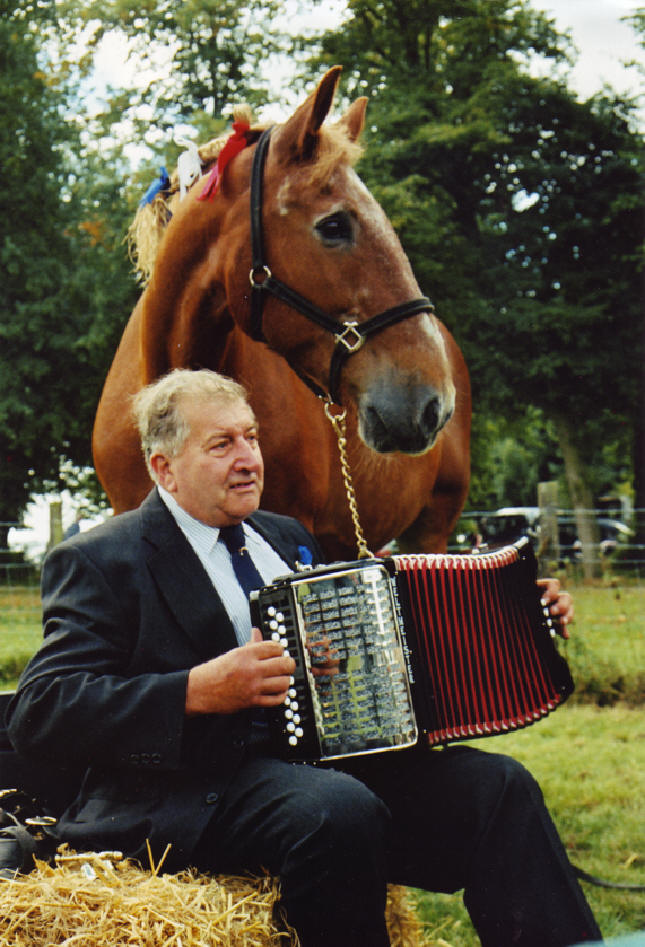 (photo courtesy of Ray Hubbard)
Ray Hubbard was born in 1933 at Langmere, South Norfolk, a true countryman who has spent his life playing music, singing songs and entertaining across East Anglia. Ray remembers lots of music at home, “Well it was in the days before television.” His father played the accordeon as did his mother. They also both played the mouthorgan, and his father could play the mandolin. “So it was Saturday nights, not so much during the week. It was get the musics out and have a sing-song. I suppose I wanted to play from just about when I was born.”
Some of Ray’s earliest musical memories were when he visited his grandfather and grandmother on his mother’s side. His grandfather played the concertina and was also a steel quoits player and would often take his concertina with him for an after match sing-song, particularly to Oakley Green Man and Billingford Horseshoes where the quoits bed was just behind the pub next to the windmill (see cover photo). Ray remembers being taken as a youngster by his mother to see his grandfather play quoits. His grandmother played the mouthorgan and he recalls that it was kept in the knife and fork drawer underneath the table. It was always, “Come on Granny, get the mouthorgan” and she did, and that was that”. His grandfather took more persuading however, and wouldn’t get up and get his concertina from the cupboard behind his chair - grandmother would have to get it out and then he would play it.
Ray’s grandparents on his father’s side weren’t musical as far as he was aware but his uncles were, and so there was always an accordion there standing on the top of the chest of drawers alongside the gramophone and it was that accordion that his father learned on, alongside his brothers. Ray remembers that they would go up to their house and his uncle would play the accordion and then he would put a record on the gramophone and would dance Ray around the table. His grandmother, who was getting old then, would say, “Now you can cut that out now George, he don’t want that, he’ll hurt himself.” But he carried on and would say, “You’re all right, ain’t you boy?”
Ray Hubbard can be heard on: VT155CDR
Stan Hugill
(Merseyside)
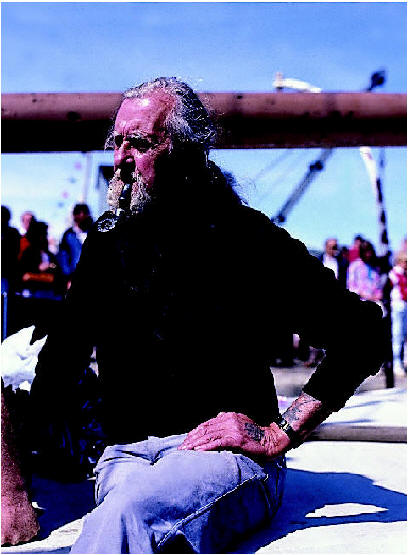 (photo: David Williams and Beryl Davis)
Stan Hugill was born in 1906 at Hoylake in the Wirral, where his melodeon
playing father was coastguard. Stan inherited from his seafaring grandfather the
texts of the shanties he had noted down, forming the starting point of the
collection that Stan subsequently made.
His first ship, a steamer, was
wrecked, whereupon Stan vowed to transfer to sail! His voyage on the 'Gustav'
made him a Cape Horner for the first time, and a passage on the Liverpool
registered 'Garthpool' in 1929 became his first as a shantyman, the man for the
job being the one confident enough to do it and able to gain the respect of his
shipmates. The 'Garthpool' was a
very leaky ship and Stan's rendition at the pumps of 'Fire down below', shortly
before the ship was wrecked, gave him the honour of being the last man to sing a
shanty in action on a British vessel.
Stan's formal education ceased at 14, though he never stopped learning, teaching himself at least nine languages and writing or compiling numerous books and articles, including 'Shanties of the Seven Seas', the shantyman's bible. (Tony Molynieux)
Stan Hugill can be heard on: VTC5CDR & VT127CDR
Len Irving (Cumberland)
Len Irving, who sings 'The Lish Young Buy-a-Broom' on VT142CD 'Pass the Jug
Round', was born at Wreay in 1889, and
was station master there for 12 years. (Sue Allen)
Len Irving can be heard on: VT142CDR
Fred Jordan
(Shropshire)
 (photo: Doc Rowe)
Fred Jordan was born on 5th January, 1922 in Ludlow, Shropshire. He was one of England's finest singers of traditional songs, and his ability to tell a story through song was second to none. He first came to the attention of the folk revival in 1952 when only thirty years of age, and over the following fifty years he entertained audiences from his native Corve Dale in Shropshire to concert halls throughout the country. He learnt his songs from his family, from his work-mates and from travellers, and he sang them in the pub on a Saturday night. Then he was invited to sing in folk clubs, concerts and festivals, and his repertoire grew as he heard more songs and singers at these events. His occupation, his life-style and his songs were of the nineteenth century, yet his singing context became the twentieth-century folk revival. (John Howson)
Fred Jordan can be heard on: VTD148CD
John Kennedy (Co. Antrim)
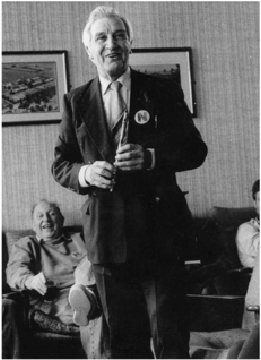 (Photo: Dave Humphreys)
John Kennedy was born in the townland of the Craigs in Co. Antrim, Northern Ireland on 31st August 1928. His mother was a very fine singer as was his grandmother and it was from her that he learned his first two traditional songs at the age of eight. In the area around the small town of Cullybackey the rivers tumbles down the hill side into near by Lough Neagh providing power for the flax and other mills. The people who lived there were obsessed with music and song and it continued in both the home and in the factory. Not only does John have a wide and varied repertoire of songs he is also a masterful fife and whistle player and many of his tunes are from the strong tradition of Orange marching bands. (John Howson)
John Kennedy can be heard on: VT137CD
Jimmy Knights (Suffolk)
 (photo: Mike Yates)
Jimmy Knights was born in 1880 in the same house in Debach where his father and grandfather had been born. When the First World War erupted he spent four years in France. Returning unscathed, he travelled the country particularly Scotland and Yorkshire, as a stallion leader, a job he did for twenty years. Keith described his first meeting with him in 1975: ‘Holy Jim’ is Suffolk's answer to Charlie Wills - a tiny, red-faced man with a white moustache and trilby hat, Jimmy, well into his 90s, still enjoys his beer at his favourite pub, still has an eye for the girls, and can still give out with some great songs in a beautiful clear voice. I first met Jim on a bitterly cold day, thumbing back home. I noticed this little old chap walking down the road followed by his pet duck, and we soon got chatting. I told him I had just recorded a singer in a nearby village. "Cor blast" he said "I've forgotten more songs than he knows". At this point my first lift in two hours arrived and I had to go. Luckily the driver knew Jimmy and told me where I could meet him, which I shortly did. Jimmy played a banjo which he had bought in Hull during his travels. He had learned to play fiddle a bit as a boy and then found he could knock out local tunes he knew on the banjo like Jack's the Lad, Devil and the Tailors, but it was his songs he was best known for. He sang in many of his local pubs like Bredfield Castle, Clopton Crown, Charsfield Horseshoes and Hasketon Turkey (Turk's Head) and said that he had first visited a pub when he was ten. He met and heard a lot of the older singers and it was from them he gathered his large and unusual repertoire of songs; singers like Charlie Stiff, Charlie Chaplain, Harry Finch, Lom Archer, Jim Baldry who had been recorded singing Radcliff Highway by the BBC in 1956. When asked about songs like The Dark-eyed Sailor and The Foggy Dew, he said, “Well, every bugger used to sing those round here - I used to, but I prefer to sing something different - something people haven't heard before.”
Jimmy Knights can be heard on:
VT154CD
Roy Last
(Suffolk)
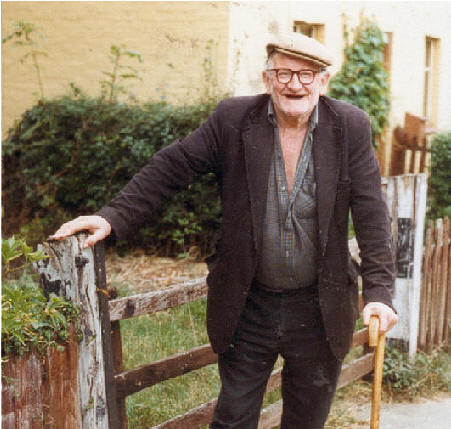 (photo: John Howson)
When Roy was recorded he rarely sang out in company, but in earlier days he was
a regular at Stonham Brewer’s Arms (known
locally as the Tap) and the Green Man at Mendlesham Green. His grand-father was
a singer and Roy learned 'William Rufus' from him:
Roy’s father, Fred used to sing every Saturday night in Rickinghall Cross, and
Roy learned 'Botany Bay' from him. 'The Costermonger’s Song' came from an old
uncle on his mother’s side who moved from Suffolk to London to work on the
railway.
One of Roy’s father’s sisters was
also very keen on collecting songs and used to write them down in an exercise
book. It was she who bought 'Peter the Paynter': a true story from the 1840s, on
a broadsheet from a man who used to sell them in Walsham-le-Willows. When Roy
was a boy, she used to sit him on her knee and sing 'Little Cock Sparrow ' with
the emphasis on the naughty” as Roy recalled. Roy’s excellent version of 'John
Barleycorn' was learned from Bill Lockwood, who used to sing it in the Needham
Market Three Tuns
and the Creeting King’s Head in the 1920s. (John Howson)
Roy Last can can be heard on: VT130CD & VTDC8CD
Ted Laurence (Norfolk)
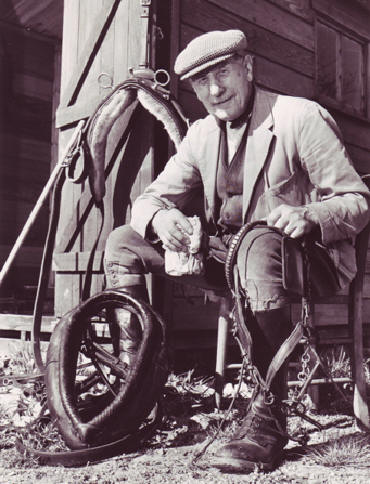 (photo: Eastern Daily Press)
Ted Laurence was born in East Bilney in North Norfolk in the late 1890s. His fatherwas the groom for the carriage horses where he worked and Ted was brought up amongst horses, often helping his father by taking the horses around the estate to exercise them. He worked with his father until he was fourteen when the First World War broke out, and he joined the Irish Guards. After the war he moved to Billingford to work as a stallion leader with Shire horses, then to Langmere where he looked after Suffolks. When the first horse there died on the way to the Suffolk Show, the owner, Mr Raynham took Ted to get a replacement stallion and Ted chose ‘Admiral John’ (see cover photo). In the 1930s Ted moved to Winfarthing, again as stallion leader with Suffolks, but eventually he changed to the French bred Percherons. Ted stayed there until he retired, when he moved to live at Shelfhanger, where Keith recorded him. Ted gave all of his stud books and horse paraphernalia to fellow horseman, singer and melodeon player, Ray Hubbard of Dickleburgh before he died and Ray has fond memories of Ted. “I heard him sing years ago and then when we had the Concert Party and we were going his way near Shelfhanger, we’d pick him up, and he’d join us and sing on the stage. That would be 1955 to about 1965. He’d sing the Dicky and Cart and I’d play for him and some times he’d bring his accordeon and play that. He sang in whatever was his local pub at the time like the Winfarthing ‘Old Oak’. He’d sing here in the Crown in Dickleburgh when he was at Raynhams. My father, when he was a young man, heard him sing there. He sang several songs but it was Dicky and Cart that stuck in my mind and he wrote that one out for me.“Three weeks before Ted died in 1981 I went over and he got the accordeon down: that used to sit on top of the chest of drawers. Then he said ‘I can’t play now, so you play it; and I played seven waltzes like Believe me if All Those Enduring Young Charms and he sung the words to every one.
Ted Laurence can can be heard on: VT154CD
Sophie Legg (Cornwall)
 (photo courtesy of Vic Legg)
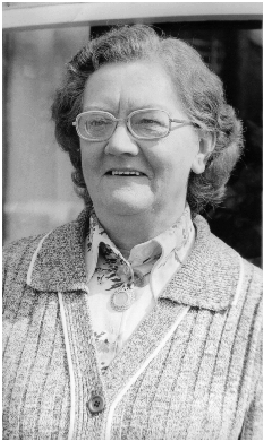 (photo courtesy of Vic Legg)
Shopie Legg was born in 1918 into one of the best known West Country travelling families, the Orchards. She is Vic Legg's mother and was source of many of his songs as were her two sisters (Vic's aunts) Charlotte and Betsy Renals.
Their father Edwin was born in 1879 and was married to Susan (also an Orchard) when he was twenty and she was sixteen. At that time they run a coconut shy at local fairs until Edwin became a fairground bare-knuckle fighter, taking on all-comers for three weeks. He earned good money, in fact he earned enough to buy themselves a wagon, enabling them to give up the fair life to go on the road. They hawked haberdashery and when they stopped at night they would often meet up with other Gypsy families and songs would be shared around the camp fire.
Sophie continued travelling with her parents until about 1936 before settling with her husband George Legg who was from Gloucester. (from Pete Coe's notes)
Sophie Legg can be heard on: VT119CD
Vic Legg
(Cornwall)
 (photo
courtesy of Vic Legg)
(photo
courtesy of Vic Legg)
(Vic with his aunties Betsy and Charlotte and his mother Sophie)
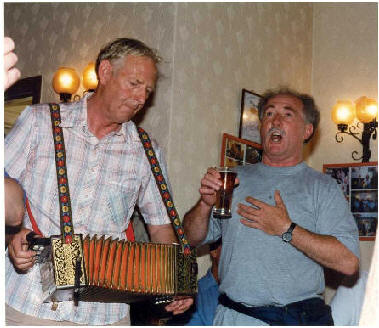 (photo: Maggy Hunt)
( Vic and Chris Ridley's in the Volunteer Inn, Sidmouth)
Vic Legg was born in Launceston, North Cornwall but has lived a little further west in Bodmin for most of his life. Over the years he has become renowned as a fine singer of traditional songs who seems to have the right song for every occasion.
Vic comes from travelling stock, and music, especially singing, has always been in his family. His maternal grandparents who travelled the Cornwall-Devon border hawking haberdashery, were both singers, and his grandmother was a fine stepdancer. Their children were, of course, reared in a singing environment: they would meet uncles, aunts and cousins at weddings and fairs, and singing would inevitably be the outcome of the gathering. Some more of the family songs can be heard sung by Vic's mother Sophie Legg and her elder sisters Betsy and Charlotte Renals on the CD VTll9CD 'Catch me if you Can'. (John Howson)
Vic Legg can be heard on: VT129CDR
(Sophie & Viv Legg)
(Viv, Vic, Sophie and George Legg)
Vivienne Legg comes from a long line of traditional singers in her extended family of Orchards, Leggs, and Renals. Her brother Vic Legg first brought to a wider audience the songs that their mother Sophie and aunts Charlotte and Betsy sang. The three sisters were recorded by Pete Coe in 1978, and these records were subsquently released on VT119CD as ‘Catch me if you Can’. In 1994 Vic recorded some of their family songs and these were released on VT129CD ‘I’ve Come to Sing a Song’. Sophie now lives with Viv and has encouraged her to sing some of the family songs which have never been recorded. Viv is the next volume in this fascinating story.
Viv Legg can be heard on: VT153CD
Bob Lewis (Sussex)
 (photo: Mike Yates)
 (photo: John Howson)
Originally from Midhurst in West Sussex, Bob learnt most of his songs from his family and friends. For some reason, "Many of the singers (there) were either builders or undertakers! Don't ask me why, though." He also has a great interest in local customs and traditions.
Following a spell of national service, Bob worked with engines for many years, servicing cars and all manner of agricultural machinery. He has now retired to East Sussex and is a regular stalwart at many folk clubs and festivals. (Mike Yates)
Bob Lewis can be heard on:
VTC1CD VTC4CD VTC5CD VTC6CD VTC7CD & VT131CD
Geoff Ling (Suffolk)
 (photo John Howson)
The Ling family of Blaxhall must be one of the best known singing families in
the county, and Geoff has certainly kept that tradition alive. His mother Susan
and father Oscar were singers and his older brother, George became known as 'a
rare old singer'. George moved from Blaxhall to Croydon, but as Geoff relates,
"If George came back to the Ship, say on holiday, there were certain
songs that the rest of the family wouldn't sing because they were his, although
we would sing them the rest of the year."
This is how it has been for years
with song ownership. How often have I heard someone say, "You don't sing that
one if 'so-and-so' is here: that's his. " What is interesting now, is that Geoff
is able to sing many of the family songs and much of the local repertoire
because he is now the main carrier.
Geoff worked mainly on farms, and he
told Keith Summers that he started singing in pubs when he was eighteen. "I'd go
around with Dad to steel quoits games at pubs like Marlesford Bell, Aldeburgh
Mill Inn and Eastbridge Eel's Foot. But the most singing was at the Ship in
Blaxhall, and that's how we'd pick up those old songs, by hearing them so
often." (John Howson)
Geoff Ling can be heard on: VTC1CD VTC2CD VTC3CD VTC6CD & VT154CD
George Ling (Suffolk)
 (photo from Sing, Say or Pay))
(George Ling with his wife Rose)
George Ling who was known as ‘Spider’ was born in
Blaxhall in 1904 and was the elder brother of Geoff Ling. His grandfather
Aaron, mother Susan and father Oscar were singers and everyone in the family
had a go at stepping. George told Keith (from ‘Sing, Say or Pay’): “All those
Smiths and Picketts and Taylors originated from Blaxhall. They used to make
pegs and work as tinsmiths down at Camel’s Pit. We used to play there as boys
and I'd help them make those pegs out of reeds. One old boy from Tunstall,
Obediah Taylor, he played the fiddle and he taught me to step when
I was nine. I used to spend more time in that caravan with him than at home.
He'd say "Come on, my son, I'll play Pigeon on the Gate" and off I'd go. Me
and brother Geoff used to dance together down the Ship ‘in reels’, we called 'em.
I could dance very well at one time of day but I could never beat those Smiths
nor Bensy Hewitt - they were the masters.
George’s first job was with his mother stone-picking in the fields, then at
twelve he went to work with a dairy herd, then went to work at Snape maltings,
where he did a bricklaying apprenticeship, with singer Bob Hart as his
labourer.He moved to Croydon in 1926 and although he did play (melodeon) and
sing in some of the back street pubs, when he returned to Blaxhall on holiday,
he still took his place as one of the senior singers there, always remembering
his early days:(From ‘Sing, Say or Pay’): “We were a happy-go-lucky lot those
days - sing a few songs, have a dance, and wherever we went someone would
bring an accordeon with a red spotted handkerchief around the stops. There was
me, Freddy Ling, Johnny
Richardson, Mike and Geoff Keble, and we all had mouth-organs and if we all
walked out somewhere to a pub, you'd hear us for miles in those quiet old
villages and they'd say "Here come the Blaxhall boys" - used to sound all
right too.”
Apparently it was not always so
friendly: “There were more fights than halfpennies that time of day. The pubs
weren't supposed to open all day, but there was only one copper for miles and
if he stopped by he'd come in for a drink. One night a bloke said to Wicketts
(Richardson) "I can't, dance or recite but just to keep the company amused
I'll fight the best man here.” Cor, there was some blood flying, I'll tell
you. If ever a stranger came in the pub - oh dear, all eyes would be on him.”
Geoff Ling can be heard on: VT154CD
Fred List (Suffolk)
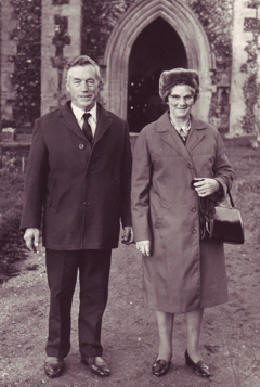 (photo courtesy of Lennie Whting)
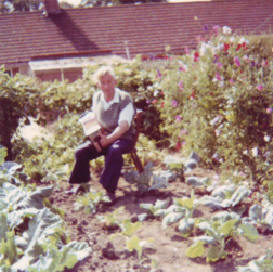 (photo courtesy of Lennie Whting)
Frederick John List was born at World’s End Farm, Saxtead, in 1911 and was
brother to Billy List. He sang lots of songs with many coming from his father,
Harry List, who was recorded by Peter Kennedy for the BBC in 1951. After Harry
died in 1962, Billy’s mother lived with George Bloomfield, Alec’s father. Fred
told Keith how he learned to play (from ‘Sing, Say or Pay’): “I first started
playing the mouthorgan when I was at school - I lived at Saxtead then. Our
family wasn't very musical, but my grandfather (John Ling) was a rare stepdancer.
I never knew him - he died when I was only three - but I heard people say he
could bring 'em both in. Well, when I was about 12 my sister sent off for an
accordeon from Hastings - a three-stop one for 14/- and she got so she could
play a few songs and I could play several hymns - Now the Day is Over - that
sort of thing. Then a chap called George Scott, a bit older than me, he moved to
Saxtead and he was a pretty good accordeon player. I was 15 and we'd play our
accordeons round his little hut and in the summer we'd get on the street corner
with a board and have a step. We stuck together and got so we'd start playing
around the pubs - Charlie Page's (Railway Inn, Framlingham) was our regular
Saturday night spot. George, he was friendly with Walter Read because they were
both boot repairers, and sometimes we'd go round for Walter and go to Monk Soham
Oak or Saxtead Volunteer, and Walter was the best playerI ever heard and a good
singer, although I have played with Alf Peachey down Cretingham Old Bell and
different places. He could play a good stepdance, and marches, that was his
speciality - Cheer, Boys, Cheer, that sort of thing.”“Some of the best musicians
I heard were some Irish chaps. They'd come over cutting sugar beet and get down
Southolt Plough or Fram Queen of a night. One of them played the fiddle, holding
it across his arm. All sorts of tunes they'd play and dance. I picked up some of
my jigs from them. That was about 1938 and these chaps were all about 50 - then
scruffy old bunch but good company. ”In later days Fred List became the house
musician at Blaxhall Ship and was featured on the 1974 Transatlantic LP ‘The
Larks they Sang Melodious’. Fred died in 1994.
Fred List can be heard on:
VT154CD
& VTDC11CD
Billy List (Suffolk)
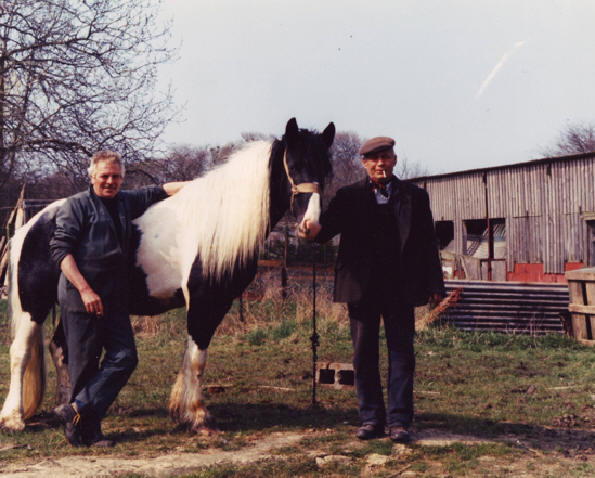 (photo courtesy of Lennie Whting)
William Pearl List
was born at World’s End Farm, Saxtead, in 1909 and was brother to singer and
melodeon player Fred List and son of singer Harry List. Billy lived in
Brundish and was remembered well by Charlie Whiting’s nephew Lenny Whiting:
“Billy was a universal chap; he drove a steam engine, a steam road roller, and
he drove one of those big old chain bucket cranes. He’d work round here or
he’d have to go away to work for maybe two or three months and he’d work a
sugar beet team. My old man and me used to meet up with Billy and his lad and
we’d go rabbiting, that was when the hedges were twenty foot wide. That was
Saturday and Sunday regular - well it was bit of extra spending money. They’d
take them to the pub at night and raffle them off. I did hear him sing, but
not a lot, because he was a Blaxhall Ship man, well in the later part of the
time, because Fred List played accordeon there.” Billy got most of his songs
from his father Harry and told Keith (from ‘Sing, Say or Pay’): “Once Dad got
started you couldn't stop him. He'd do Banks of Sweet Dundee, With
me Navvy Boots on, Knife in the Window. I learnt that one Paddy and the
Rope from Bob Scarce - I used to see him in Blaxhall Ship when I'd go with
Fred, and that one Murder of Maria Marten - I got that from a book, 'cos
that really happened somewhere round here. Old Charlie Hinney, he was another
good singer. He had hands as big as pails. He used to live near by me in
Brundish. He was 90 when he died (in 1974). He'd sing All that Glitters is
not Gold and The String Around me Old Pyjamas."
Billy List can be heard on: VT154CD
Harry Litherland (Lancashire)
Harry Litherland was born in 1931 in Aspull near Wigan, Lancashire. His father Tom had a concertina and played by ear, often in local pubs. Harry had been playing violin but his father wouldn't let him touch the concertina until he was thirty. He showed him the basics but it was an old chap called Silvester Halliwell who taught him most. Harry's concertina is a McCann system duet and although Halliwell's was a Crane system he was still able to put him on the right path. At one time the concertina was very popular in the Wigan area and Harry particularly remembers two brothers called Rigby who played the local music halls. I first met Harry when he was busking in Leigh in Lancashire and he spent many years making his living this way, often travelling hundreds of miles to find his next audience.
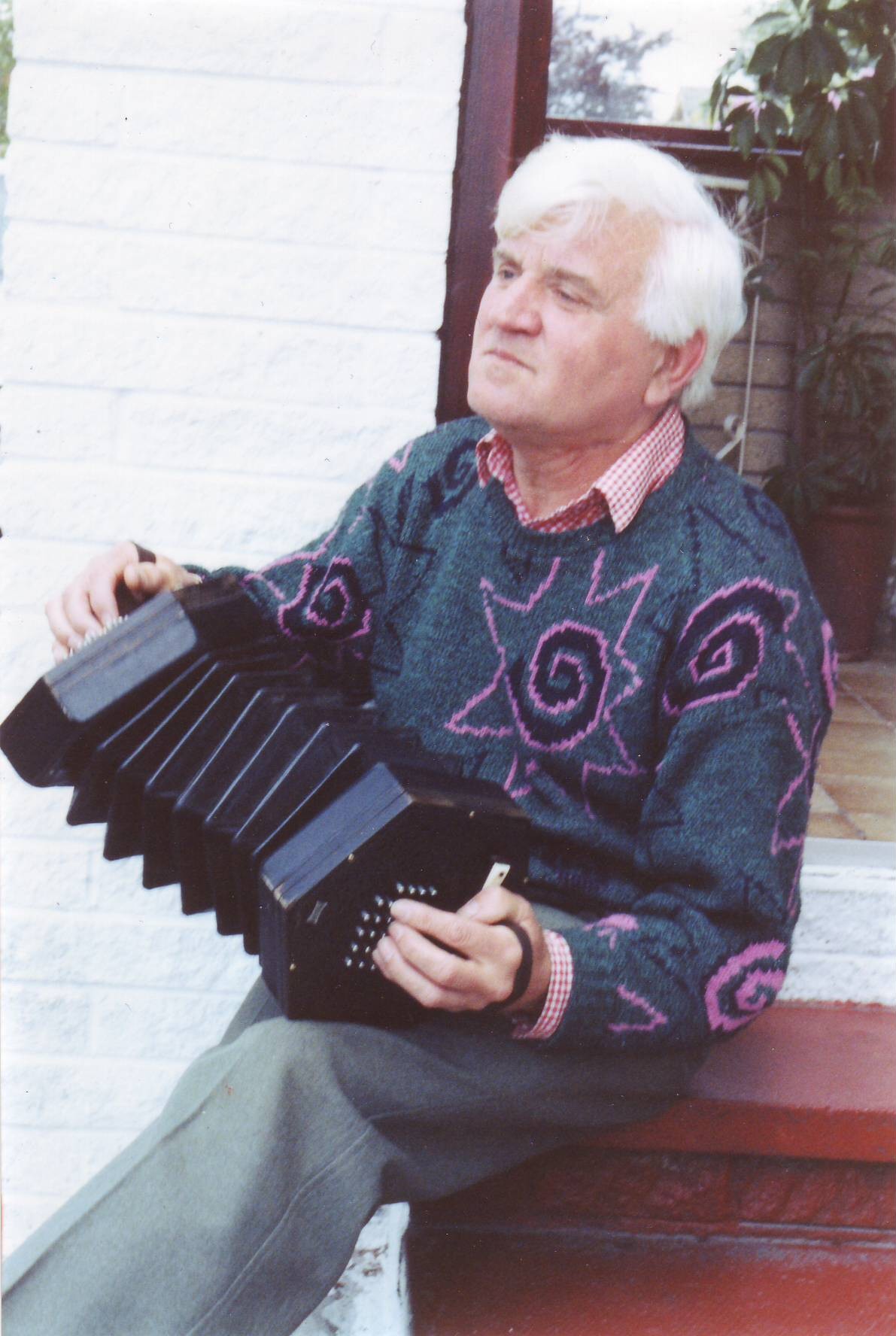 (photos: John Howson)
Harry Litherland can be heard on: VTC10CD
Ernie Lyas (Suffolk)
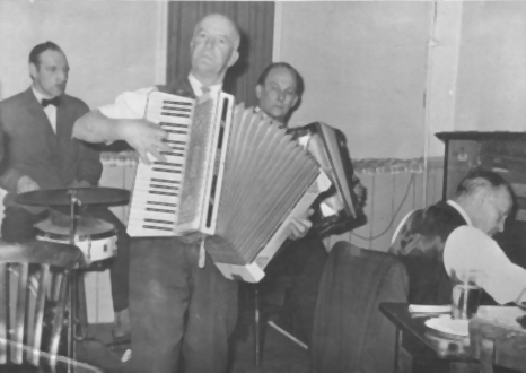 (photo:
courtsey of Ernie Lyas)
(photo:
courtsey of Ernie Lyas)
Although the melodeon was extremely popular in Mid-Suffolk, some people who
started with it later switched to the piano accordion and one such musician was
Ernie Lyas of Stowmarket. He recalled that he used to play what he called a
'windjammer' but always wanted a piano accordion and bought his first one in
1939. He also played jew's harp, tin whistle and mouthorgan and at one time he
played saxophone with a Haughley band led by Johnny Ransome. He mainly played in
the Stowmarket Railway Tavern or Onehouse Shepherd and Dog usually with a
drummer and piano players Billy Eaton or Vicky McClean and he was also a member
of the Stowmarket British Legion concert party, along with Doddy Thorndyke.
Ernie Lyas can be heard on: VTDC8CD
Jimmy Lynch - (West of Ireland)
Jimmy Lynch was born in the west of Ireland. His mother played melodeon and the concertina and his father sang, particularly at threshing parties. He was one of five children, three brothers and one sister but only one of his brothers played music and he tragically died when he was just fourteen. Jimmy's mother played for crossroad dances which would start at four o'clock on a Sunday afternoon and continue until it was dark. In more recent years Jimmy lived in Worsley Mesnes, near Wigan and had a large collection of musical instruments. He took up busking and was a familiar figure with his rack of foot-operated dancing dolls which he transported in an old pram, often travelling by train or on visits back to Ireland, by ferry.
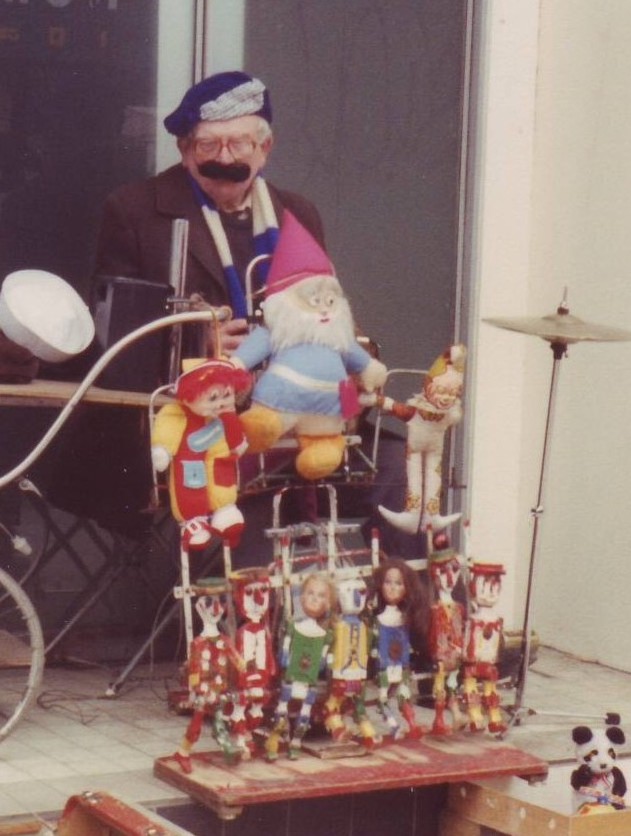
 (photos: John Howson)
Jimmy Lynch can be heard on: VTC10CD
John & Tim Lyons - (Co. Cork)
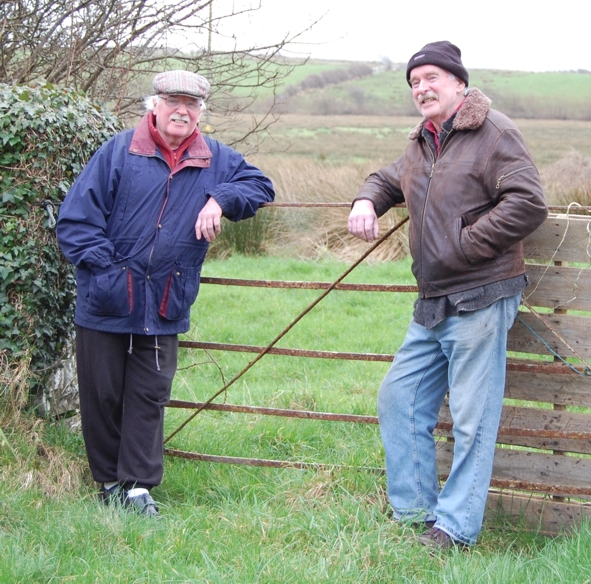 (photos: John Howson)
John Lyons was born on 31st October 1933. Tim was born on 8th December 1937. Both were born in Evergreen Road in Turner’s Cross, a suburb of Cork City. Their grandfather (whom they never met), was a stone-mason living in Mulcarthy’s Bridge, near Banteer, Co.Cork. He was a member of the Irish Land League, a political organisation which sought to help poor tenant farmers. As its aim was to abolish landlordism in Ireland, the family was evicted from their home and local people took them in to stay. John and Tim’s father, also called Tim, was fourteen years old at this time. One night, he and a friend made a plan. They packed a bag, climbed out the window, and walked to Cork city. There they signed on with the British Navy and their father, Tim Sr. became a gunner, fighting in The Battle of Jutland in 1916. On leaving the Navy, he met and married a Cork woman called Kathleen Buckley.
As young children, John and Tim were known as Jackie, (a popular name in Cork) and Tadhg (Pronounced ‘Tige’ – Tiger without the ‘r’). They had two brothers, Richie and Patrick and a sister Nora. After his Navy service, their father got a job in Henry Ford’s motor works in Cork city as a machine operator, making con-rods. Later, as work became scarce, he tried his hand at anything he could, including photograph framing. He usually worked at home, but also visited people’s houses, carrying his carpenter’s tools and a large mitre block on the back of his Raleigh bike. At home, he also cut hair, turning the sitting room into a barber’s shop with a striped pole outside over the gate.
The family moved to north Cork, near Banteer, the area where their father had been brought up. They rented a gate house on an estate in Dromtariffe owned by Captain Leader, which was named ‘Rosnalee’, situated between Mallow and Millstreet on the road to Killarney. The first music John and Tim remember was when their first cousin Paddy Kelleher visited the house and played piano accordion. They were actually living a short distance from Sliabh Luachra (The Rushy Mountain), an area rich in music, but were too young to realise it at the time.
In 1946, their father moved to England in search of work and as an ex-Navy man he was able to get a council house in Wolverhampton, paying a rent of just 10d. He eventually moved the whole family there. John moved over in 1949 when he was coming up to sixteen years old and his father got him an apprenticeship as an electrician with the Electric Construction Co. A year later, Tim followed him over. He was then twelve and continued his schooling in Wolverhampton until he was fifteen. His father wanted him to become a tool-maker and he got him an apprenticeship at the Wolverhampton Die Casting Company.
Whilst in England, the only music they came across was on the radio. On Sunday mornings, they would listen to ‘As I Roved Out’ with field recordings which had been recorded by Seamus Ennis and Peter Kennedy. Another favourite programme of theirs was ‘The Jimmy Shand Show’ on Radio Luxembourg, which was the nearest they could get to Irish music. Irish National Radio reception was very poor in those days as it was broadcast from Athlone (the centre of Ireland) and they couldn’t receive it in England.
They would buy mouth-organs and try to imitate what they heard on the radio. On a Saturday afternoon, they would play music in their bedroom. Tim can remember that John made a set of drums out of Tate & Lyle tins (sugar containers) with some canvas stretched over them. Later, the brothers clubbed together and bought a Hohner one-row melodeon between them.
While they were all living in Wolverhampton, they still kept the house in North Cork, which they would return to for summer holidays. In 1954, John received his enrolment papers for the army, as conscription was still in place. His father had not had a good experience in the British forces and he told John to leave England. John moved back to Ireland and lived in the house in North Cork with his sister Nora. Tim spent his teenage years in Wolverhampton and then the same scenario arose. After finishing his apprenticeship at 21, he too received his conscription papers. Tim then, using a false name, left the factory where he worked and sought work elsewhere; he worked for a time on building sites in Birmingham but as he could not reveal his correct tax details, he had to use an emergency tax code, which left him financially crippled, so in 1959 he too went back to Ireland.
By this time John was beginning to get involved with local musicians. There was a dance platform near to the house where they lived, under a large spreading chestnut tree. On a summer’s evening, musicians would arrive and play local polkas and slides for the dancing. John had bought a Paolo Soprani button accordion and was playing with Sean Lynch’s band from Kanturk. Around this time, he was meeting several Sliabh Luachra players including fiddle players Dennis Murphy known as ‘The Weaver’ and Morris O’ Keefe from Kishkeam, nephew of the legendary Padraig O’Keeffe. Also accordion player Johnny O’Leary from Maulykeavane, and he remembers John and Julia Clifford were also with them. When Tim returned home, in 1959, they both played with Tommy Doocey’s band from Banteer, and later with Mick Williams’ Duhallow Céilí Band which played all around North Cork and parts of Kerry.
Irish railways were bringing in new diesel engines and John found work as a maintenance electrician in Dublin. Because of the erratic shift work, John soon left and started work with Unidare, maker of electric cables. Tim, now in Cork, trudged around the area looking for work, but to no avail. Eventually John managed to get him a job at Unidare also, working in the tool room and they lived together in digs in Dublin.
They found lots of music in Dublin and were regular visitors to the Piper’s Club in Thomas Street and sessions at St Mary’s Music Club in Church Street. They remember this as being one of the great venues for traditional sessions. They were in self-catering digs and one day whilst buying some cutlery, they got talking to the shopkeeper, and got onto the topic of music. He turned out to be the great Clare fiddle and concertina player John Kelly, who had moved to Dublin in 1945. They remember him as one of the stalwarts of the Dublin traditional music scene along with flute player Dessie O’Connor, accordion player Sonny Brogan, Galway fiddle player Joe Leary and banjo player Barney McKenna. At that time, Barney was also playing jazz in a bar in Howth, County Dublin. He was soon to join the Ronnie Drew Group which later became the Dubliners.
Ireland was building its first oil refinery at Whitegate in County Cork and advertised for electricians. They were offering high wages. John and flute player Mick Kelly found employment in Whitegate. However, after 6 months that job finished so they moved to England to find work.
Tim had stayed in Dublin still working for Unidare until that job came to an end. He got another job in a small sheet metalworks but that didn’t last either, so after three years in Dublin, in 1963 he also decided to hit the road and headed for London. He wasn’t married then, but had met his future wife Anna and she went to London around the same time.
While in England, John met his first wife Marian with whom he had six children; Martin, Dominic, Katie, Kieran, Eoin and Liam, all of whom are now adults and some of whom are following in John’s footsteps playing traditional music. John and his young family eventually moved to County Clare where work was plentiful. They rented a house in Newmarket-on-Fergus as there was work in Shannon and music nearby as well. Newmarket was close to Shannon which was booming, with an increasing number of factories being built. John recalls that they used to go to Clare before they actually went to live there, often to fleadhs and the festivals on the west coast. This was when Willie Clancy was still alive so it was, of course, before the famous Willie Clancy Week was going then. They loved Clare because of the great music, so when John decided to settle back in Ireland it was not his home county of Cork he chose, but County Clare where the work and the music were.
Shortly after John arrived in Newmarket-on-Fergus, the Bunratty Cottage sessions started and for a number of years John became a regular member, together with Martin Talty, Paddy O’ Donoghue, Jimmy Flynn, Denis Doody and Tony Lynch.
Meanwhile Tim was enjoying life in London where he spent the next eight years. He had found the Irish pubs and the folk clubs, in particular The Singers’ Club where he met Ewan McColl. Once it was realised that Tim had songs, he was regularly asked to sing and eventually he started getting bookings at the club. McColl invited Tim to his house in Kent where he was introduced (via McColl’s recording collection) to some of the great Irish singers like Elizabeth Cronin, Robert Cinnamond, Joe Heaney and Nicolás Tóibín. Around this time, Tim was also asked to join a group of singers, The Exiles, alongside Enoch Kent, Gordon McCulloch, Bobby Campbell and Paul Lenihan. They didn’t play together very often but Tim recalls a memorable open air ‘Ban the Bomb’ concert in Trafalgar Square and an unforgettable trip to the Isle of Arran to play at a midnight rave where he thinks the pop group ‘The Monkees’ also appeared. Tim was featured on the Exiles’ 1967 Topic LP “The Hale and The Hanged” (12T164) playing button accordion.
He continued to keep in touch with the London-Irish scene attending Comhaltas Ceoltóirí Éireann meetings in the Greyhound, Fulham Palace Road. At a Fleadh Cheoil in Cecil Sharp House in Camden, he met Jim Doody, a singer and teacher who asked him to go on tour with him and that was Tim’s first foray into the English folk clubs. Their first bookings were in Devon and although they didn’t do much after that, the folk scene were starting to hear of Tim and he was getting solo work all over the country such as another ‘Ban the Bomb’ concert in Exeter Town Hall with Julie Felix and the Ian Campbell folk group, The Beaford Festival with A.L. Lloyd and Dave and Toni Arthur and in 1967, an appearance at the Sidmouth Folk Festival in Devon. In 1969, he was also included on a Topic compilation LP (12T184) ‘The Breeze from Eireann’ where he played alongside tin whistle player Festy Conlon. During this time, he still had a full time job on a building site in Brixton. The young foreman there was a follower of folk music and a fan of Luke Kelly’s. When it was necessary for Tim to leave the site to catch an afternoon train to a venue, he would cover for him in return for a fiver in the pub on a Friday night. Tim remembers that the money from folk clubs was good then. He would get fifteen pounds for a night singing which was to him a week’s work in London. He had particularly gained a following in the North of England and came to know The Watersons, staying at Mike’s house when he sang at Hull. But it was the North East that took him to their heart and Tim often stayed with his good friend Tom Gilfellon. When he told them that he was going back home to Ireland in 1970, they organised a farewell concert for him. The night was a sell-out and Tim remembers he got a fee of £30, his highest ever fee in those times. Tim had, by then, decided to move to County Clare.
John was certainly enjoying the local music in Clare with regular Ennis sessions in Hogan’s (now Brogan’s), Kelly’s and Paddy Arthur’s where he met a lot of local musicians and singers including John Joe Casey, Dessie Mulcaire, Séamus MacMathúna, Johnny Galvin, Paddy Murphy and Carl McTigue. He also made many trips west to Miltown Malbay and Doolin where he met and played with the Russell Brothers: Packie, Gussie and Micho, and he remembers that in those days it was a quiet little session with just the local musicians, usually in O’Connor’s pub. In Miltown, he would meet and play with Jimmy Ward and Willie Clancy and also J.J Talty, Martin Talty and the singer Mick Flynn. It was lively times, mainly in Queally’s pub. There was a little snug in the back where Willie Clancy would play, until he moved to Lynch’s which was then owned by Willie’s friend Tom Friel. This became a stronghold for traditional music in the town.
Regarding the source of his songs, John remembers that they came from everywhere. He learned them from the radio, from singers he met and from books. Before he moved to Clare, he would cut songs out of the Cork Weekly Examiner (Carbury’s Column) which had a traditional song every week, and stick them in a scrapbook; he was always looking for new songs. He started entering singing competitions at the fleadhs and became Munster Champion, and he succeeded in coming 2nd at the Fleadh Cheoil na hÉireann in Boyle in 1960.
Tim’s move to Clare in May 1970 gave him work in Shannon and the local music scene was of course a great attraction to him. He recalls that there were sessions at the drop of a hat, often on Thursday, Friday, Saturday and Sunday nights with great local musicians. John was well ensconced in the music scene in Clare by the early 1970s, visiting fleadhs and festivals in Scarriff, Tulla, Feakle, Ennis and Ennistymon. In East Clare, sessions he would never miss were in Donnellan’s in Kilkishen, and the Blacksticks in O’Callaghan’s Mills where he would meet and play with Martin Rochford, Vincent Griffin, Paddy O’Donoghue and Eddie Duggan. John was also a co-founder of the Shannon Folk Club which booked many new and exciting acts that were emerging on the folk scene such as Paul Brady, Joe Burke, Stockton’s Wing, De Dannan and Stoker’s Lodge. At this time John didn’t travel much outside of County Clare but he remembers a coach load of musicians including Willie Clancy, Quilty tin whistle player Joe Cunneen and P.J Downes going to Dublin to do a television programme for RTE called ‘Bring Down the Lamp’.
Around this time, Tim was playing music with singer, tin whistle and flute player Micho Russell on a weekly basis in O’Connor’s Pub in Doolin which was at that time the heart of the west Clare scene. This resulted in the duo being invited, by Leon Lamal the agent for the group ‘Rum’, to tour Belgium for two weeks including three gigs in France, two in Paris and one in Orléans. In 1972, Tim recorded an LP for the Leader label called ‘The Green Linnet’ (LER3036) and John was also recorded in 1974 for an LP on Topic called ‘The May Morning Dew’ (12TS248). There were few paid bookings in Ireland then. Although John recalls in earlier days when he played at Hogan’s in Ennis, the musicians were each given a bag of sandwiches at the end of the session which they ate outside under the archway of the pub before travelling home.
The Topic LP that John made provoked an awareness of John in England and he was invited to do some folk club tours. In 1976, John went to America for three weeks. This was for the bicentenary celebrations of the United States and the party of twenty five who travelled there reads like a Who’s Who of Irish traditional music; it included Ollie Conway, Willie Keane and The Mullagh Set, Junior Crehan, Tom Munnelly, Ciarán MacMathúna, Denis Doody, Donal O’Connor, Paddy Tunney, Micho Russell, Maeve Donnelly, Sonny McDonagh, Sonny Murray and De Danann.
Tim recorded another LP for the American label Green Linnet which was released in 1978 and called ‘Easter Snow’ (SIF1014). In the same year, Tim was asked to join De Danann, and they toured England, Ireland, Wales, Scotland, Holland, Belgium and Germany before embarking on a massive eleven week tour of America.
In the 1980s Tim became very active musically. Gigs where his traditional songs were wanted started to increase, particularly in Dublin where new folk clubs were starting up, like the one at Slattery’s on Capel Street. Tim had tried to write songs when he lived in London but found himself too influenced by Ewan McColl. He recalls writing a song about the 1966 Aberfan disaster but after examining it, he realised it was a carbon copy of the song ‘The Gresford Disaster’. He didn't start seriously writing songs until 1985, twenty years later, and when he was increasingly getting bookings to sing his own, often comic, songs.
In 1988, Tim and Anna moved to Galway and became involved in the music scene there. Then while on a visit back to Clare in 1989, Tim had a chance meeting with flute player and singer/songwriter Fintan Vallelly. It was in Friel's bar in Miltown Malbay, and after a little friendly altercation about one of Fintan's songs called ‘The Moving Statues’ which Tim sang, but thought it to have been written by Belfast singer, the late Brian Moore. Tim and Fintan got on very well. Fintan was intrigued that they were both writing similar satirical songs but in different styles and he asked Tim to join him on a tour of Scotland the following April. It went very well and in 1989 they released a cassette together called ‘Knock Knock Knock’ (UFMA tapes001) and in 2000 a CD under the name ‘Schitheredee’ called ‘Big Guns and Hairy Drums’ (WHN002) which concentrated on their own humorous songs. They also got themselves an agent, Frank Bechhofer, who organised tours all over England and Scotland which they continued to do until around 1995.
In 1997, Tim appeared on an American CD called, ‘Celtic Mouth Music’ (Ellipsis Arts CD4070) and in 1998 on a compilation of music and songs from 1798 uprising against British rule in Ireland called, ‘The Croppy’s Complaint’ (CRCD03).
Back in Clare, John was playing on a regular basis with local musicians around the Shannon area including Pat Mullins, Pat Costello and Martin Breen. They were known as ‘Tradaree’ and toured in Ireland and in Brittany. John was recorded on two Shannon based tapes called ‘Down Our Street’ and ‘The Artful Dodgers’ and in 1993 he recorded a solo singing cassette called ‘The Troubled Man’ (WWOO2). This was the same year that John met his second wife Ann, also a singer, at the singing festival in Ennistymon. The following year he was included on a French compilation CD called ‘Voyage Musical – Irlande’ (YA225704). Around this time, the Ennis Singers Club was founded by the late Peadar McNamara and John was included on a compilation recording of the Club called ‘Clare Songs, Rare Songs, and Quare Songs’. In the early 2000s John played and sang with the late Haulie Moloney in Malachy's Bar in Quin and they recorded a CD appropriately titled ‘Malachy's Men’.
As well as playing with local musicians, John continued to make occasional appearances at some of the English folk festivals such as Sidmouth and the National Festival Folk Festival at Loughborough, and English folk clubs such as the Swindon Folksingers Club. In 2001, John performed with Sean Talty (son of the late Martin Talty) and Eamon McGivney at The Beethoven Festival in Bonn, Germany.
John still lives near Newmarket-on-Fergus with his wife Ann. They have two children Aisling and Sean, who are award winning traditional musicians in their own right. Aisling plays harp and concertina and Sean plays tin whistle and uilleann pipes. The family are members of the Tulla Branch of Comhaltas Ceoltóirí Éireann and John is a Patron of Cnoc na Gaoithe the new Tulla Comhaltas Cultural Centre.
Tim and Anna now live in County Galway and Tim still sings and plays at various gatherings around Ireland. Recently he has been involved in an Irish Arts Council funded song writing project called ‘The Wild Bees Nest’, and has recorded his latest, and first serious, song on the CD which is the culmination of the project.
After spending their lives criss-crossing the Irish sea for work, singing and music have been, and are still a very important part of what these two remarkable brothers do. Yet amazingly, apart from playing in so many sessions together, they have rarely shared a stage. The good news is that in recent years they have started to appear together and long may they continue to do so.
John & Tim Lyons can be heard on: VT158CD
Sean MacNamara Eamon Coyne & Peggy Peakin (Liverpool)

,+playing+the+fiddle+in+the+Liverpool+Ceili+band+in+the+Irish+centre,+1964.jpg)

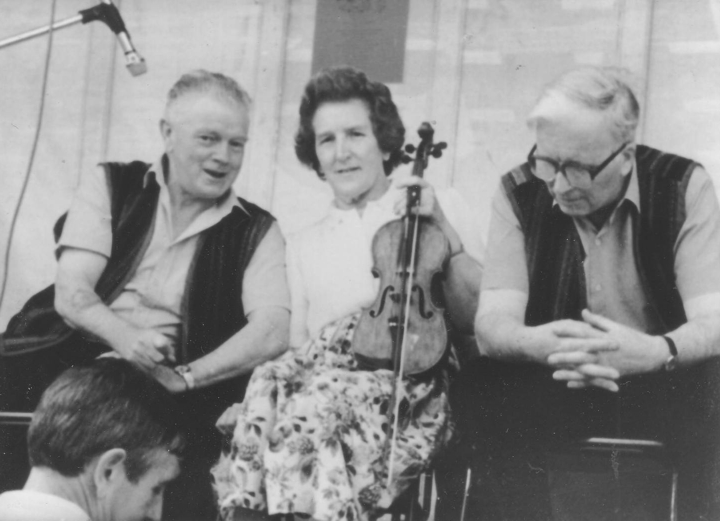
Liverpool Ceili Band 1960s 1980s - Sean (middle), Peggy (left) Eamon, Kit Hodge, Sean
Sean MacNamara was an original member of the famed Liverpool Ceili Band, a band that had four fiddle players in it's front line including Eamon Coyne, Charlie Lennon and their original leader Kit Hodge. During the sixties they won the 'All Ireland' ceili band competition two years running and they visited America and appeared on the television show 'Sunday Night at the London Palladium'. Peggy Peakin is Kit's sister and she has also been playing fiddle in Liverpool for almost half a century but didn't join the band until she became their regular piano player, replacing Peggy Atkins.
There is still a vibrant and continuing Irish musical tradition in Liverpool and these two musicians have influenced and inspired it. (John Howson)
Sean McNamara Eamon Coyne and Peggy Peakin can be heard on: VTC1CD & VT125CDR
Jim Matthews
(Cumberland)
Jim Matthews, born in 1878 at Chalkfoot near Dalston, was a retired rural overhead linesman with the GPO. He sings the nonsense song 'My Uncle Pete' on VT142CD 'Pass the Jug Round'. (Sue Allen)
Jim Mathews can be heard on: VT142CDR
Bert Mayes (Suffolk)
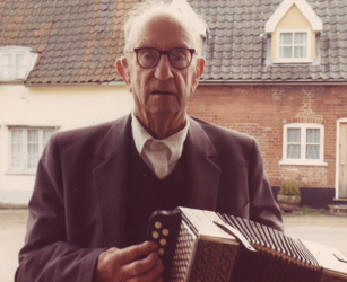 (photo: John Howson)
Bert was born in Monk Soham, Suffolk in 1904, and never moved far from his home
village. He worked on farms, first at Kenton Lodge, then at Kenton Hall and was
not very keen on horse ploughing. He maintained that farm work today is like
play compared to his time. Bert played a ten key melodeon for nearly thirty
years, then moved onto a two row. He played a lot in local pubs, like Bedfield
Dog, Worlingworth Crown, Brundish Crown and particularly the two in his own
village the Oak and the Elm. He was friendly with Kenton fiddle player Fred
Whiting and said that if anybody played a dance tune slowly Fred could ‘dot that
down on paper’. “A clever old boy!” he said. Bert would also meet up with fiddle
player Harkie Nesling, the Gifford brothers Walter and Sam and melodeon players
Alf Peachey and Walter Read.
Bert Mayes can be heard on: VTDC11CD
Geoff Mayes (Suffolk)
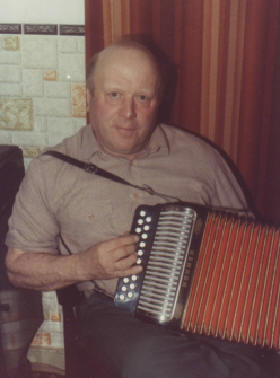 (photo: John Howson)
Geoff was
born in Hepworth, Suffolk in 1924, and he worked on a local farm and lived in
the same house all of his life. His first instrument was a mouthorgan which was
bought for him by his mother in Bury St Edmunds where she would bike to do her
shopping. When he was sixteen he bought his first melodeon, a ‘Viceroy’; at the
time he was earning 11/4d a week. He stopped playing for many years until he met
up with Ernie Chapman from Stonham who encouraged him to play again. Geoff
recalled a time when every pub in the area had a melodeon player but his fondest
memory was of the old Black Horse in Hepworth, there he remembered several
melodeon players including Will Beals, known as Will ‘Woopsie’ and Edgar Howells
who was the local saw sharpener. He particularly remembered him playing for the
annual Slate Club payout night when all the family would go to pick up what they
had saved for
Geoff Mayes can be heard on: VTDC11CD
John Mitchell (Suffolk)
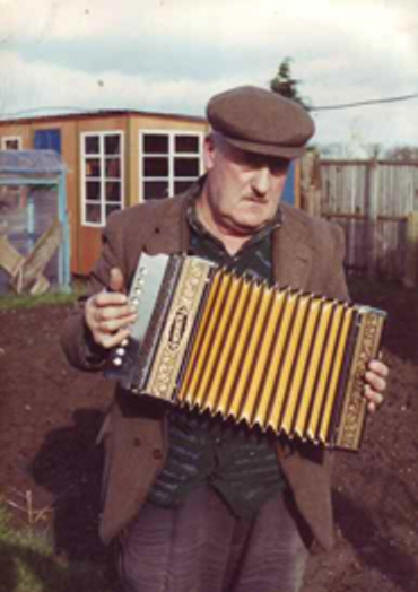 (photo:
John Howson)
(photo:
John Howson)
I met John Mitchell in Forward Green, Mid-Suffolk where his family had lived
there for many generations. His father, Albert, had played melodeon in the
village pub, the Shepherd and Dog. John learned to play many of his father's
tunes but never played in the pub himself. He was in the army for four years and
continued to play by buying a mouthorgan when he was in Germany.
John Mitchell can be heard on: VTDC8CD
Douglas Morling
(Suffolk)
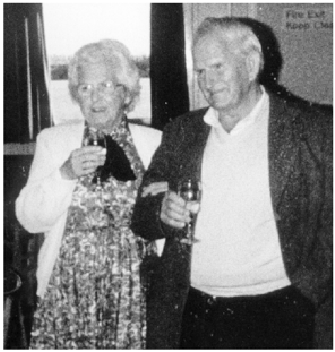 (photo courtesy of Ethal Morling)
Douglas was born in 1910 and died in 1993 and was a quiet man of medium build who worked as a plasterer. He was Eileen’s (ex landlady of the Eel's Foot') brother-in-law and was married to Ethel, who was photographed by 'Picture Post ' magazine singing in the Eel's Foot' when she was a young girl. Douglas himself was not a regular singer in the pub. They lived in three places in Eastbridge: first in the ‘tin houses’ (near the sluice, now demolished), then in a cottage opposite the Eel’s Foot, and finally opposite the shop in Lydon Cottages. (John Howson)
Douglas Morling can be heard on: VT140CD
Tommy Morrissey
(Cornwall)
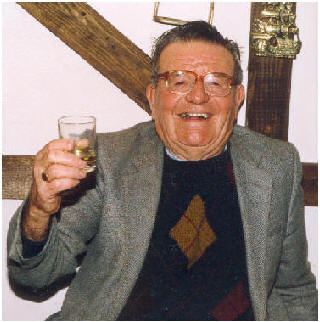 (photo:
John Howson)
(photo:
John Howson)
 (photo: John Howson)
(Tommy Morrisey at the helm of his fishing boat the' Girl Maureen')
Tommy Morrissey was born in 1915 and always had a preference for songs about the sea, which was
hardly surprising as he worked every day out of Padstow harbour. He was one of
the last of the old style fishermen who fished in just about every way possible:
pots for crabs and lobsters, hand-lines for mackerel and a trawl off the side of
his tiny boat the 'Girl Maureen', for plaice, skate and the like.
Several years ago storyteller Taffy
Thomas spent a season fishing with Tommy and he still has fond memories of the
evening song sessions: "Visitors to the tiny North Cornwall port of Padstow any
weekend may well find one of the pubs packed with locals raising their voices in
song for the sheer joy of harmonising together. "At the heart of the session in
all probability, would have been two men; one a fisherman ruddied by the sea
winds singing as though his life depended on it whilst egging on the other,
Charlie Pitman, a sharp featured landsman enacting the songs in gestures whilst
singing like a linnet. Both are renowned local characters'. The crack is fierce
as they josh each other along. "Come on Pitman, give us the one that made you
famous!" Then where appropriate, sources are acknowledged: 'That's one from
Charlie Bate,' or 'That's one from the Callie,' (a long closed harbour-side pub
called the 'Caledonian').
"But Tommy's singing should by rights be accompanied by the throb of a marine
diesel engine, as he could frequently be heard singing whilst heading down the
Camel estuary towards the Atlantic waves." (John Howson & Taffy Thomas)
Tommy Morrisey can be heard on: VTC1CD VTC5CD & VTC9CDR
Mickey Moscrop (Cumberland)
 (photo- courtesy of David Hay)
Mickey Moscrop, who sings the hunting songs 'Pass the Jug Round' and 'John Peel' on VT142CD 'Pass the Jug Round', was born in the Bewcastle area and was well-known as a singer around the pubs and village halls of north Cumbria. (Sue Allen)
Mickey Moscrop can be heard on: VT140CDR
Rob Murch (Devon)
 (photo: John Howson)
Rob received his first banjo as a Christmas present when he was 11 years old. He
had already been playing the ukulele for 2 years, when his father Bill noticed
him picking notes and thought he would be more suited to the banjo. Bill
happened to know an excellent banjo player called Tom Barriball from a period
when they had played together in the Dartmoor Pixie Band. Tom was happy to teach
Rob and a close relationship between the two of them began.
Tom himself was taught first by Eddie
Orchard (the uncle of Cornish singers Vic and Viv Legg) of Launceston and then,
as he progressed, by Joe George of Plymouth, the composer of 'Kissing Cup Waltz'. Rob started performing at an early
age with the Dartmoor Pixie Band (of which his father was still a member),
sitting in at the back of the stage. He began by just playing chords, but as he
improved he adapted the classic fingerstyle Tom was teaching him, to play the
country dance tunes themselves.
Rob still performs regularly with the
Dartmoor Pixie Band and it is through the band that he first met Mark Bazeley
(grandson of the band’s founder Bob Cann) and Jason Rice. They now often play
together as a trio around the West Country, and also further a field at festivals
and folk clubs.
Rob Murch can be heard on: VT139CD & VT146CD
Maggy Murphy
(Co. Fermanagh)
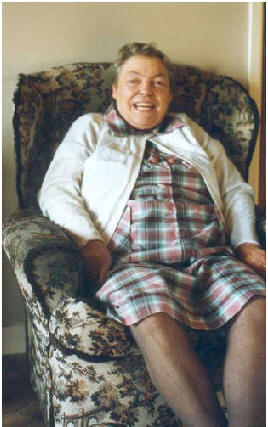 (photo: John Howson)
Maggy Murphy was born in Tempo, Co. Fermanagh, Northern Ireland and has lived in and around that area all her life. Her singing was first recorded in 1952 by Peter Kennedy at the house of Mr Bob Woods at Bellyreragh where she was working in service. Peter Kennedy was taken to record her by the Irish folk-song collector Sean O'Boyle. As Maggy says, "Sean was married to the daughter of Mrs Woods and he had heard that I sang while I was milking the cows and coming away from work."
She spent her working life in service so it's maybe not surprising that she has several songs which feature serving maids /boys. Maggy says of her days in service, "That time you were hired at a hiring fair. Tempo fair wasn't a hiring fair - Trillick was a hiring fair and Enniskillen was a hiring fair. It was 10th of May and 10th of November, every six months and you worked then for six months in a place and if you left before the six months then they kept your wages. So you had to stay there whether you were starved or not. "
Maggy left work at Bob Woods' to get married and was married for thirty years until her husband died in 1981. She remembers: "He (her husband) was a good melodeon and spoons player. My maiden name was Chambers and Sarah was my niece. She would have been just 16 or 17 when she sang the chorus of 'Linkin' o'er the Lea' with me. My father was a good singer surely, but he wasn't as good a singer as my mother and you could never learn a song from him, but I learned the whole songs from my mother singing them, and that was at home. She'd sing them, then I'd sing along with her. Then if I'd get them wrong she'd write them down for me. She got her songs from her mother but I never knew my Granny. Now all the Chambers they could sing but only my brother Ed had songs like 'Clock striking nine'. They called him Ned. He's been dead 27 years now and he was also a terrible (good) dancer. Honest to God if he was dancing you'd swear it was drum sticks. That was dancing the old-time reels and things like that. Then my uncles on the Chambers side; one also called Ned, he was in the army and he used to go to country houses and he used to sing and lilt for people to dance to, and my Uncle Paddy he was also a terrible (good) dancer and he played the mouthorgan. I used to be great at picking up songs from other people singing them but I never sang in pubs and after I got married I only sang occasionally in country houses."
Maggy Murphy was 72 years in October 1996 and she found a new audience for her songs and not only in her own locality, but she was also invited to several singing weekends including Inishowen, Derrygonelly and Forkhill and she has appeared on 'The Pure Drop' on RTE television! (John Moulden)
Maggy Murphy can be heard on: VT134CDR
Buster Mustoe (Worcestershire)
Buster was the landlord of the Vale of Evesham pub ‘Round of Grass’ in Badsey, Worcestershire. The pub takes it’s name from the locally grown asparagus. Mike Yates was taken to see him by Gwilym Davies who knew of Buster through recordings made by Charles Menteith. Buster had also sung The Tree on the Hill, Here we come a-Wassailing and Marriage to me has been a Failure to Menteith and the recordings can be heard in the British Library National Sound Archive. (John Howson)
Buster Mustoe can be heard on: VTC6CD
Harkie Nesling (Suffolk)
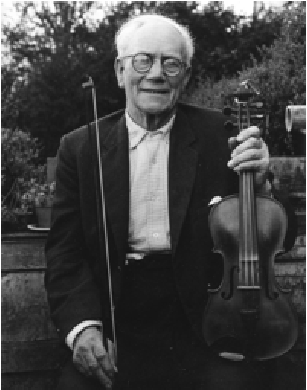 (photo: Mike Yates)
Harkie (Harcourt) Nesling was born in 1890 in Bedfield although his father’s family were from Westleton. In 1910 Harkie moved to London for a short period, to work as a wheelwright, and at night played in a pit orchestra for the silent movies, before an accident at work forced him to move back to Suffolk, where he married. He told Keith of his first musical experiences (from ‘Sing, Say or Pay’): “My first instrument was a concertina. I got it when I was only about five or six. My dad's boss had a brother called Sidney Curtis, a crippled chap. He had two or three concertinas and he knew I liked music, so one morning I got up to go down the bottom of the garden to have a wee y'know, and when I came back there was this box on the doorstep. I was real pleased with that. It weren't an English concertina, no, a German one. After that I mucked about on a 5-string banjo and a mandolin but never on an accordeon - I preferred string instruments. I didn't get on the violin till I was about 14 just after I left school.” After the Great War, Harkie reunited with fiddle player Walter Gyford and melodeon player Walter Read to form a country dance band. They played for weddings and village hops, in pubs such as Monk Soham Elm and Bedfield Crown, and rather intriguingly played every Thursday (pension day) at Bedfield Post Office! (From ‘Sing, Say or Pay’): “We played all old country tunes - polkas, waltzes, hornpipes. Walter Read was a master of step-dance music. And on Sundays I played in the band in Monk Soham church with Tom Chapple (violin) and his wife - she played organ and piano lovely. Every Christmas I'd walk to Earl Soham with a couple of mates and play carols in the pubs - we used to get back home about five in the morning with two or three quid in our pockets; and in August our band was always at the Galas - Debenham on Monday, Framlingham on Tuesday and Dennington on Wednesday, one after the other. We had some damn good times then!”In later years Harkie teamed up with fellow fiddle enthusiast Fred Whiting and it was at Harkie’s cottage that Keith first met Fred. Harkie died in 1978. As Keith summed him up him, “wheelwright, barber, carpenter, wart-charmer and local musician all his life!”
Harkie Nesling can be heard on: VT154CD
Jen Newson (Suffolk)
 (photo: Carole Pegg)
(Jen - left , with Oscar Woods)
Jen (John) was born in 1952 in Woodbridge, Suffolk but has lived in the village of Easton for many years. He has worked in engineering and is now in the building trade. He was Oscar Woods son-in-law and spend many hours with Oscar, learning to play the melodeon. As you can hear from his recordings he has picked up Oscar’s style completely.
Jen Newson can be heard on: VTDC11CD
Harvey Nicholson (Cumberland)
Harvey Nicholson of Wreay, who sang 'The Copshawholme Butcher' on VT142CD 'Pass the jug Round' was born at Sebergham in 1892 and after spending his early life being hired out on farms, later became a plate-layer on the railway. Harvey was killed in an accident on the railway shortly after he was recorded. (Sue Allen)
Harvey Nicholson can be heard on: VT142CDR
Jim Nixon
(Cumberland)
Jim Nixon sang 'The Keach in the Creel' on VT142CD 'Pass the Jug Round', a song he says he learned from his grandfather. He was a farmer at Peastree Farm in the valley of the River Caldew, which runs from the Caldbeck fells to Carlisle, where it joins the River Eden. Jim was born at Linstock, just north of Carlisle, in 1902. (Sue Allen)
Jim Nixon can be heard on: VT142CDR
Will Noble (South Yorkshire)
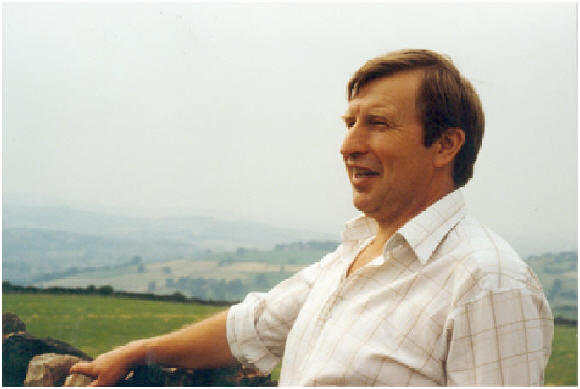 (photo:
John Howson)
(photo:
John Howson)
Will Noble is a builder, drystone waller and stone mason and has lived all his
life in South West Yorkshire. He became known all over the country as a part of
the Holme Valley Tradition along with John Cocking, Barry Bridgewater and Ernest
Yates.
Will's family sang, particularly his
two uncles, and it was probably from them that he learned his first song whilst
on the farm as a boy. His father, Arthur, also sang, although his repertoire was
mainly made up of fragments. Although it was the
family that gave him a taste for singing, Will's first regular singing was at
the local hunt meetings, particularly those of the
Holme Valley Beagles. Although not a huntsman himself, he would go to the 'do'
after the hunt for the singing, and it was here
that he started to learn songs. At Christmas he visited 'The Fountain' at Ingbirchworth and joined in the local carol-singing
sessions. This strong tradition is still active in several South Yorkshire and
Derbyshire pubs. Will is now the carrier of the songs
of many fine local singers, and in his ample hands his local singing tradition
is surviving very well. (John Howson)
Will Noble can be heard on: VTC1CD VTC4CD VTC6CD VTC7CD VT147CD & VT161CD
Ernie Nunn
(Suffolk)
 (photo:
John Howson)
(photo:
John Howson)
In Wetheringsett, Mid-Suffolk the Nunns were the famous musical family and Ernie
Nunn, who was born in the parish in 1908, continued the tradition. He played
melodeon in the village pubs, the White Horse and the Trowel and Hammer along
with his brothers George (known as 'Ninny') and Walter (known as 'Hood').
Ernie's cousins stepped and they would attract others who stepped like Elijah
Parker (Smith) from Mendlesham Green and musicians including Reg Pyett. He
recalled that the women would also dance in the pub, in particular the Heel and
Toe Polka.
Ernie Nunn can be heard on: VTDC8CD
Sarah Anne O'Neill (Co. Tyrone)
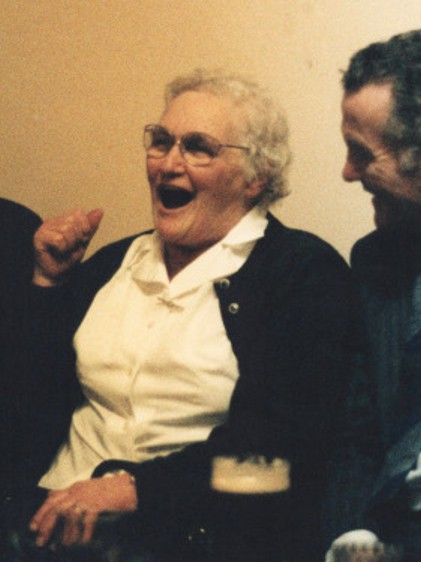
Sarah Anne O'Neill was born in Derrytresk, Coalisland, County Tyrone in 1919. She came from a large family of ten children and three half-brothers from her mother's first marriage. Her father sang and played the fiddle and would gather other fiddle players to the house for some tunes. There was also lots of singing in the house and this encouraged herself and her younger brother Geordie (Hanna) to learn songs. Sarah Anne continued the tradition of house singing parties for many years in her own home. In 2009 she was awarded the TG4 Traditional Music Award, one of the highest honours in Irish traditional singing circles.
Sarah Anne O'Neill can be heard on VTC10CD
Tom, Jean and Ashley Orchard (Devon)
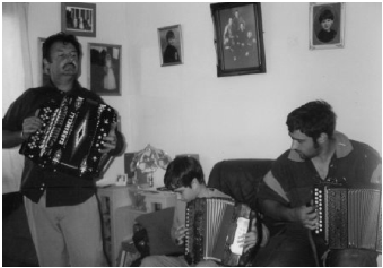 (photo courtesy of the Orchards)
Tom, a young Ashley and brother Richard
 (photo courtesy of the Orchards)
Jean and her mother Amy Birch
 (photo Katie Howson)
Tom steps to Mark Bazeley's melodeon
Tom, Jean and Ashley
Orchard come from true Gypsy stock and they now live at Holsworthy, north Devon
where Tom runs a roofing business. They have a strong family tradition of
singing, stepdancing and making music and members of the family including Jean’s
mother Amy Birch and Tom were recorded in the 1970s and some of those recordings
appeared on Topic and Folkways LPs.
In recent years they have taken their music out of
their family circle to new audiences at festivals and gatherings up and down the
country. Theirs is a fascinating family story is told by Jean in the booklet of
their CD 'Holsworthy Fair'
VT151CD (John Howson)
Padstow Carol Singers
(Cornwall)
 (photo courtesy Doc Rowe)
Sacred songs, hymns and carols held onto a regional identity until the appearance of the Victorian hymn books such as 'Hymns Ancient and Modern' (1861). After this date, for the most part, carols became standardised nationally.
Fortunately examples of earlier regional forms still exist in small pockets around England. Fisherman's choirs in North Yorkshire perform there own fishermen's hymns (see VTC5CD) and Christmas carollers sing a local repertoire in village pubs around Sheffield. This is also the case in North Cornwall where each Christmas the people of Padstow tour the houses and hostelries of their town to sing their own special repertoire of carols. (John Howson)
The Padstow Carol Singers can be heard on: VTC1CD
Freda Palmer (Oxfordshire)
 (photo Derek Schofield)
Freda Palmer with Mervyn Vincent, Padstow
Freda Palmer came from the village of Leafield in Oxfordshire although she was living in Witney when I met her. Leafield is, of course, the home of the traditional Fieldtown Morris and must once have had an active singing tradition. Freda had quite a large repertoire of songs and was very happy to sing, although many of her songs had to be teased out of her memory over quite a period of time. As a girl, Freda had worked with an aunt making gloves and to pass the time, the pair would swap songs, singing to each other across a communal workbench. The songs heard here came originally from her aunt. Other recordings of Freda Palmer can be heard on MTCD311-2 ‘Up in the North, Down in the South’. (Mike Yates)
Freda Palmer
can be heard on: VTC7CD
Ernie Payne (Gloucestershire)
Ernie Payne was another Gloucestershire singer
who was introduced to Mike Yates by Gwilym Davies. Ernie lived in the village of
Hawkesbury Upton and Mike recorded him singing The Seeds of Love in 1975. Gwilym
subsequently recorded over two dozen songs from Ernie but these were mainly
Music Hall songs. (John Howson)
Ernie Payne
Walter Pardon
(Norfolk)
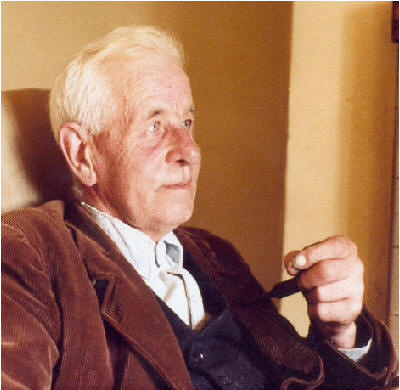 (photo John Howson)
Walter Pardon became one of the most famous folk singers of the 20th century.
Born in 1914 in the village of Knapton, Norfolk, he spent all of his life
working there as a carpenter. Both of his parents were singers, as were his many
uncles. During the depression of the early 1930's, Walter spent much of his time
with his Uncle Billy who worked on a golf course as a groundsman. When times
were bad he'd be laid off... "We'd sit of an afternoon in one of the (garden)
sheds. He'd keep a bottle of something or other under the floorboards and he'd
get that out and we'd sit there, the two of us, him singing and me listening.
And that's how I got most of my songs."
Like many country singers he also
sang songs associated with the sea including: ‘The Bold Princess Royal’, ‘The
Wreck of
the Ramillies’ ‘The Dark-eyed Sailor’ and ‘Jar Tar Ashore’. In 1974 Walter was
discovered by Peter Bellamy and, having made a number of record albums, was soon
appearing at festivals all over the country. In 1976 he was invited to
Washington to appear in the American Bicentennial celebrations. (Mike Yates)
Walter Pardon can be heard on: VTC1CD VTC5CD & VTC7CD
Alan Pate (Cambridgeshire)
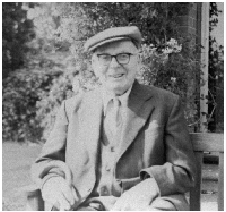 (photo courtesy of Martin Pate)
Alan Pate was born in 1895 at Clare Farm, Witcham, Cambridgeshire. The land had
been bought from Clare College, Cambridge by his father George Pate, who moved
from Little Downham, Cambridgeshire. Alan lived on the farm all his life and his
grandson still does some farming there.
He was a self taught piano player and
read music a little. He also played fiddle for local dances in the 1940s along
with Mildred Harrison on piano. This was particularly popular after the monthly
whist game which was held in the village school hall. Their repertoire included
waltzes, the barn dance and other dances of the period. Alan was known in the
village for his comic monologues, as was his elder sister Olive, who was the
infant teacher in the village school. He would be asked to recite them at Mepal
(the next village) over sixties club as well as at functions in his own village.
He told his stories from memory and never had them written out. He died in 1982.
Other Items from Alan Pate in the Sam
Steele collection are The Farmer’s Boy, Johnny Sands, It Don’t Seem a Day Too
Long and the monologues Watching the Hole and The Student.
Alan Pate can be heard on: VT150CD
Billy Patterson (Norfolk)
The only information we have about Billy Patterson is that he lived in a council
house in Chedgrave, Norfolk and that he was an old man when Steve Shipley
recorded him in 1975.
Billy
Patterson can be heard on
VTDC11CD
Fred Pearce (Suffolk)
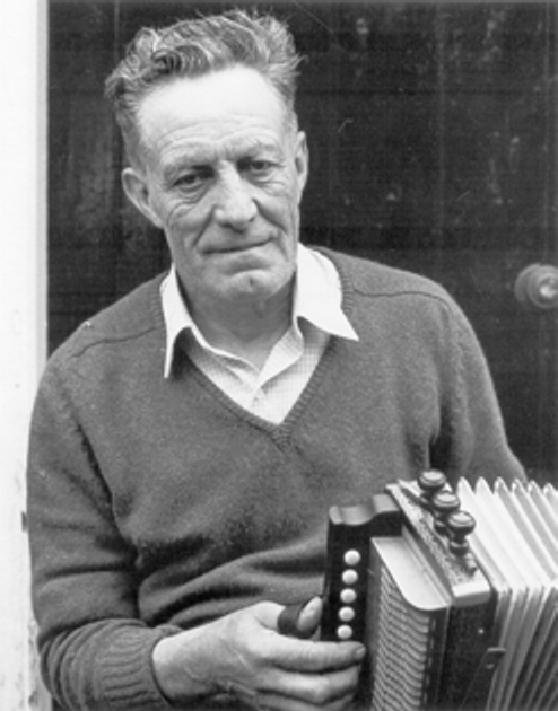 (photo Mike Yates)
Fred was born in Eyke, Suffolk in 1912, and moved to Blaxhall in 1938. He played mouth-organ as a child but he didn't start on the melodeon until he was twenty-four. He was self taught although there were several good players in Blaxhall to teach him and he reckoned that he had played in about forty pubs in his time, travelling mainly by bike or bus, including Darsham Fox with Ernie Seaman and as far afield as Ilford in Essex. One of his proudest memories was playing for twelve hours nostop on Coronation Day (1953) at the Waveney Hotel, Oulton Broad. Eventually he became the resident melodeon player at the Blaxhall Ship where he was expected to play a mixture of stepdance tunes, polkas, waltzes and song tunes every Saturday night. He took over from George Leek and when Fred retired in about 1960 he was followed by Bob Melton, Fred List and Oscar Woods and although he become slightly deaf he would occasionally relieve one of his successors and could still play extremely well.
Fred
Pearce can be heard on
VTDC11CD
Cecil Pearl (Suffolk)
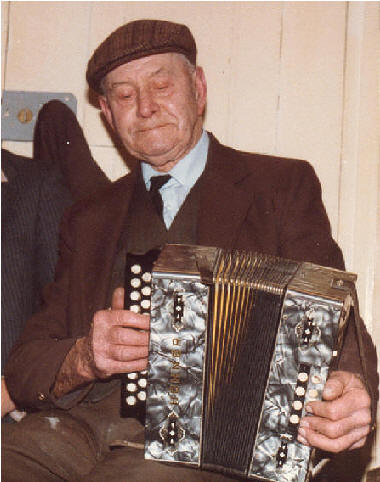 (photo: John Howson)
I was contacted by Cecil's grandson and recorded Cecil at his house in Claydon near Ipswich when Cecil was in his eighties. He spent his working life on the land and used to operate a steam threshing machine on his father’s farm at Henley. He has a light flowing style on his Hohner two-row, and a repertoire gleaned from a lifetime of listening to some of the best local players: people like Dick Iris from Hadleigh, Charlie Rookyard from Helmingham and Tom Bayham from Otley, who used to play in Coddenham Duke’s Head, Witnesham Barley Mow, and Swilland Half Moon. Then on Whit Monday Cecil would visit Debenham Fair, knowing that he would find the highly-acclaimed Alf Peachey playing in one of the pubs there. (John Howson)
Cecil Pearl can be heard on: VT130CD & VTDC11CD
Clement Pearson
(Suffolk)
 (photo:
John Howson)
(photo:
John Howson)
Born in Wickham Skeith, Mid-Suffolk, Clement or 'Tiner' as he was known (derived
from Clementine!) had vivid memories of lively Saturday and Sunday nights in the
Swan during the 1930s and he also visited other local pubs like the Brockford
Griffin, Thwaite Buck's Head, Thornham Four Horseshoes, Stonham Brewers' (The
Tap), Westhorpe Crown and Mendlesham Fleece and King's Head. He learned to play
from his brither Jack and liked to vamp on the mouthorgan and once had a
chromatic one, but said he gave that up as he nearly cut the end off his tongue
with the button.
Clement Pearson
can be
heard on: VTDC8CD
Jack Pearson (Suffolk)
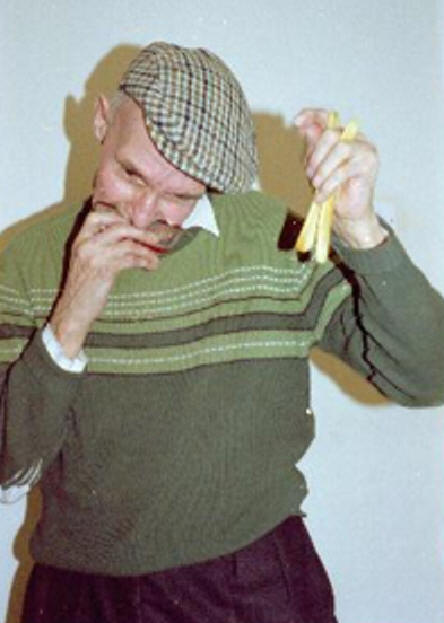 (photo: John Howson)
Jack Pearson was a musician who mastered the rare art of playing bones and
mouthorgan together. Although I recorded him in his retirement home in Felsham,
he was actually born in Wickham Skeith where at one time he lived at Mill Hill
in a hut. He said that he learned his first tune, 'Now the day is over' when he
was seventeen, from a man who was over eighty. He often played for social
evenings in the village hall with his mother playing the piano. He had a large
collection of instruments bought from catalogues, and played them all by ear. In
earlier days he played in the Wickham Skeith Swan along with local melodeon
player Ethel Collins and taught his younger brother Clement Pearson to play.
Jack Pearson can be heard on: VTDC8CD
Norman Perks
(Gloucestershire)
I went to Hawkesbury Upton,
Gloucestershire looking for Ernie Payne who sang a version of 'The Seeds of
Love'. Norman Perks was in the bar and, overhearing me ask for Ernie, said that
he knew a good song. I recorded Norman's one song just before Ernie arrived and,
sadly, never had time to ask Norman anything about himself, his song, or even
whether or not he knew any other songs. (Mike Yates)
Norman Perks can be heard on: VTC5CD
Charlie Pitman
(Cornwall)
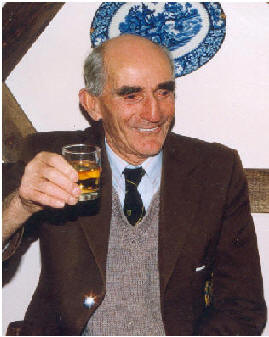 (photo: John Howson)
Charlie Pitman was born in 1914 in St Ives and his father was a lighthouse keeper and so he spent some years away from Cornwall at Fairlight, on the South Downs. After returning to Cornwall, Charlie worked on the land and in later years became the green keeper at the local golf course in St Merryn. He enjoyed fishing from the rocks on his native North Cornwall coast, sometimes with Tommy Morrissey and he entered many competitions. His other great interest was bell ringing and he regularly rang the bells at St Merryn church, but it was singing in the pub on a Saturday night which he really loved, especially comic songs, which he performed with a wry twinkle in his eye. Charlie died in 2003.
Charlie Pitman can be heard on: VTC1CD & VTC9CDR
Peter & Charlie Plant (Suffolk)
The Plant
brothers were from Framlingham and again there has been very little written
about them. There is David Nutall’s sighting of them in Saxmundham Railway (see
his piece on George Woolnough) and Carole Pegg’s recordings at Great Glemham
Crown, where again they had just turned up, although Peter was actually a
regular at the pub, where he would meet up with local melodeon player and singer
Ted Cobbin. Keith Summers recorded them there in 1975 and in his piece at the
beginning ofthe booklet he mentions that Peter Plant was in much demand by local
landlords to play in their pubs.
Peter &
Charlie Plant can be heard on
VTDC11CD
Monty Chapman (Cambridgeshire)
 (photo courtesy of Neil Lanahm)
(Monty (centre) on a night out)
Monty was born at Weston Colville, Cambridgeshire. He was known firstly as an entertainer and would sing and accompany himself on his single row melodeon often with the opening line, 'I used to be a good singer ‘till they brought out music'. In the 1950s he worked for Baldock’s Steam Engine Company of Haverhill and drove a Garrett engine. When Baldock’s closed he worked for Burton’s Coaches as a coach driver and would have his melodeon behind the seat, which would be brought out to entertain on every possible occasion! When he retired from this he became a lollipop man. He was sadly missed by the community for his quick local wit and sayings.
Monty
Chapman can be heard on
VTDC11CD
Mr Potter (Cambridgeshire)
Unfortunately we have no information about Mr Potter except that he lived in Weston Colville, Cambridgeshire and that he played his father’s country dance tunes on a single row melodeon.
Mr Potter can be heard on
VTDC11CD
Reg Pratley (Oxfordshire)
 (photo courtesy of Jamie Wheeler)
(Francis Shergold with Reg at the back right)
Reg Pratley was born in 1909 in Leafield, Oxfordshire. His father Frederick was the landlord of the Potter's Arms wherehe encouraged singing on a Saturday evening and sang songs himself. As a young boy Reg would stand on a table and sing, and he remembered that he would often get 8d or a shilling for singing. Frederick kept the pub for thirty years before handing it over to his eldest son who kept it for a further seven years. Reg continued this family tradition and after moving to Bampton he became landlord of the Jubilee where again he found “a lot of people who could sing a song or tell a story”. He kept the pub for thirty years and died, after retirement, in 1996.
Reg Pratley can be heard on VTC10CD
Reg Pyett (Suffolk)
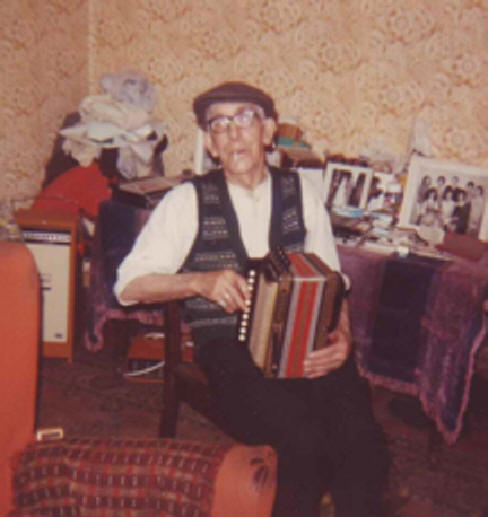 (photo:
John Howson)
(photo:
John Howson)
One of the best melodeon players in Mid Suffolk was Reg Pyett. He was born in
1899, into a large family in Mendlesham. He was eighty-one when I met him, and
he told me that he started playing when he was eight and used to meet up with a
local melodeon hero, Alf Peachey, when he was eighteen. He remembered playing a
lot for stepdancing. Reg worked on the railway and was able to get privilege
tickets which came in useful when, in 1925, he started courting a girl in
Notting Hill. On one occasion the landlady where he stayed arranged for him to
play at the London Hippodrome. He had gleaned tunes from all sorts of sources,
including fair ground steam gallopers.
Reg Pyett can be heard on: VTDC8CD
Ted Quantrill (Suffolk)
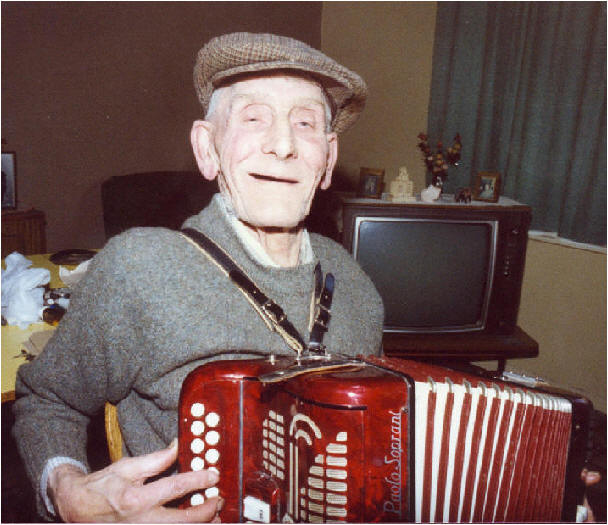 (photo: John Howson)
I didn't meet Ted Quantrill too many times but what an impression he made on me
when we did meet! He was amongst the last of the Lowestoft fishing folk who had
worked the North Sea under sail and he remembered those days vividly. He was one
of the few singers who sang to me whilst accompanying himself on the melodeon.
During his later days at sea he had lost a leg and when I met him he was
confined to a small flat in the back streets of Lowestoft. I'll let him tell his
own tale:
"I went in a ship called the Crystal
T1275. Oh Yes! There aren't many of us left now that went in the sailing smacks.
It had a beam trawl and two short heads rather than an auto door like they have
now. All depending what time of the year it was we'd go… well, in April we'd be
in old Cromer now, that way, north about. When the summer had set in we'd go
what we called up and along. Up to the Hinder almost as far as the Wash, and get
the big whiting with the roes in them, and we used to sell those separate. We
nicknamed them dust: ‘I wonder how much dust we're going to get this week’, we'd
say. "Now when it comes to music where can I start? Yes, my poor old father, he
was the skipper of a smack, not a five-hand but a four-hand. In fact he would
take four in the winter and three in the summer. Now you didn't need a ticket
for one of them but a five hand-smack you did, and he always had an old
accordeon; he was always a good player. Now, my ambition was to play one and
every night when he came in from sea, I used to sit on that chair and watch his
fingers. Now, I used to play in the pubs and give them an old song. I can't read
a ha'penn'orth of music - I don't want to - but I could go from one song to
another." I once asked Ted why he sang so few songs about the fishing. His reply,
"Well you've been out there, out in the wind and squall, that's the last bloody
thing you want to sing about when you get home!" (John Howson)
Ted Quantrill be heard on: VTC1CD & VTC5CD
Billy Rash (Cambridgeshire)
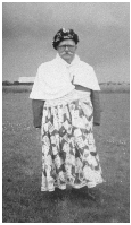 (photo courtesy of Peter & Alison Rash)
Billy Rash was born as a twin in 1880, and lived in Gable Cottages, West
Wratting, Cambridgeshire. He worked as a pigman and cowman for a Mr Frost and
then worked in Pettit’s bakehouse in the village. He was also a grave digger and
church bellows blower!
He sang songs and played melodeon in
the Chestnut Tree, West Wratting and was described as a short tubby man who was
always jolly. Russell Wortley recorded him playing and his repertoire seems to
been mainly song tunes. When Billy died in 1962 his son George came home with
all his belongings including his accordeon (melodeon) and a squeeze box
(concertina) and the young grandchildren squabbled so much over who should have
the melodeon that George put an axe through it.
Billy was
a member of the ‘Ancient Order of the Foresters’ and was a cricket umpire for
Fulbourn near Cambridge and West Wratting. When there was a village fete he
would wear fancy dress to umpire (see photograph) and when he got older they
would take a chair out onto the pitch for him.
Other songs from Billy Rash in the Sam Steele collection are The Banks of the
Sweet Dundee and the Dark-Eyed Sailor.
Billy Rash can be
heard on:
VT150CD
Betsy Renals (Cornwall)
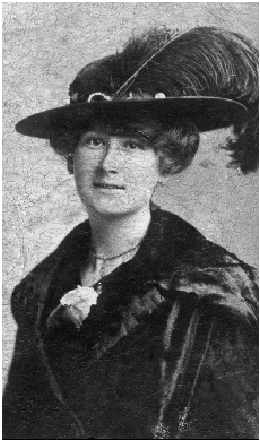 (photo courtesy of Vic Legg)
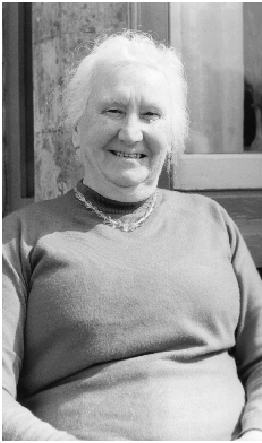 (photo courtesy of Vic Legg)
Bestsy Renals was born in 1900 into one of the best known West Country travelling families, the Orchards. She is Vic Legg's aunt and was source of many of his songs as were her two sisters Charlotte and Sophie (Vic's mother).
Their father Edwin was born in 1879 and was married to Susan (also an Orchard) when he was twenty and she was sixteen. At that time they run a coconut shy at local fairs until Edwin became a fairground bare-knuckle fighter, taking on all-comers for three weeks. He earned good money, in fact he earned enough to buy themselves a wagon, enabling them to give up the fair life to go on the road. They hawked haberdashery and when they stopped at night they would often meet up with other Gypsy families and songs would be shared around the camp fire.
Betsy and her sister Charlotte married brothers Jack and Bob Renals, on the same day in 1924. They went on the road and although the boys were Gorgios (non Gypsies) they took to travelling life for the next seven years. (Pete Coe)
Betsy Renals can be heard on: VT119CD
Charlotte Renals
(Cornwall)
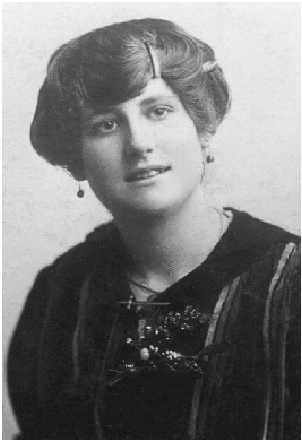 (photo
courtesy of Vic Legg)
(photo
courtesy of Vic Legg)
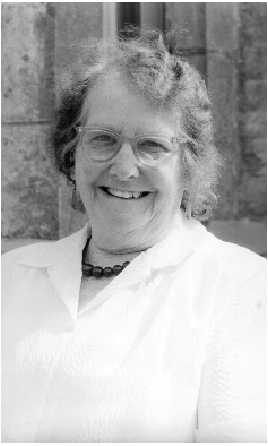 (photo
courtesy of Vic Legg)
(photo
courtesy of Vic Legg)
Charlotte Renals was born in 1902 into one of the best known West Country travelling families, the Orchards. She is Vic Legg's aunt and was source of many of his songs as were her two sisters Betsy and Sophie (Vic's mother).
Their father Edwin was born in 1879 and was married to Susan (also an Orchard) when he was twenty and she was sixteen. At that time they run a coconut shy at local fairs until Edwin became a fairground bare-knuckle fighter, taking on all-comers for three weeks. He earned good money, in fact he earned enough to buy themselves a wagon, enabling them to give up the fair life to go on the road. They hawked haberdashery and when they stopped at night they would often meet up with other Gypsy families and songs would be shared around the camp fire.
Charlotte and her sister Betsy married brothers Bob and Jack Renals, on the same day in 1924. They went on the road and although the boys were Gorgios (non Gypsies) they took to travelling life for the next seven years. (from Pete Coe's notes)
Charlotte Renals can be heard on: VT119CD
Jack Rice (Devon)
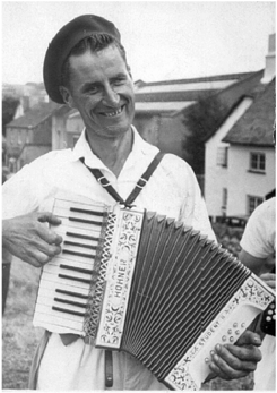 (photo courtesy of Elsie Rice)
(Jack with Chagford Merrymakers)
 (photo: Bob & Jaqueline Pattern)
(Stepdancing to the music of Bob Cann)
Jack Rice lived in Chagford on the edge of Dartmoor were he was the local postman. He was a quiet man who would get involved in any local gathering including the local carnival band known as the Merrymakers. In later years he played piano accordion but it was his mouthorgan playing that he was renowned for. He was described as a brilliant player by many and collector Sam Richards once described him on a local radio programme as the best traditional mouthorgan player he had ever heard. His forte were hornpipes particularly those for stepdancing, which is hardly surprising as he was a champion stepdancer himself. (John Howson)
Jack Rice can be heard on: VT144CD
Jason Rice (Devon)
 (photo:
John Howson)
(photo:
John Howson)
Jason Rice is Jack Rice's grandson and is carrying on the families musical tradition on piano accordion. He met up with Bob Cann's grandson Mark Bazeley some years ago and found they had many tunes in common. They had in fact both learned them separately from their respective grandfathers.
Jason and Mark are now two of the best exponents of English dance music (in the Dartmoor style of course) and along with banjo player Rob Murch they are now travelling to festival and clubs all over the country.
Jason Rice can be heard on: VT139CD VT144CD VT146CD
Les Rice (Devon)
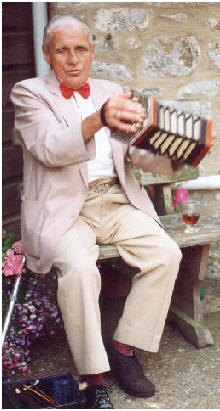 (photo: Maggy Hunt)
Les Rice lived in Chagford on the edge of Dartmoor and was cousin to Jack Rice. He was far more flamboyant than Jack and was never happier than when performing in one of the towns inns to an audience of visitors or locals. He played mouthorgan and anglo concertina and was well known for his old songs. He was also a excellent stepdancer and would vie with his cousin Jack for the coveted Dartmoor championship.
Les Rice can be heard on: VT144CD
'Lubidy' Rice (Suffolk)
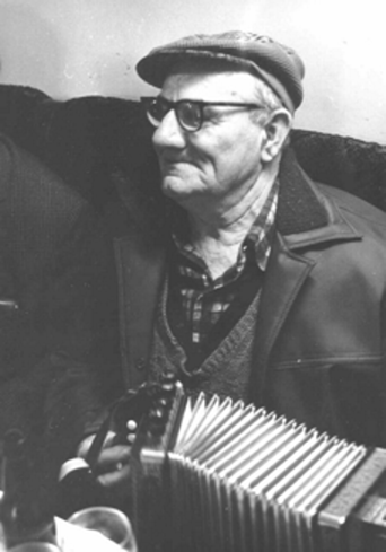 (photo:
John Howson)
(photo:
John Howson)
Many singers also played instruments and a real 'jack of all trades' was 'Lubidy'
Rice who was born in Gislingham, Mid-Suffolk but lived for many years in
Finningham. He was known locally as a bit of a character, a keen poacher and a
champion runner. As well as singing, playing melodeon and mouthorgan, he also
stepdanced, as did his wife Ethel, and they were known for stepping together,
face to face. Over the years his regular haunts were Finningham Black Horse and
White Horse, Wortham Dolphin, Thurlow Arms, Rickinghall Cross, Thornham
Horseshoes, and Walsham-le-Willows Six Bells and Blue Boar which is where he
learned the song ‘21 Years on Dartmoor'.
'Lubidy' Rice can be heard on: VTDC8CD
Rob Say (Northumberland)

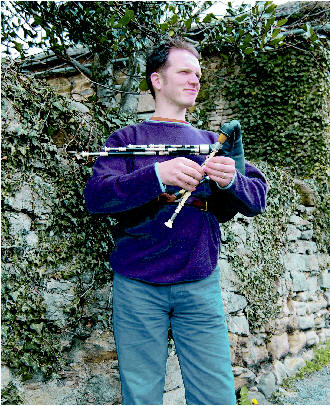 (photos John Howson)
Rob Say was born in Norfolk in 1975, spending his first ten years in the market town Wymondham. When Rob was ten, the family moved to Witton Gilbert in Durham. There his father Barry, who was from the North East, renewed his interest in the Northumbrian pipes. The family also became involved with a local morris team and it was a meeting with them that first got Rob interested in the concertina. Two of the morris musicians, played English concertina. Rob was intrigued by it and wanted to know how it worked. He borrowed a concertina and amazingly, he took to it like a duck to water and, using local tune books and his parents' recordings of Northumbrian music, he quickly started to learn tunes. Several months later he met Alistair Anderson at an event in Darlington where he also met Joe Hutton, Willy Taylor and Will Atkinson, who really impressed him although at the time he couldn't say why. This was probably the moment that confirmed to him that this was the quality and type of music he wanted to play.
He was now also realising that there was a lot of similarity between the pipes and the concertina. Once over the initial stages of learning the concertina, he became interested in the set of pipes his father played. After school he would take the pipes out of their case and have a go, but then put them back before his dad got home from work. Again he became intrigued: they were a very different beast to play, compared to the concertina. At eighteen he got his first set of pipes but it was also the same time he started university in Sheffield. He was suddenly 130 miles away without anyone to play with.
He would return home as often as possible, meeting up with the likes of Andy and Margaret Watchorn in Alnwick and Adrian Schofield who, at the time, was regularly in the North East. On each visit Rob would make sure there were as many sessions to attend as possible. The most memorable ones were often at the house of Annie Snaith, who had played piano with Billy Pigg and John Armstrong of Carrick in the Border Minstrels and so was a direct link with that generation of musicians. She would have sessions with fifteen pipers crammed into her sitting room, with a roaring fire at one end and an old piano at the other. There would be old chaps with old sets of pipes in battered cases arriving through the door. The session would start in a somewhat subdued way at first, then at ten o’clock there would be a fantastic tea and everyone would let their hair down and create amazing music
It was at university that Rob met and married Ali Courtice who is a dancer and dance musician. After his graduation they moved south to Hampshire to find work and for almost three years there, Rob didn’t meet any musicians. His playing became seriously reduced although he did make sorties back to the North East as often as he could. On one of his trips back to the North East Rob arrived at Bellingham Show, where he was asked if he was considering entering the piping competition that was about to start. He had not thought of entering but he took out his pipes and won the novice competition. Then at the Alnwick Gathering a couple of years later the Watchorns asked him to enter, pointing out that there were only two competitors and rules stated that there had to be three. Rob then won his first intermediate prize. He continued to enter competitions sporadically, entering open competitions, which gave a much wider choice of tunes and encouraged the use of classic variations. He went from not being placed to getting thirds and then seconds. Then he reached a stage where he was consistently coming second to Andy May, the acknowledged leading piper of his generation.
Then in Rothbury in 2000 he finally won his first open class competition. This proved to be a turning point in his fortunes, as he entered more competitions and experienced more success. Rob has now semi-retired from competitions but still maintains an interest in this important institution which also provides opportunities to meet other pipers. He is now based in Northumberland, in the village of Wall near Hexham, where in 2006 he was asked to organise a village dance, so he and Ali formed The Wall Star Village Band, consisting of musicians who all have some sort of link with the village. They continue to play for local dances as well as now travelling further a field. Rob is now also a sought-after teacher of the Northumbrian pipes and the concertina.
Over this time many of the older generation of players have passed on, but Rob still has vivid memories; of going to the very last dance played by the Cheviot Ranters in the Guest Hall, Alnwick and an occasion when he was performing the ‘Seven Stars Hornpipe’ and Willy Taylor came running to pull his fiddle out and join in half way through, as he was so glad to hear the tune. Then, the unforgettable moment when Will Atkinson leant over and said, “Keep playing like that and you'll be alright.”
Wise words indeed!
Rob Say can be heard on: VT157CD
Bruce Scott (Liverpool)
 (photo courtesy of Bruce Scott)
Singing in the Liverpool Irish Centre
 (photo courtesy of Bruce Scott)
Bruce (second from the right) with a demolition team
Bruce Scott was born in 1941 in Everton, Liverpool, an ‘FBI’ or foreign-born Irish: his maternal grandparents were Dublin Catholics and on his father’s side the family were Derry Protestants. The oldest of six children, Bruce recalls hearing his mother’s mother singing Irish ballads and Percy French songs and other family members singing too: “I suppose the first song I ever got was Kevin Barry. I must have been a bit political when I was a kid - that was off my mother, she always sang it. I would have been about twelve maybe. In those days people would have dos in their houses and I’d be listening in. They used to have what they called ‘Jars Out’ after the pub, because the pubs shut at ten then, so they’d bring some drink back from the pub and the kids stayed up. There was no records or anything like that, it was always singing.”
From there on he learned songs from local Irish workers like Kerryman Noel Scanlon and mixed with visiting travellers like the Dorans. He travelled Ireland extensively in the early 1960s with Barry Halpin and came back with many songs that are rarely heard in Ireland today. More recently he took to writing his own songs and in 2004 he won the All Ireland Newly Composed Ballad competition with 'My Colleen By the Shore'
Bruce Scott can be heard on: VT149CDR
David Savage (Suffolk)
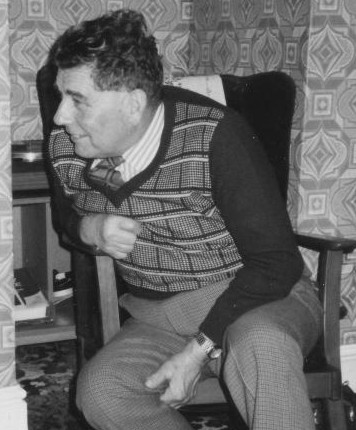
David Basil Savage was born in 1921 in Blaxhall, east Suffolk, He was one of ten children (one sister and nine brothers) and attended the village school, where he was allowed to leave early at the age offourteen, as he had secured a job on a local farm. He worked at Stone Farm, Blaxhall for most of his working life. His father, Robert, was a shepherd and known as a local character. His mother Priscilla sang songs and was recorded by George Ewart Evans in 1956. David sang mostly in Blaxhall Ship, often alongside his brother Len Savage and his cousin Geoff Ling who can be heard on VTC2CD ‘Songs Sung in Suffolk' and VTC3CD ‘Comic Songs Sung in Suffolk'. David died in 1997
David Savage can be heard on: VTC10CD
Francis Shergold (Oxfordshire)

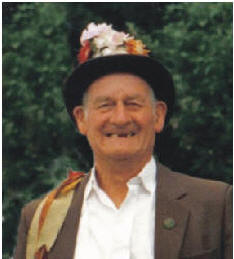 (photos: John Howson)
Francis was born in 1919 and as a young boy the family lived at the toll-bridge at Swinbrook, near Eynsham, on what was then the main Oxford to Cheltenham Road. The family moved to Bampton, Oxfordshire in 1932 and he worked for most of his working life at Weald Manor where he eventually became head gardener. He soon joined the village morris team (Bampton Traditional Morris Dancers) and was initially taught by the then squire and fiddle player ‘Jinky’ Wells. Francis first danced on Whit Monday in 1935 and eventually became squire when Wells retired. Francis danced for 60 years and held the role of squire for 50 of them before retirement in 1995. His songs come a variety of sources including his mother and the one time landlord of the Jubilee Inn in Bampton, Reg Pratley. More of Francis’ songs can be heard on VTC7CD ‘It was on a market day -Two’. (John Howson)
Francis Shergold can be heard on: VTC6CD VTC7CD & VT111CDR
Sam Sherry (Lancashire)
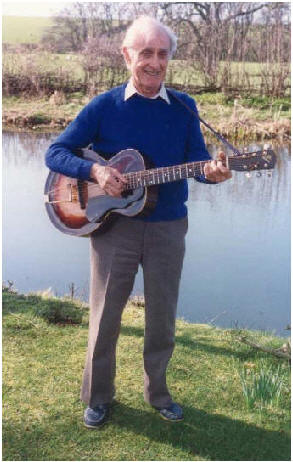 (photo: John Howson)
Sam Sherry performed for most of his life. His father Dan Conroy was a well known Music Hall artiste in the 1890s and all of Sam's brothers followed in their father's footsteps becoming known as the 'Five Sherry Brothers'. They performed in Variety theatres throughout the country. Topping the bill from Glasgow to Great Yarmouth and from Blackpool to most of the major London theatres.
On retirement Sam settled in Galgate near Lancaster, with a new career repairing and fitting out narrow boats. It was then he visited the local folk club and sing some of his Music Hall songs. A chance mention that a clog dancer was need for a local function set him off on his next venture. He had learned the Lancashire clog steps, as a youngster, from his father. Soon he became known as one of the finest exponents of the Lancashire clog dance. Even appearing on 'Coronation Street!. (John Howson)
Sam Sherry can be heard on: VTC1CDR & VT118CDR
Albert Smith (Suffolk)
 (photo: from Sing, Say or Pay))
Albert Smith was born in Butley in 1914. He was a
forestry worker and when he married he moved to Chillesford and lived there
until he died in 1982. His cottage was small but had a large kitchen garden of
which he was very proud. He was said to have fed the whole village with
vegetables!
Albert’s local local pub was the
Butley Oyster where singers like Ciss Ellis, Crump Snowden and Percy Webb sang
regularly. He played mouthorgan and Jews Harp as well as reciting comic
‘ditties’ to amuse the crowd and was often called upon to play Pigeon on the
Gate for
stepdancing as Percy Webb told Keith (from ‘Sing, Say or Pay’): “All my uncles
were good singers and stepdancers, especially when those Smiths were there or
Dick Woolnough. Fred Pearce could play well or Albert Smith - he'd play
mouthorgan in Butley Oyster and I'd dance.”
Albert Smith can be heard on: VT154CD
Bill Smith
(Suffolk)
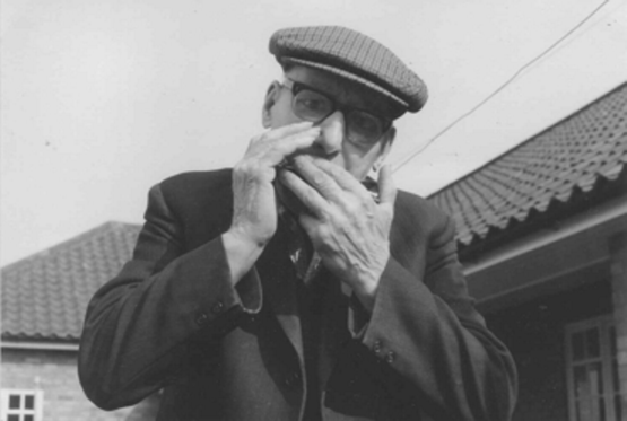 (photo: John Howson)
One particular local hotbed of mouthorgan playing in Mid-Suffolk was Walsham-le-Willows,
where I met Bill Smith. He was born in the village in 1898 and learned to play
mouthorgan and melodeon by the time he was eighteen. He played mostly in the Six
Bells where there would be three or four mouthorgan players including Alfred
Barham and George Hubbard as well as local songsters like 'Dilgy' Pollard. Bill
often lamented that music-making and singing stopped when the jukebox came in.
Bill Smith can be heard on: VTDC8CD
Hubert Smith (Suffolk)
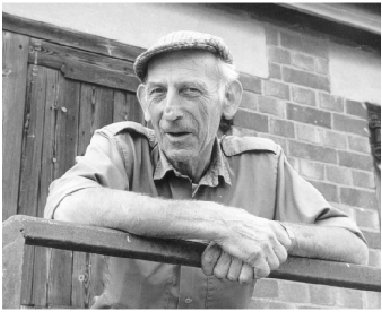 (photo:
John Howson)
(photo:
John Howson)
Hubert's main audiences for his singing in latter years were the cows he looked
after. He was a stockman for most of his working life, with days which could
stretch from four o'clock in the morning to ten o'clock at night: "I wouldn't do
anything else!"
He came from Tannington originally,
but lived at Thorpe Morieux for most of his life. In earlier days he worked with
melodeon player Font Whatling, and his sister married the renowned stepdancer Wattie Wright.
Thorpe Bull was usually the venue for a good sing, where Hubert would meet up
with Tom Smith (no relation) and play melodeon or sing a song or two. "If I gave
them a song they'd often be a bit dirty!" he told me. (John Howson)
Hubert Smith can be heard on: VTC3CD & VTDC8CD
Phoebe Smith (Suffolk)
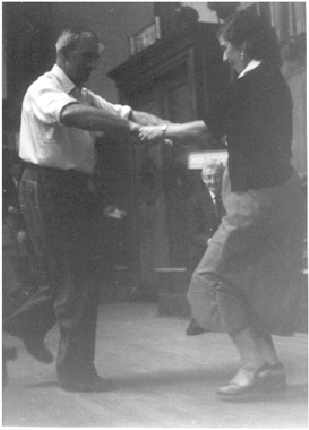 (photo courtesy of the Vaughan Williams
Memorial Library)
(photo courtesy of the Vaughan Williams
Memorial Library)
(Phoebe stepdancing with Bob Roberts)
Phoebe Smith was born in 1913 in Faversham, Kent, was the daughter of Bill Scamp and Ann Jones of Crowborough in Sussex, who earned their living partly on fruit farms in East Kent. She married Joe Smith, a scrap-dealer who played the fiddle, and they lived in Ickham Kent, then Tilbury in Essex and finally in Melton in Suffolk.
She sang and stepdanced from childhood and she learned many songs from her paternal uncle, Oliver Scamp, who was a horse-dealer. Phoebe visited several folk clubs in the sixties and seventies, particularly in London, and became known for her dynamic performances. (John Howson)
Phoebe Smith can be heard on: VT136CD
Tom Smith (Suffolk)
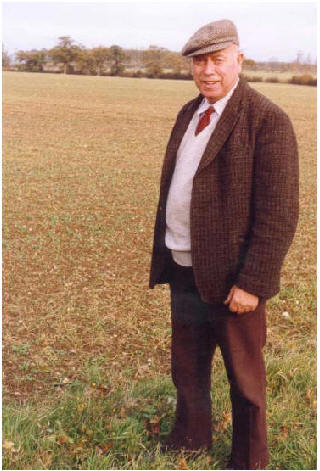 (photo: John Howson)
Tom Valentine Smith (yes, born on 14th February!) has lived all his life in
Thorpe Morieux, apart from a brief spell (about six years) away. "We had to move
back!" he said. His working life was split between twenty-five years on the land
and twenty-six working for Suffolk County Council. Without a doubt, it was Tom's
father, Bert Smith, who encouraged him as a singer, and it is mainly from him
that Tom's repertoire is gleaned: "He could sing from morning to night."
Thorpe Morieux Bull was the place
where the 'old boys' would gather for a Saturday night sing. Along with Bert
Smith, there would be Tom's brother George, Herbert Game, Briar Crick and Truby
Reynolds from Brettenham. "They've all gone now, but in those days you would
turn out at ten o'clock, so at half past eight the dart board used to come down
off the wall. Then singing for the last two hours!”
Tom has never really been a pub
singer himself, preferring to concentrate on the piano accordion, for which he
was always in great demand in many of the pubs in his area. The songs he sang to
me, had been written out when his father was alive, and I must say I'm glad they
were. (John Howson)
Tom Smith can be heard on: VTC1CD VTC2CD VTDC8CD & VTC10CD
Harold Smy
(Suffolk)
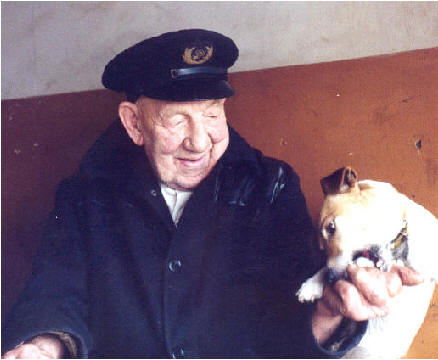 (photo:
John Howson)
(photo:
John Howson)
It was in a pub in Ipswich that the name Harold Smy came up, "Old Harold the bargeman, he'll give you a song. You'll find him down in
the docks most days not far from Tolly's Brewery." And it was there
that I met him. He was in his eighties and still helping around the repair yard
and supervising the piloting of sailing barges up the river Orwell, the river he
had known all his life. There in a little dockside office, he sang to me and
told me of his life.
"You see my father, my brothers, my
uncles, my cousins, they'd all been on the water. Even on my mother's side; all
her brothers and father, but they were all in steam; channel boats. I worked
with sail. I'd sail anywhere. I've been on trips to the continent on the 'Ena'.
Then going back some time I had one called the 'Frederick and Mary'. I was
bombed out of the 'Boy Joe' in 1940. I've enjoyed every minute of it. I don't
think I could do anything else if I had my time over again. I mean I haven't
done any harm in the world and I might've done some good!
"Most of my songs are about the water
and they come from my father. My old father he could sing, I can remember him
getting up and singing 'Scarborough in the Castle'. Well I've been singing all
my life. I love singing. Oh, I used to get about and give a song; the best pubs
were the Tankard, the Beehive and the Spread Eagle, but any old pub with a piano
you could have a bloody good sing. The bargemen; one or two used to play
concertinas. That's what I ought to have done. I used to stepdance, though, on a
tray, and there used to be one old boy and he'd have leather boots, and he had a
hole bored in the heel and had farthings put in there. He'd do a heel and toe
and 'cor they'd rattle." (John Howson)
Harold Smy can be heard on: VTC5CD
Emily Sparkes (Suffolk)
 (photo:
courtsey of Mrs Rumsby)
(photo:
courtsey of Mrs Rumsby)
Desmond and Shelagh Herring recorded Emily Sparkes in the late 1950s, at her
home Rattlesden, Mid-Suffolk. It was there she did most of her singing. She had
a repertoire of old and unusual songs which she had probably learned from her
father and grandfather. Her father’s name was James Poole, known as 'old
Sootpole', who was a well known pub singer who played concertina and danced on
the tables. Emily's daughter, Mrs Rumsby, who gave me this family information,
remembered that her mother also played mouthorgan and sang and told stories to
amuse the children and she might have sung at the Women's Institute when it was
formed in the village. Emily died in 1968 or '69.
Emily Sparkes can be heard on: VTDC8CD
George Spicer (Sussex)
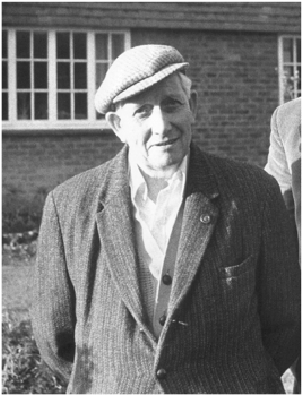 (photo
courtesy of the Vaughan Williams Memorial Library))
(photo
courtesy of the Vaughan Williams Memorial Library))
Although thought of as a Sussex singer, George Spicer was, in fact, born in the village of Little Chart in Kent in 1906. He worked as a herdsman in the area between Dover and Deal, picking up most of his songs there from his parents, in-laws and friends who sang in pubs such as The Wheatsheaf Inn at Martin and The Rose at West Langdon. In 1940 George and his family moved to Selsfield in Sussex and soon became friendly with singers such as Pop Maynard and Harry Holman. (Mike Yates)
George Spicer can be heard on: VTC4CD & VTC6CD
Ron Spicer (Sussex)
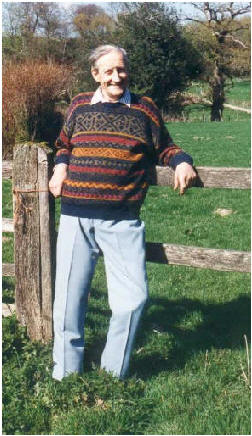 (photo: John Howson)
Although he has been a musician all his life, playing melodeon, accordion and electric organ, Ron has only started singing in recent times, years after the death of his famous singing father, George. Ron sangs some of his father's songs but also sang a wide range of other songs, sometimes to accordion accompaniment. He had a gentle but winning way with his songs and he quickly became one of the most popular figures at singing venues in the south-east. He and his wife, Doris, must have been amongst the most ardent supporters of folk clubs in their area, often going as many as 5 or 6 times a week. Born near Dover, Ron lived with his parents on farms where his father worked in various parts of Kent until moving to his final farm, not far north of the Andingly Show Ground as an 11 year old. (John Howson)
Ron Spicer can be heard on: VT131CD
Walter Stevens (Gloucestershire)
When Mike Yates and Gwilym Davies visited the Gloucestershire village of Bisley they made enquiries at the post office and other places in the village to see if anybody knew of any singers and the response was, “Go and see old Walt!” Unfortunately when they tracked him down he said that he had forgotten all of his songs, but just as they were leaving he said, “Have you ever heard of the Wonderful Musician?” and here it is! (John Howson)
Walter Stevens can be heard on: VTC7CD
Jack Stannard (Suffolk)
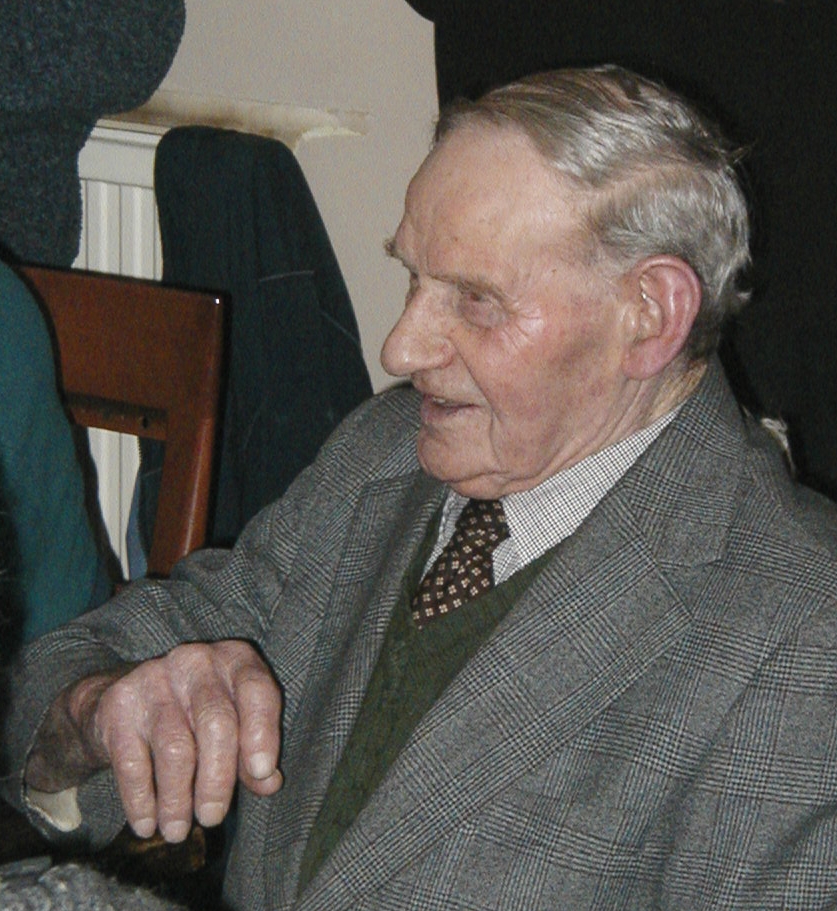 (photo: John Howson)
Jack Stannard was born in 1917 in Bedfield, Suffolk. He left school at the age of fourteen to work on the land for ten shillings a week. He then developed a particular love of Suffolk horses, becoming an expert horseman. He spent most of his working life in the employ of Robert Nesling of Bedfield. Jack’s large family were known for their singing and he has sung in most of the pubs in his locality, and at the age of ninety four, is still happy to give a song from his repertoire of country and comic songs, whenever the company is right.
Jack Stannard can be heard on: VTC10CD
Staithes Fisherman's Choir (North Yorkshire)
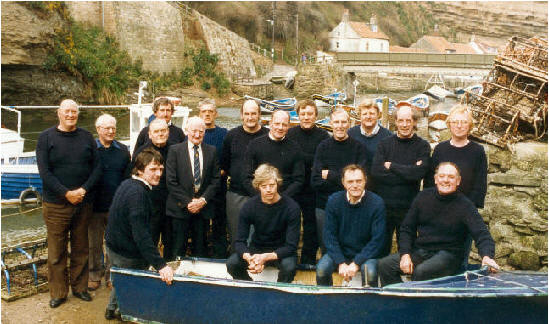 (photo Maggy Hunt)
The fishermen of the North Yorkshire coast have for years had a tradition of
hymn singing and sang not only at Sunday services, but also at sea and in the
village pubs at night.
In Staithes there were three chapels
and a church and each had its own choir. In the late 1950’s a fishermen's choir,
led by Mr Verrill, was formed and they gave concerts all around the district, as
well as once travelling to Manchester for an industrial service. The old choir
gave its final performance at Sleights in 1980, and the choir heard today was
formed in 1985 with four of the old choir as members.
The Staithes Fishermen's Choir sing
the traditional repertoire of fishermen's hymns and sacred songs, some of which
are rarely heard outside this area. Along with the fishermen of Filey and Maske
they continue this strong North Yorkshire tradition. (John Howson)
Staithes Fisherman's Choir can be heard on: VTC1CD VTC5CD & VT112CDR
Stan Steggles (Suffolk)
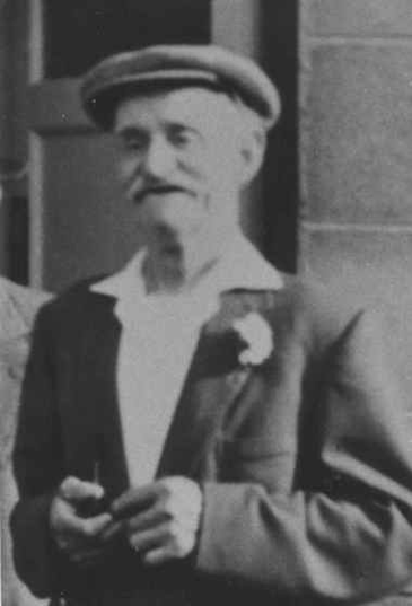 (photo:
courtsey of Charlie Steggles)
(photo:
courtsey of Charlie Steggles)
Desmond and Shelagh Herrings recorded Stan Steggles in 1958. Then he lived in
Rattlesden, Mid-Suffolk but was originally from Woolpit. Stan's son, Charlie
Steggles, told me that his dad would sing whenever he could, particularly at
weddings, and often after tea he would sit by the fire and rattle them off. He
was a bricklayer by trade, as was his father and his grandfather (and Charlie
continued the tradition). Stan was in the East Surrey Regiment during World War
One and had a knee-cap blown off and then learned shoemaking but he never kept
it up. Stan had a rich repertoire of old and unusual songs.
Stan Steggles can be heard on: VTDC8CD
Charlie Stringer
(Suffolk)
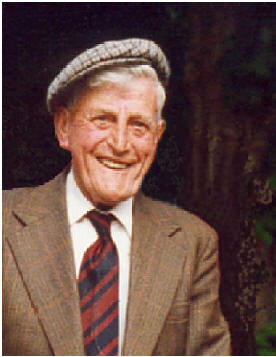 (photo: John Howson)
I first heard Charlie Stringer when Clement Pearson, a mouth-organ player from
Wickham Skeith, brought him to a music session in Finningham Railway Tavern. "Charlie'll
give you a song," and he certainly did. Born and bred in Wickham Skeith, he
lived there all his life apart from one year when there was a fire at his house.
Charlie's working life was spent on the land, and he became an expert horseman.
He told me, "I started work at thirteen and come harvest time, I had to harness
the horses, that was my job. I got a pound for that for the month. While they
mowed in the fields, they would sing all the time. I picked up some songs then."
Wag Stringer, Charlie's father, was
the local blacksmith and a fine singer himself, and Charlie learned many songs
from him. He told me, "I used to go to the pub with him when I was five years
old. Wickham Skeith Swan that was, and he used to sing in there, that's when I
learned my first song. 'Cranky Sue', that was." Another of Charlie's memories
went like this: "I used to sing a lot: when you got a singing gang out, I'd sing
two or three, then somebody else would sing. Ted Sykes, he'd sing; David Mayes,
he used to know some old songs. I used to sing with him, but I never used to
sing his songs, and he never sung mine." (John Howson)
Charlie Stringer can be heard on: VTC2CD VT130CD & VTDC8CD
Gordon Syrett / 'Tinker Parker (Suffolk)
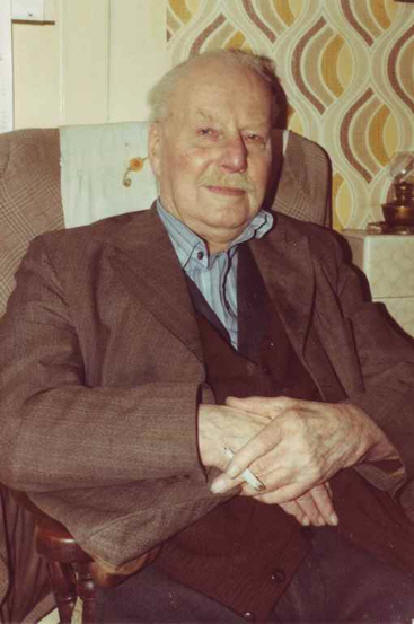 (photo: John Howson)
 (photo courtesy of Colin Hart)
One of the first and finest singers I met in Mid Suffolk was Gordon Syrett. His family had moved to Mendlesham in 1665 and Gordon was born in 1887. He was a wise old man when I met him, with a classic East Anglian singing style. I was first taken to see him by Elijah Parker (known locally as ‘Tinker’) who lived in the same village as me and who took me on Sunday morning sorties to his old family stamping ground: Mendlesham Green and it was Gordon's cottage which was a regular stopping off point for us, particularly as many other locals would call in there too. Gordon and Tinker would sit yarning about times gone by and in particular about the now closed local pub the Green Man just a few houses from Gordon's. This pub had been a hotbed of singing where Gordon met up with other local songsters such as Pom Hart and Bug Stannard. Ted Thorpe, who lived at the end of Tan Office Lane, played melodeon, and it was halfway down this lane that Tinker's family caravan stood. His mother, known as 'Ma' Parker sang and she would also give a step when Ted had wound up into a couple of hornpipes. Tinker's cousins Arthur and Walter Loverage were also renowned stepdancers as was his uncle Elijah Smith. Gordon died in 1983 and Tinker in 1984.
Gordon Syrett & 'Tinker' Parker can be heard on: VTDC8CD
 (photo:
John Howson)
(photo:
John Howson)
I met Wallie Syer in the west Suffolk village of Bildeston but he was actually born just up the road in Hicham in 1906. It was there he started work driving a tractor on a local farm, and throughout his working life he turned his hand to many jobs including portering at Stowmarket Railway station and at a local hospital.
He didn't sing out until later in his life but a couple of songs he'd learned from his father enabled him to join in when there was a bit of singing going on at a wedding or in a local pub.
Wallie Syer can be heard on: VTC3CD
Phil Tanner (Glamorganshire)
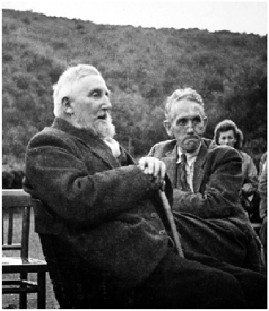 (photo courtesy of Museum of Welsh Life)
(Phil Tanner sings for the BBC)
 (photo courtesy of Museum of Welsh Life)
Phil Tanner was undoubtedly one these islands’ greatest traditional folk singers as well as the custodian of local traditions such as Wassailing and Bidding Weddings, where he would perform his remarkable mouth music for the guests to dance to. He had sung all his life, yet it was not until he was ‘discovered’ in the 1930s, when he was in his seventies, that his fame spread from the small south Wales village of Llangenneth where he was born in 1862.
In 1936 he was taken to London to be recorded and appeared on the BBC radio programme ‘In Town Tonight’. In 1949 the magazine ‘Picture Post’ published an article entitled ‘The old singer of Gower’ by John Ormond Thomas, who lamented that Phil Tanner was living in an old people’s home with only uninterested elderly residents to listen to his songs. He ended with a plea for more of Phil Tanner’s songs to be taken down. This was probably the spur that encouraged the BBC in Wales to visit Phil Tanner later in the same year and make some more of the recordings we have here. Phil Taner died in 1950. (John Howson)
Phil Tanner can be heard on: VT145CD
Lorna Tarran (Essex)
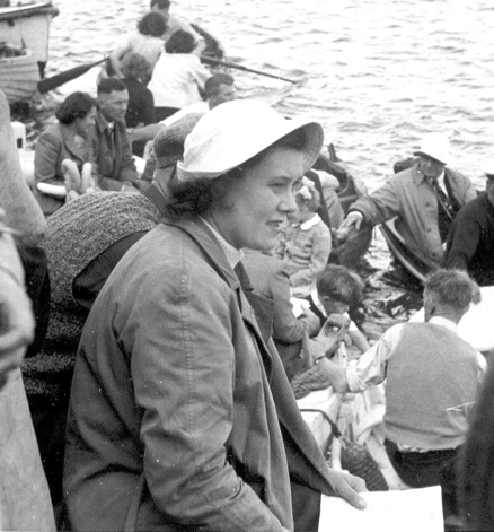
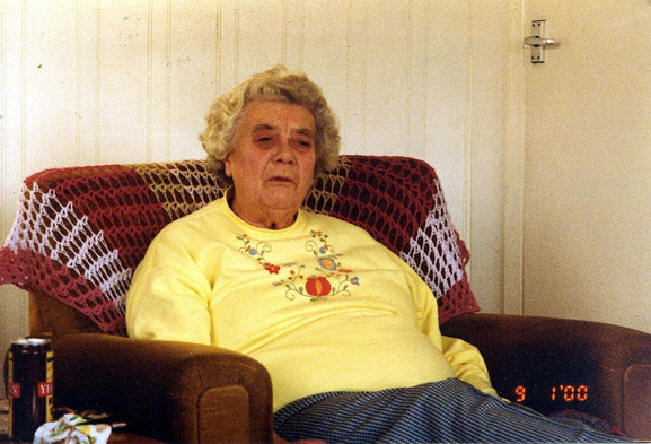 (photos courtesy of
the Mersea Island Museum Trust)
(photos courtesy of
the Mersea Island Museum Trust)
Lorna
Corolene Tarran (nee Mills) was born in West Mersea in 1920. She learned songs
from her grandmother Bertha French and her father Jim Mills who was a Rowhedge
man. He was a yachtsman and a self-taught chef who often worked as ship’s cook
for millionaire yacht owners including the royal family. On Regatta Day, Lorna,
along with the rest of the family, often spent the day on her uncle Dubbie
French's smack the 'Waterlily' and he was another source of songs for her. Lorna
worked in local grocery shops and joined the WAF during the Second World War and
it was then she met her husband. After the war she worked at the yacht chandlery
shop. She was always keen on local history and when Basil Slaughter visited her
in the 1970s she recorded a piece about her memories of Mersea Island as well as
songs, recitations and even her father's recipe for whelks cooked in Bovril! The
tracks of her on this CD came from these recordings via the Essex Record Office
in Chelmsford. Lorna died on the island in 2002.
Lorna Tarran can be
heard on: VT135CD
Scan Tester (Sussex)
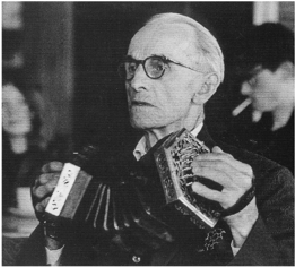 (photo: Brian Shuel)
Lewis Tester, known to all his friends as Scan, was born at Chelwood Common in
1887 and he was brought up in the Green Man, Horsted Keynes, Sussex. He had
music in the family and as a child was drawn into adult company through his
ability to stepdance and play the tambourine. At the age of eight he was out
pubbing with his older brother, Trayton, by then a grown man, from whom he took
his concertina style and technique. Almost certainly Scan played in the band at
the servants’ ball at the 'Coach and Horses' every Christmas for twenty years from
the age of ten. From 1924 until 1931, in response to the craze for dancing
current at the time, Scan formed a family band called 'Tester's Imperial' which
comprised of himself on the fiddle, his daughter Daisy on the piano, his wife
Sarah on drums and his brother Will on the bandoneon and clarinet.
Scan played the concertina in the
Stone Quarry at Chelwood Gate from the early 1930’s until shortly before he died
1972. He knew all the old songs and gave the local crowd what they liked. He had
been born just down the road; everybody knew him and had been brought up to know
his music. Had his forty years' residence at the Quarry been the sum total of
his musical activity, it would have been a considerable achievement, though not
so very different from that of many other country musicians.
In the mid-1950’s a neighbour, Mervyn
Plunkett, invited him to join the 'West Hoathly Country Band of Music'. Game to go
anywhere in good company, Scan later accepted invitations to perform his old
dance tunes at folk clubs and festivals around the country including playing
solo to a full house at the Royal Festival Hall in London. (Reg Hall)
Scan Tester can be heard on: VTC1CD
Joe Thompson (Cumberland)
Joe Thompson was born at Calthwaite, not far from Carlisle, and followed foxhounds all his life. He sang three hunting songs: 'The Horn of the Hunter', 'The Welton Hunt' and 'Joe Bowman'. According to his grand-daughter his singing of hunting songs at home thoroughly irritated his wife, but when he used them as lullabies for his baby daughter they worked a treat! (Sue Allen)
Joe
Thompson can be
heard on:
VT142CDR
Doddy Thorndyke (Suffolk)
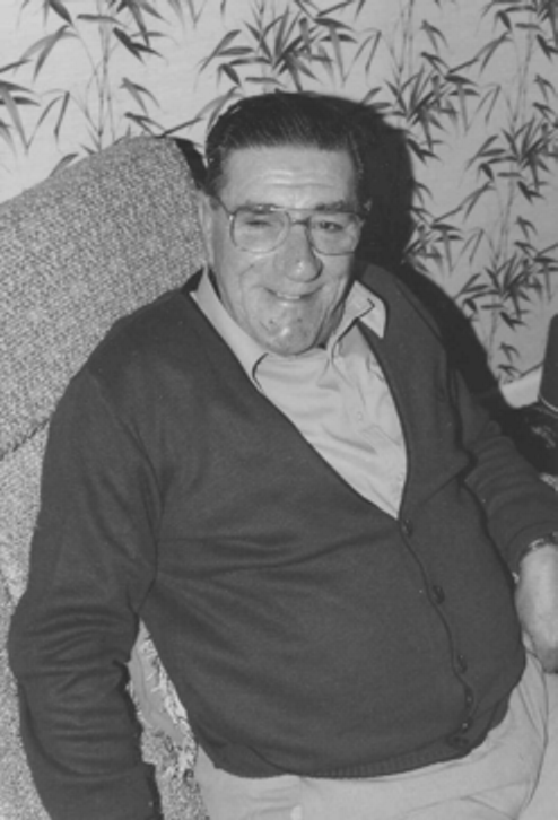 (photo:
John Howson)
(photo:
John Howson)
In the Stowmarket area of Mid-Suffolk there was one singer everyone mentioned to
me: Doddy Thorndyke. He was from a Romany family with a long history of singing
and he remembered his father singing ‘Bold William Taylor'. Other members of the
family played melodeon, concertina, bones, clappers and stepdanced. Doddy had
just one eye, as did six others in the family - he said it was a curse. He used
to yodel as he walked through the market square and people would follow him. He
was also a member of the Stowmarket British Legion concert party and they used
to produce a show every Sunday. His other regular haunts included Stowmarket
Railway Tavern, Onehouse Shepherd and Dog, Woolpit Bull, Crowfield Rose and
Crowfield Bell. Doddy worked as a lorry driver and was tragically killed in an
accident whilst driving, in 1984.
Doddy Thorndyke
can be heard on: VTDC8CD
George Townshend (Sussex)
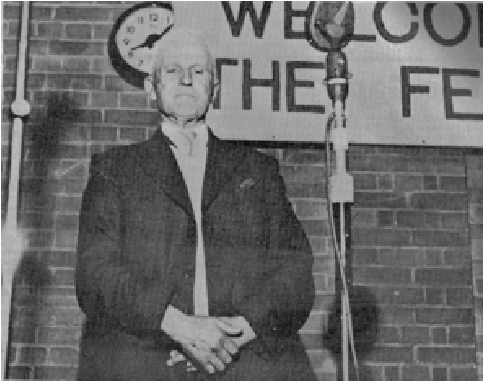 (photo: Tony Green)
George Townshend was born at East Chiltington, near Lewes, Sussex in 1882 and he started school at the age of three, having six older sisters at school to look after him. When George was seven, his father decided to leave farming for the life of a publican and became landlord of 'The Jolly Sportsman' at East Chiltington. This became a singing pub with weekly sing songs on a Saturday night as did the next pub they took, 'The Half Moon' near Plumpton. George would stand alongside of his father and sing in harmony. George's father then continued with farm work and George worked with him.
The highlight of his year was in September at the Great Lewes Sheep and Cattle Fair. Late in the day when the cattle had been sold, George and his father, joined others singers in a large tent or booth for several hours of songs. That was the day in the year when they would hear new songs, as there were singers from miles around, including many shepherds who were normally unable to join in the pub evenings. George continued his working life on the local railway first as a timekeeper, then after WW1 with the railway police. In later years he was discovered by the folk scene and sang at a festival at Cecil Sharp House in London and several recordings were made of him by Ken Stubbs and Tony Wales in the 1950s. More of his singing can be heard on MTCD304 ‘Come Hand to Me the Glass’. (Tony Wales & John Howson)
George Townshend can be heard on: VTC7CD
Denys Troughton - North Yorkshire
Denys Troughton was born in 1927 in Lythe, which is just above Whitby in North Yorkshire. He lived there until he married his wife Doris in 1956. She came from the small village of Hinderswell, which is midway between Mickleby and Staithes. Denys moved there and that is where they still live today. He learned local songs when he was young and later regularly sang at a pub in Goldsborough known as 'Dolly's'. Denys trained as a joiner and eventually started his own small business. He first joined a choir which was formed in Goldsborough and then joined the Staithes Fishermen's Choir in the mid 1980s.
Denys Troughton can be heard on: VTC10CD
Emma Vickers (Lancashire)
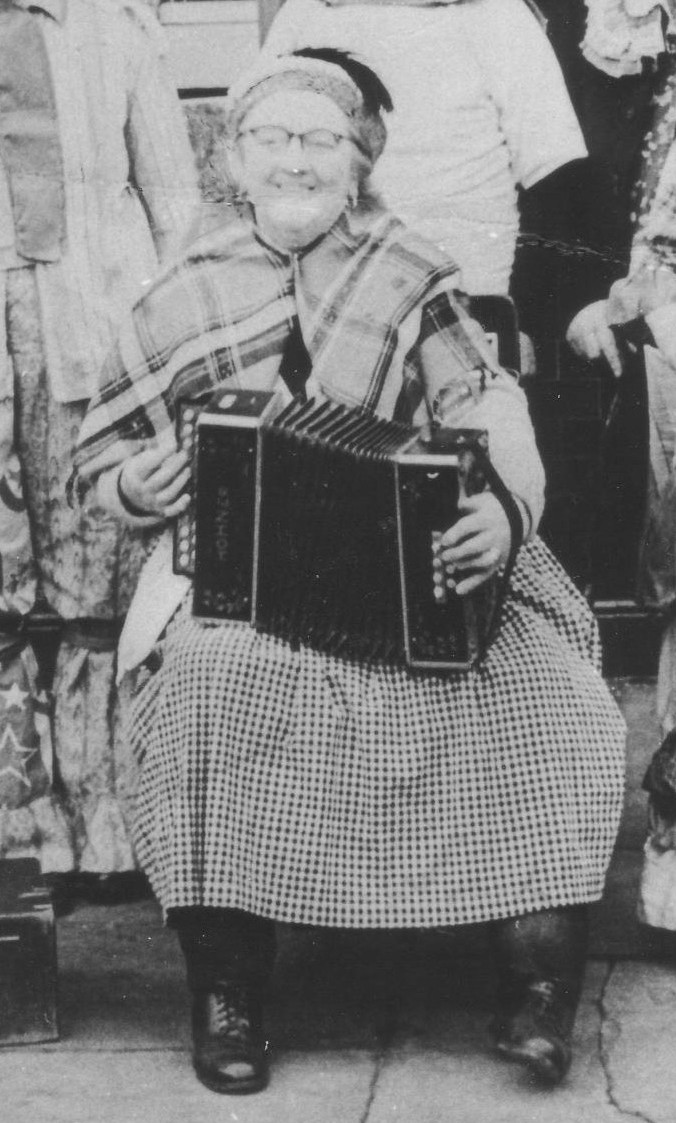
Emma Vickers was born in 1894 and lived in Burscough, Lancashire. Her father, as with many other members of the family, worked on the Leeds-Liverpool canal which goes through the village. He played fiddle and clog danced and sang songs as did her grandfather. Emma played the melodeon and led the local pace-eggers at Easter time and apart from singing the songs associated with that custom she also sang many of the family songs. Emma was recorded by Fred Hamer in 1963 and several of her songs were included in the EFDSS books 'Garners Gay' (1967) and 'Green Groves' (1973). She died in 1977.
Emma Vickers can be heard on: VTC10CD
George Wade
(Suffolk)
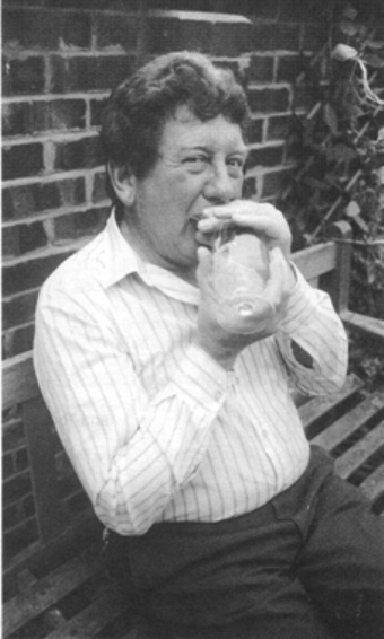 (photo:
John Howson)
(photo:
John Howson)
George Wade was born in Stowmarket, Mid-Suffolk where he worked at the I.C.I.
plant. He started playing mouthorgan when he was in the army when he spent some
time in hospital with a broken leg and learned to play under the bedclothes! He
plays by ear and remembers that the first tune he learned was 'Red River
Valley'. After his stint in the army, George left the mouthorgan in a drawer for
several years and then met up with Tom Williams who encouraged him to play
again, developing the technique of using an empty glass to create an echo. He
started playing out regularly on Sunday nights and visited country pubs like
Crowfield Rose and Henley Cross Keys as well as Stowmarket pubs like The Railway
Tavern, The Pickerel, the Queen's Head and the Rose and Crown.
George Wade can be heard on: VTDC8CD
Stan Walters (Essex)
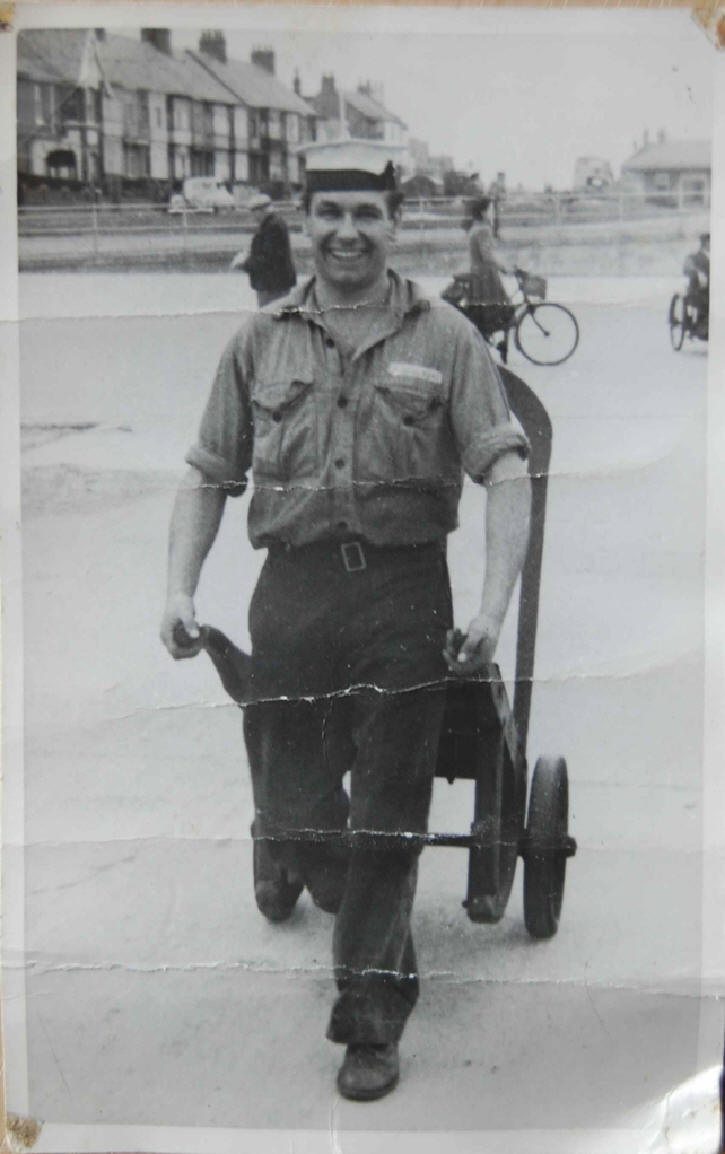 (photos courtesy of Rosie Walters)
Stan
Walters was born in Wicken Bonhunt, near Stansted Mountfitchet in 1916. His
father was a pig farmer and Stan left school in his early teens to help on the
farm. His first
job involved a ten mile walk every morning and in the winter he was given a
cigarette to keep him warm. He then took a succession of jobs including work in
a saw mill and a bake house until he was called up and joined the Navy for seven
years. He started in the galley and then worked on the ship's lighting before
being put in charge of the rum ration: a job he liked, as many of the younger
ratings refused their share, which left more for Stan. While in the Navy he
learned a lot of songs, most of which were quite bawdy. After the Navy he joined
the Naval Reserve before working for the local council for the next twenty-five
years. Almost every Saturday night he would go out with his wife Rosie to a
local pub (most often the Dog and Duck in Stansted Mountfitchet) where he would
play mouthorgan and lead the singing. He died suddenly in 1980 just after these
recordings were made by Sam Richards.
Stan Walters can be heard on: VT135CD
Fred Whent (Suffolk)
 (photo from: Sing, Say or Pay)
Fred ‘Eley’ Whent was born in Ipswich in 1900. Keith had spelt his name ‘Eely’ Whent but in the 1901 census he appears with this first spelling. The family moved to Ufford when Fred was seven. He was a self-taught fiddle player although he did take lessons from a violinist from St Audrey’s Hospital in Melton which gave him the rudiments of music, but as these recordings show that didn’t stop him becoming a remarkably creative fiddle player! In 1917 he went into the army and kept up his musical life by playing in a fife and drum band. After seeing action in France he returned home and started playing in local pubs, like Wickham Market Vine and Volunteer, Blaxhall Ship, Snape Plough, Easton White Horse and Woodbridge Cherry Tree. This was usually with a group of mates, particularly fiddler Spanker Austin and melodeon player Reuben Kerridge. They also played for servants’ balls and in church. Around the Hacheston area he teamed up with another fiddle player, blacksmith Walter Clow, sometimes with Fred playing banjo and mouthorgan together. He nearly left his familiar surroundings of village pubs and this is how he described it to Keith (from ‘Sing, Say or Pay’): “Anybody in those days who could play the violin or accordeon was highly thought of and sought after, but now we're on the scrapheap. I played once at a dance at the White Horse Hotel in Ipswich. Lady Balfour invited me down there to play and after the dance she gave out to the audience that the young violinist had never played with a pianist before - I hadn't then - and they all clapped and she gave me a letter of introduction to Henry Hall for an audition with his orchestra. But my step-father wouldn't let me go - he was a shepherd, always in bed by half past nine. Still, I prefer to play in the pubs - I reckon a good busker can beat a professional any day!” In his later days he played regularly in Bramford Cock alongside musicians like David Nuttall who always remembered him being known as ‘Fiddler’ Went and there doing what he did best - improvising. This was Keith’s epitaph to him: “Eley Went, died suddenly in 1976 but is still well remembered around Woodbridge and Blaxhall. As many people still say, "Eley Went and thar he goo".
Fred
Went can be
heard on:
VT154CD
Jeff Wesley (Northamptonshire)
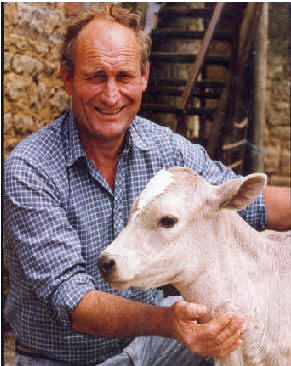 (photo:
John Howson)
(photo:
John Howson)
Jeff Wesley was a farmer in Northamptonshire when he was recorded. He
has been singing as long as he can remember; as a boy driving a tractor, he
would sing songs learned at school such as 'The Farmer's Boy’, as well as those
he had learned from his mother.
In the 1970's a folk club was started
near his home in Whittlebury and his mother-in-law (after hearing him sing in
the garden) suggested that he could sing 'as well as those at the club!'
He met an old singer called Perce
Foster in the next village, Perryend, who taught Jeff several local songs, as
did Norman Franklin from Brackley. Other songs came from whatever other sources
were available: records, books and festivals. Whatever the source, though, Jeff
soon makes a song his own and sings it as though he has known it all his life.
In recent years he has enthralled audiences all over the country. (John
Howson)
Jeff Wesley can be heard on: VTC1CD VTC4CD VTC6CD & VTC7CD
Font Whatling (Suffolk)
 (photos:
John Howson)
(photos:
John Howson)
Walter ‘Font’ Whatling was born in 1919 in the
village where he lived all his life, Worlingworth. He worked as a driver and was
one of the first in the area to have a car.Font was a true countryman and was an
active member of the Dennington Pony and Trap Club, taking a cup at the Suffolk
Show in 1974. His first instrument was the concertina and he also liked to play
the drums, but it was melodeon that he became known for. His interest was first
aroused when he first met Walter Read, the blind shoemaker from Bedfield, who
was probably the best melodeon
player in the locality. Font would take Walter in his car to remote rural pubs
where they would play together.
As Font told Keith (from ‘Sing, Say or Pay’) : “He was a tremendous player - you
see him playing the Sailor's Hornpipe and he would use every button on the thing
and never open it up more than a couple of inches. St Dunstan's offered to buy
him a new accordeon and I helped him pick one out of a catalogue - beautiful job
it was. I was about 19 then and Walter could hold his place in the queue with
anyone, especially step-dance tunes.
“I can remember one night in Bedfield
Dog, I stepdanced for 25 minutes, straight up, while Walter played. I was fairly
fit then but the sweat was streaming down my neck at the end. Walter said "Font,
I thought you would never stop, boy." “Blast Walter," I said, "I was waiting for
you!"
Font’s prowess as a stepdancer was well known and he won competions at Ubbeston Wheatsheaf and Badingham Bowling Green. His party piece was to step and play at the same time, which always brought the house down. One of his life-long friends was Wattie Wright with whom he would step in unision, arm in arm. In the 1950s Font formed a band with Wattie on drums and Eddie Woolnough on second melodeon.
Font Whatling can be
heard on: VTDC11CD &
VT154CD
Joe Whelan
(Co. Offally,
Ireland)
 (photo:
John Howson)
(photo:
John Howson)
Joe Whelan was born and brought up at Eglish, midway between Birr and Cloghan in Co. Offaly. There was a single-row melodeon in the house which his grandmother and mother played but they later acquired a two-row accordeon in B & C and it was on this that he started, at the age of about twelve. Joe listened to the renowned accordeon player Francie Brereton when he came to work in Cloghan but Joe actually received few tips from anyone and evolved a style of his own.
In the first ten years after the war, traditional music was attracting an active following in rural Ireland, and Joe's teenage years were swept along in the tide of this new excitement.
Joe arrived in England in 1960 and found himself amongst like minded musicians and he was soon leading his own bands. Family commitments led to Joe's semi-retirement from music for a while and then at the end of the 1980s he was invited to play in the Goldsmith Arms in Penge with an old friend Michael McMahon. Liam Farrell had played there some time previously, and he was now at a bit of a loose end following Raymond Roland's death. Joe and Liam came together and a new partnership was born. (from Reg Hall's notes)
Joe Whelan can be heard on: VT141CD
Roisin White (Co. Armagh,
N. Ireland)
 (photo:
John Howson)
(photo:
John Howson)
Roisin White was born near Kilkeel in Co. Down and remembers her mother singing all kinds of songs around the house which gave her a life-long interest in songs.
Learning the Irish language at school, she became interested in the literature and poetry of her country, realising that many of the poems were in fact songs. In 1974 she went to Inisheer, the smallest of the Aran islands to improve her Irish. There she became aware of their traditional singing or, as she perceived it then, natural singing. Roisin sings a eclectic mix of songs which have been passed onto her by the likes of Joe Holmes, Eddie Butcher, Paddy Tunney, Bridget Tunney and Robert Cinnamond.
Nowadays she is increasing in demand to sing all over Ireland as well as festivals in England and America. (John Howson)
Roisin White can be heard on: VT126CD & VT156CDR
Charlie Whiting (Suffolk)
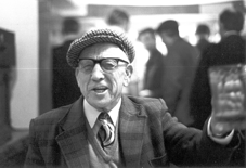 (photo: Mike Yates)
Charlie Whiting was born in 1905 in quite a grand farmhouse called The Homestead
in Southolt, which was owned by his father James Whiting who was known as
‘Dimmer’. When his father died, Charlie sold it and bought a little cottage on
the green at Southolt opposite the Plough. He then bought five or six more
cottages in the row, which he later sold, only to buy them back and sell them
again, apart from the one he lived in until his death in 1984.
Charlie worked for his brother, who had a two
horse farm called Trust Farm in Wilby. His brother Jim spent his days out
dealing with his horse and cart while Charlie did the drilling and ploughing
with the horses and looked after the few cattle and bullocks they had. In the
1950s he bought a paper round and ran this for 10 to 15 years. On retirement he
did odd jobs, dug graves in Southolt church yard and was churchwarden there. The
Whiting family loved to perform (Charlie and Fred Whitings grandfathers were
brothers). Charlie’s brother Tony was known as a brilliant singer and Charlie
himself was a good melodeon player until he lost some fingers with a garden
mower - some say it was a chain saw, others say he had two accidents! Southolt
Plough was a lively pub, with people coming for miles on a Saturday and Charlie
would have been amongst them all night singing and telling tales, just as
he did in Dennington Bell and Brundish Crown. But it was stepdancing that the
Whitings became best known for and Charlie won competitions held at Ubbeston
Wheatsheaf and at Badingham on the back of a wagon. Fred List told Keith (from
‘Sing, Say or Pay’): “Now, it's interesting to see the different styles of
stepping. Some people like Charlie Whiting - he's very nimble on his feet - he's
one of the best and he's got his own style. Others go all over the place.”
Charlie’s elder brother George (who moved to Essex) also had a reputation as one of the best and his niece Chrissy when she was the landlady of Finningham Railway Tavern, was renowned for her broom dancing (See ‘Many a Good Horseman’ - John Howson 1985 /1993). Two of Charlie’s nephews became fine steppers; the late Russell Whiting and Lenny Whiting who continues the family tradition in great style. Charlie was such a lively character that he was given one of the main roles in 1974 film ‘Akenfield’ which was based on the 1969 book of the same name by Ronald Blythe. The film was directed by Peter Hall and critics said that it was an improbable film to make - with no cast, no stars and no script - but it became a significant film in the history of British cinema.
Charlie Whiting can be heard on: VT154CD
Fred Whiting (Suffolk)
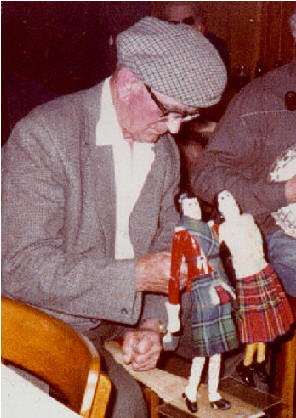 (photo: Katie Howson)
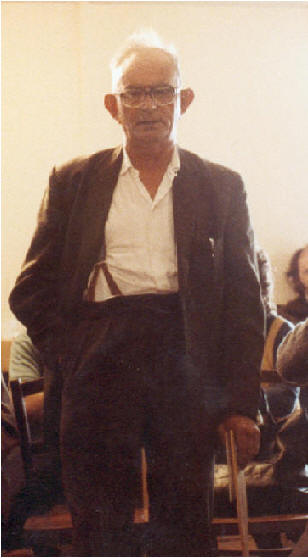 (photo:
John Howson)
(photo:
John Howson)
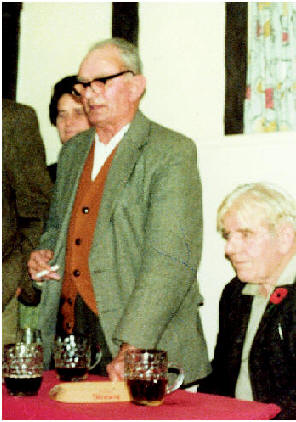 (photo:
John Howson)
(photo:
John Howson)
Fred Whiting was born in Kenton near Debenham and lived there for most of his
life. 'Pip’, as he was often known left school at thirteen. He told me how he
started his working life: "I went with a flock of sheep and worked seven days a
week, and the only concession I got was I could knock off at half-past three on
a Sunday afternoon. I got seven bob a week and I paid six bob a week board, so I
had a shilling a week for myself!"
I first met Fred soon after I moved
to Suffolk. I wrote to him, and soon he was telling me about the days when he
used to sing in Earl Soham Victoria, Rishangles Swan, Kenton Crown, and
Westleton Crown where he would meet up with the local fishermen. We started to
pick him up on Saturday nights and he would take us to some of the pubs he had
known; in particular I remember the heady nights at Brundish Crown. Fred was not
only an excellent singer, he also played fiddle left-handed. He actually had it
strung normally, so he played it upside down! During our nights out singing and
playing, he would get out his dancing dolls which always pleased the
gathering.
Fred was in fact a prolific song
collector himself, and over the years he picked up songs wherever he went,
including some from New South Wales where he spent a few years in his late ’teens. It was his father who started him off singing: "I'll tell you the first
song I ever learned in my life, and I learned it from my father. My mother died
when I was about half past five, and my father used to sing a song to get me to
sleep, and he'd get me to sing with him. The first song he ever learned me was
'The Sailor Boy'. It’s known all the way up the east coast of England. Well
after that, like any kid, I wanted something fresh when I'd learned it, and he
got me onto 'To be a farmer's boy', and I believe that was written by an old
Suffolk shoemaker. The other song he used to sing was 'What's the life of a
man', but I forgot most of that now. That's
how I started my career as a singer." (John Howson)
Fred Whiting can be heard on: VTC1CD VTC2CD VTC6CD VT130CD & VT154CD
Tom Williams (Suffolk)
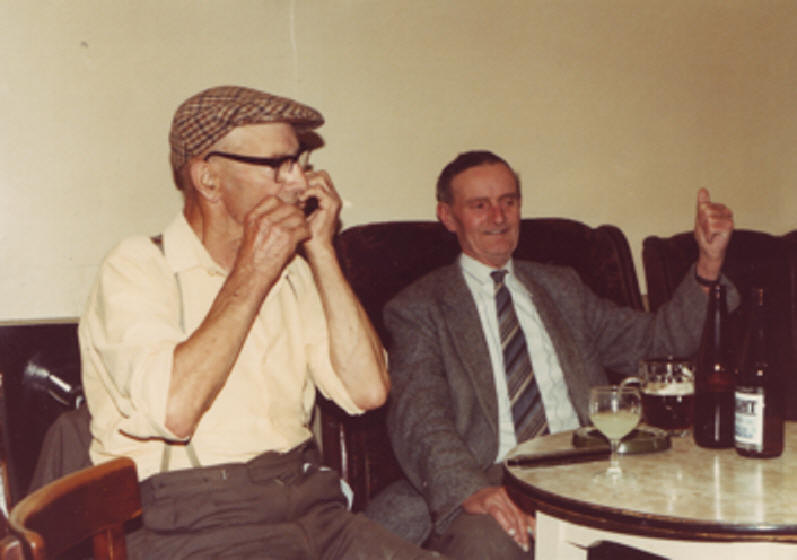 (photo:
John Howson)
(photo:
John Howson)
Tom Williams came from Stowupland and played moutgorgan all over mid and west
Suffolk right up until his death in 1983. He would often list the pubs he'd
played in and they included Lindsey Red Rose, Onehouse Shepherd and Dog,
Wetheringsett White Horse, Stonham Magpie, Stonham Tap (Brewers' Arms), Little
Stonham Ten Bells, Sudbury Spreadeagle, Finningham White Horse and Westhorpe
Crown. Then, on his doorstep, Stowmarket Walnut Tree and the Pot of Flowers.
Often he would turn up with a bag of mouthorgans to encourage others to play,
and at the Old Newton, Shoulder of Mutton, he remembered landlord Walter Peck
and local West Bugg stepdancing. Tom's father also stepped and was known for
dancing ‘amongst the pint pots'. As you can hear from Keith Summers' 1976
recordings, the regular Chelsworth Peacock session was a lively one and not only
did Tom meet up with accordion player Tom Smith, but also with a blind
mouthorgan player called Alf Cresswell, who sold newspapers in Bildeston market
square. Alf was a great bones player, as can be heard on the recordings, and he
also played mouthorgan and bones together, and they can now be seen in a glass
case in the Bildeston public house The Red Lion.
Tom Williams can be heard on: VTDC8CD
John 'Dusso' Winter
(Suffolk)
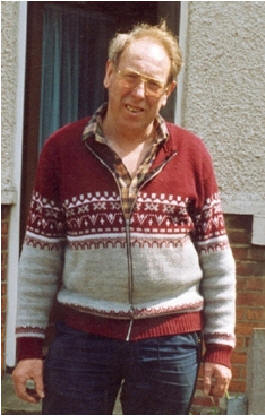 (photo:
John Howson)
(photo:
John Howson)
John's father was a fisherman and a singer, and it is from him that he gets his nickname 'Dusso'. Born and bred in Southwold, John worked at a variety of jobs including, at one time, full-time fishing. He has also been an auxiliary coastguard for over thirty years. Vivid memories come flooding back when he remembers the singing that used to go on in the area:" I used to hear lots of singing when I was much younger. There was a chap in the Harbour Inn by the name of Phil Jarvis. He was also known as 'Salty Sam', he could sing. He used to sing lots like 'Captain and the Mate', 'My Lovely Nancy' and one I don't expect you'd be able to sing now, the 'Indian Lady'. Now old Stanley Townsend, his song used to be ‘The Vicar and the Curate', and he used to play a few chords on the piano when old 'Dinks' Cooper and Jarvis used to sing their songs." (John Howson)
John Winter can be heard on: VTC5CD
George Withers
(Somerset)
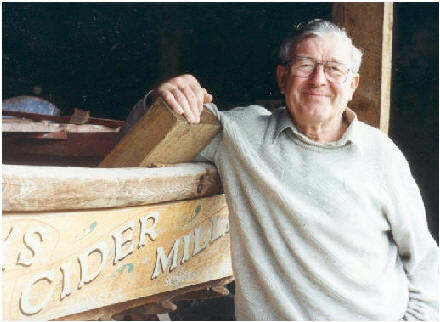 (photo:
John Howson)
(photo:
John Howson)
George Withers was born in 1924, the year that Cecil Sharp, the most renowned collector of Somerset folk songs, died. He was the fifth child and only son of six children. Both his parents were musical and his father sang regularly in choirs and village concerts. George learned several of his songs from his parents including local songs that in earlier years Sharp had collected from James Bishop, who was a next door neighbour of the family. In 1927, the family moved to Donyatt where George lived and farmed for the next 35 years. The next move was to Isle Abbots where he met Harry Adams, a prolific singer and storyteller. Harry revived George's interest in traditional songs and as George says: "The more I sing those old songs, the more I enjoy them." (Bob & Jaqueline Pattern)
George Withers can be heard on: VTC4CD VTC5CD
VTC6CD & VTC9CDR
Lucy Woodall (Worcestershire)
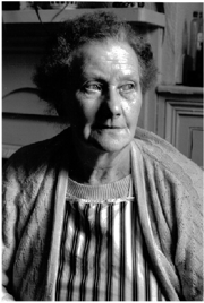 (photo Mike Yates)
Lucy Woodall lived from 1894 until 1979 and worked until her 70s as a chainmaker, having started well over fifty years earlier. She started work in 1912 at the age of 13. She recalled singing in the chain shop, and in the case of Rosemary Lane (which can be heard on VTC7CD ‘It was on a market day - Two’), miming the protagonist's pregnancy by pushing a pair of tongs up her apron to make it swell out. The main part of her repertoire consisted of Music Hall songs such as The Volunteer Organist, Break the News to Mother, The Miner's Dream and Inside a Whitewashed Hospital. She lived at Old Hill, near Dudley which was in Worcestershire when this recording was made and is now in the West Midlands. (Roy Palmer)
Lucy Woodall can be heard on: VTC6CD & VTC7CD
John Woodrow (Norfolk)
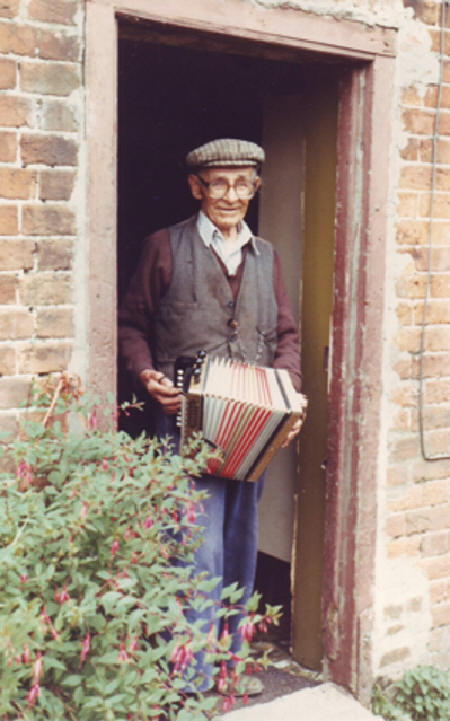 (photo John Howson)
John was born in Ingham, Norfolk and it was there he worked and lived all his life. He worked on the land and would plough with three horses. He would often sing when he was working and one day he took a mouthorgan with him to the dismay of the horses. They reared up and John thought he was going to lose them. He liked to accompany songs on the melodeon and was always keen to learn new songs. He knew Harry Cox and he often visited Lessingham Ship were he learned ‘The Butcher’s Boy’. When he was young he said that he would play all night in his village pub the Swan and he would stepdance on the tables. Another regular singer and stepdancer there was there was Bert Larter who came from Happisburgh. When the annual fair was held in Ingham there would be a stepdance board (presumably for a competition) and the visiting fair man who ran it played the melodeon for them to dance to.
John Woodrow can be
heard on:
VTDC11CD
Gordon Woods
(Suffolk)
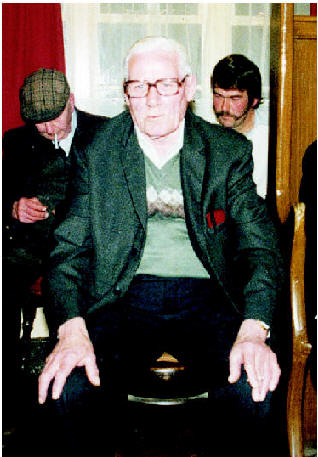 (photo John Howson)
I remember well how I first heard about Gordon. I was on the telephone to the
famed Worlingworth melodeon player, Font Whatling, and we were talking about the
old singers and musicians that used to be around the area. Then Font said, "You
do know old Gordon Woods down in Framsden, don't you? You know, the one who sings
all the old songs." In fact I didn't, but I followed up the lead and soon found
myself in the company of a fine singer with an interesting repertoire. Gordon was
born in Stonham but lived in Framsden for most of his life. This is what Gordon
told me: "Yes, my father was a singer. He used to sing when he was younger, and
I can remember him singing, but I hadn't left school then. I didn't learn any
songs from him: he used to sing such complicated ones. There was one about the
baby's names (see VTC3CD - track 9) He'd sing some real old songs, the sort we
wouldn't remember today. Well he's been dead over thirty years now. His name was
Alfred George Woods and he used to sing in Framsden Greyhound before I was old
enough to drink.
"I used to go out with Alf Peachey a
lot. We'd go around several pubs, like Ashfield Swan. We couldn't go far 'cause
we only had bicycles. There was a singer there called Freddy Fairweather who
sang many funny songs and another in that village called George Emeny. Ashfield
Swan was full of life.
"I used to sing here in the Greyhound
(now renamed the Doberman!) regularly, we used to get quite a lot from Ipswich
come. I would sing in there, and so would old Sam Friend. He used to sing some
good ones, some of the proper old horseman's songs. Font used to come and play
there for many years, and he'd bring Billy List with him."
It's obvious that Gordon heard many
singers over the years, and it is from them that he gathered his repertoire of
songs:
a real collector! So when Gordon was asked where a particular song came from,
he'd just answer, "I don't know, I just
picked them up around the pubs." And long may that tradition continue!
(John Howson)
Gordon Woods can be heard on: VTC1CD VTC2CD & VTC3CD
Oscar Woods (Suffolk)
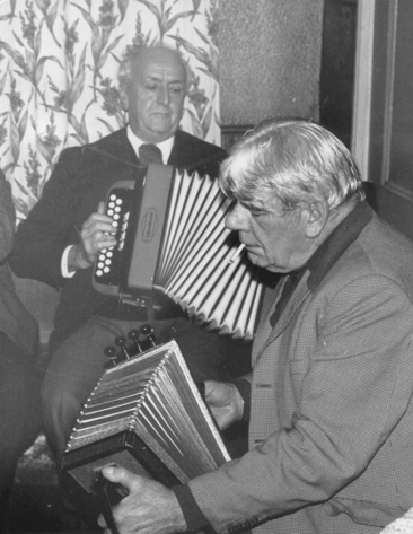 (photo John Howson)
(Oscar plays with Font Whatling in Framlingham Hare & Hounds)
Oscar was born in Friston, Suffolk. The family then moved to Sternfield and he finally settled in Benhall. He had a variety of employment and for many years he ran a coal yard. His first encounter with a melodeon was as a young boy when he heard a local farm worker called 'Tiger' Smith playing outside his house. Oscar soon acquired one of his own and made a point of learning many of Tiger's old tunes, working especially hard to get the more tricky hornpipes for stepdancing. When Oscar got his first car he took Tiger out to further-flung villages like Dennington where they met Dolly Curtis. After Tiger Smith died, Oscar met up with some of Tiger's old musical pals, Ernie and Charlie Seaman from Darsham, and again, Oscar made a particular point of learning some of the more unusual tunes and made a conscious effort to keep these tunes going. Oscar became the last of Blaxhall Ship’s resident melodeon players. He died in 1984 and is still highly regarded as one of England’s finest melodeon players.
Other
recordings of Oscar Woods’ playing can be found on TSCD659 Rig-a-Jig-Jig and
MTCD339-0 A Story to Tell.
Oscar Woods can be
heard on:
VTDC11CD
George Woolnough (Suffolk)
Little has been written about George Woolnough and he was one of the few musicians not to be featured in Keith
Summers survey of East Suffolk traditional music Sing, Say or
Pay. This fact didn’t go down too well with George particularly as there was a
full page photo of his father-in-law Shirt Burrows. Nevertheless George was a
good melodeon
player who was also a dab hand at playing the tambourine. David Nutall of
Ipswich spent many an hour listening to and playing with George Woolnough and
here are his reminisences of first meeting George and Oscar Woods: “Ken Stubbs
sent me one of his immaculately penned postcards to suggest I visit George
Woolnough in Saxmundham. Perhaps I could record him? It must have been a Sunday
evening when I called in on George, because he and Mrs Woolnough had been out
the night before in the company of another accordeon player. A good player, they
said. Usually. He hadn't been quite on top form the previous night, but I must
hear him. Oscar Woods. We arranged to meet at the Railway on the following
Saturday. He'd be there. George played a few tunes, but as it got darker, and
they lit the gas-lamps, I realised that the Woolnoughs were not on the electric.
No recording there, then.
In the Railway there was a four-stop accordeon on the shelf by the bar. After a
while Oscar came in, sat down on the bench under it, accepted George's accordeon
and
went straight into a waltz medley. Did he mind being recorded? Not at all. Later
his four-stop appeared from somewhere and he played that. We played in turn and
I recorded the
entire evening, apart from my own contribution.We met up again a fortnight
later. Word had got around. Charlie and Peter Plant materialised from the
audience and played. A chair involved in competitive dancing couldn't take the
pace and didn't last the evening. George sang a show stopping ‘Sweet William’.
Once again, I let the recorder run, and it is from those two nights that the tracks on this album are taken. The tune-ups didn't stop, but I didn't make any more recordings, so these tapes remain a unique record of who was playing what in Saxmundham in the late 1960s.”
George Woolnough’s can be heard on: VTDC11CD
Ben Youngs (Suffolk)
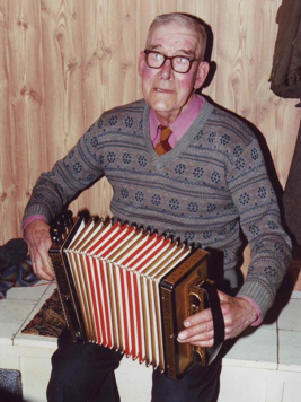 (photo John Howson)
Ben was originally from Trimley on
the Felixstowe peninsula in Suffolk. He finally retiring to Ipswich after
working at the Ransomes’ works in the town. He was the youngest of
fifteen children and one of his brothers also played melodeon, a sister played
piano and another brother played hymns on the fiddle. Their father Horace, was
an accomplished
melodeon player who also played a four-stop one row. Ben remembered that his
father would sit in a chair and lean back against the wall so that his legs were
dangling and play
fast hornpipes and the notes would come flowing out. When Ben was in his early
teens he also heard other local players in Trimley like Alex King and another
who was known as ‘Note’ Bolger. He thought that Alex was particularly good and
would stand underneath his window to listen to him. Ben was fond of waltzes and
many came from 78 rpm recordings
played on a record player with a big horn that one of his brothers bought.
Ben Youngs can be heard on: VTDC11CD
News Veteran Mail Order welcome page About Veteran
English CDs Scottish CDs Irish CDs American & Blues CDs Books & DVDs
Search by English counties Search by Instruments Shanties & Sea Songs Morris Dance music